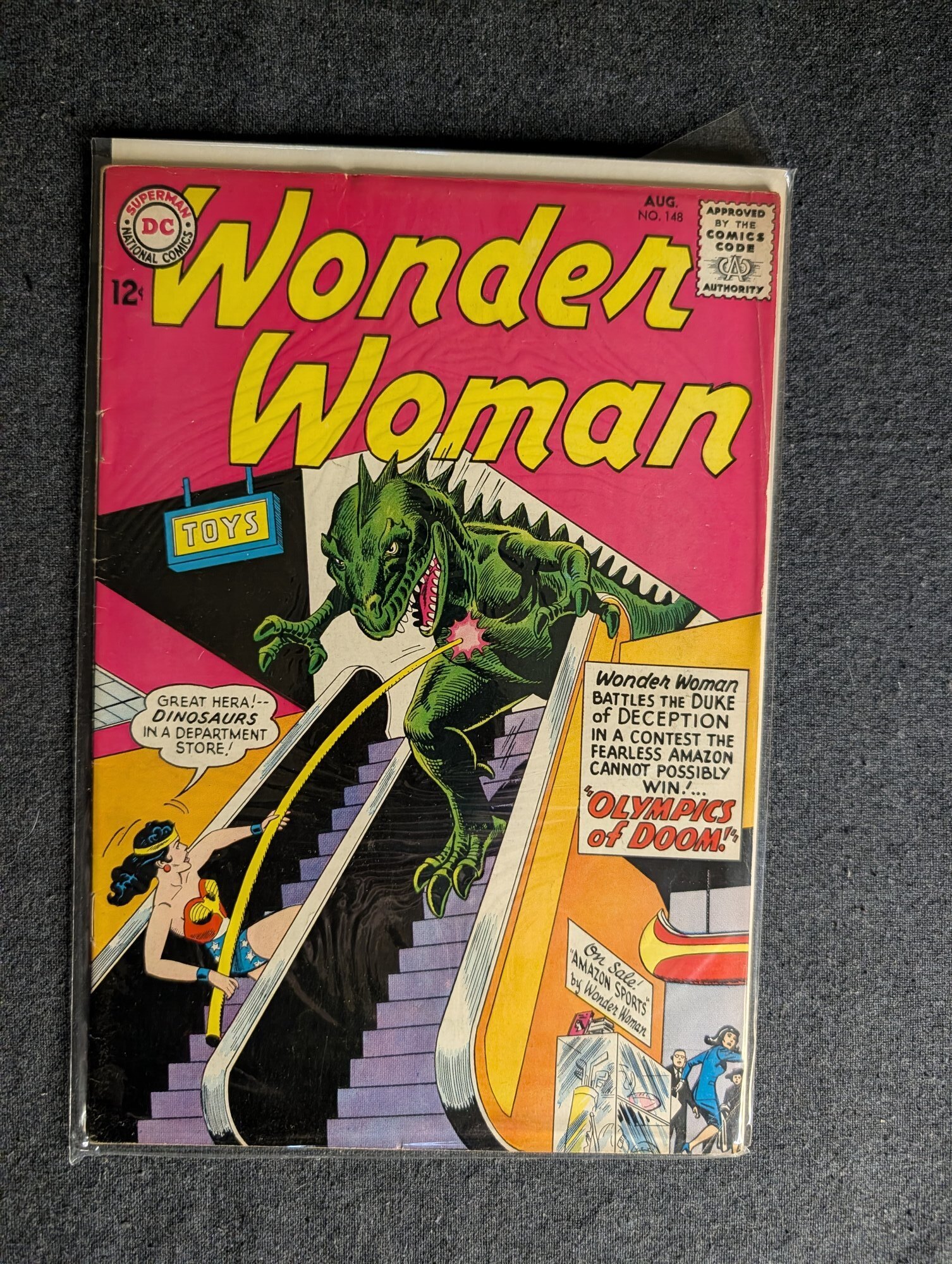
Approximate
Condition Profile
DC COMICS · 8/64
UNIT ECA-013189
WONDER WOMAN #148
Silver Age Wonder Woman adventure with Ross Andru and Mike Esposito art
// Unit specification
// Copies in archive
| Unit | Grade | Variant | Status |
|---|---|---|---|
| ECA-013189 | ~4.5 | — | AVAILABLE |
// Run position
// Condition analysis
Cover shows moderate wear consistent with a mid-grade Silver Age book: visible spine stress lines and a vertical crease running through the upper spine area, mild corner blunting at top right and bottom right, and slight surface wrinkling in the pink background near the logo. There is a small tear/bend at the top edge and general handling softness to the cover stock, but colors remain bright with no major color breaks or missing pieces visible. The book is in a protective sleeve which obscures fine edge detail; interior pages and back cover were not assessed.
// Valuation — market reference
| Bracket | Grade | Est. market value | Marker |
|---|---|---|---|
| LOW_RAW | 0.5 – 1.5 | $12 | |
| MID_RAW | 4.0 – 6.0 | $40 | |
| HIGH_CERT | 9.8 SLAB | $2,200 |
// Archive commentary
Wonder Woman #148 (DC Comics, cover-dated August 1964) arrived during Robert Kanigher's long editorial and writing tenure on the title, with cover and interior art by the Ross Andru and Mike Esposito team that defined the Amazon's look through much of the 1960s. The issue is a representative example of the era's Wonder Woman output: a done-in-one adventure story typical of the period's Silver Age superhero anthology approach, without a first appearance, origin retelling, or other landmark event attached to it. Its interest lies chiefly in the creative team and the broader collected run rather than any single historic moment inside its pages.
Market data shows a conventional back-issue curve for a non-key Silver Age DC title: values climb modestly through the mid grades before accelerating sharply at the top of the census, where certified copies are scarce. With only a single 9.6 and no 9.8 recorded among 44 universal census copies, high-grade examples are genuinely hard to find, and that scarcity supports outsized premiums for top-graded slabs even though the book carries no key-issue demand driver. Demand is steady but not competitive in the way key issues are, meaning pricing is driven more by condition scarcity than by character or story significance.
This is a book collected primarily by Wonder Woman run-builders and Silver Age DC generalists rather than key-issue investors. Lower and mid-grade raw copies move in the affordable range typical of common Silver Age fare and are readily available given the healthy census population in those grades. High-grade certified copies, by contrast, trade infrequently and can command a disproportionate premium relative to the book's modest mid-grade values, reflecting the difficulty of finding a well-preserved copy rather than any inherent rarity of the issue itself.
INQUIRE_ABOUT_THIS_UNIT
Institutional buyers, auction houses, and private collectors — direct line to the archive.