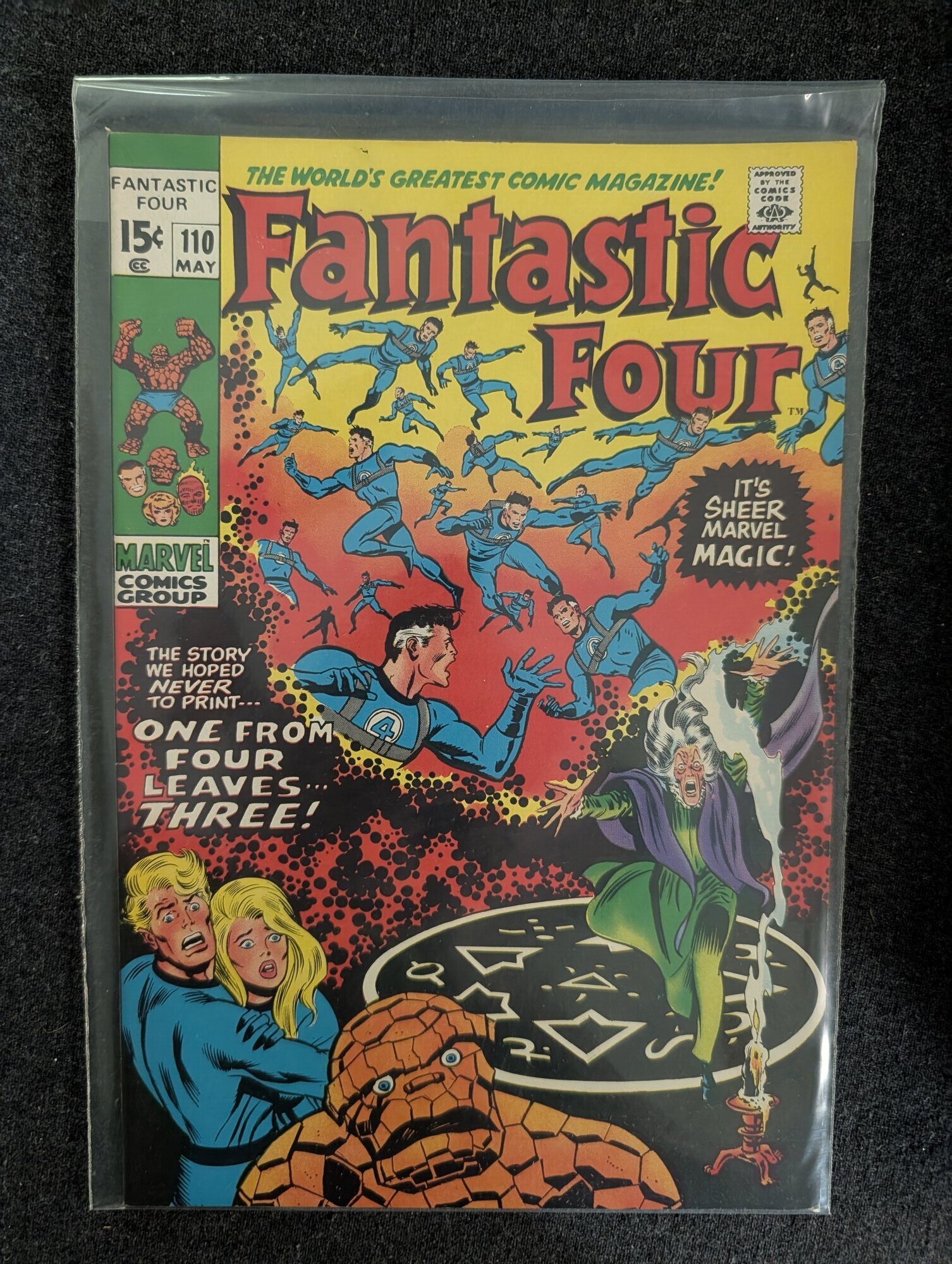
Approximate
Condition Profile
MARVEL COMICS · 5/71
UNIT ECA-028330
FANTASTIC FOUR #110
John Buscema-drawn Fantastic Four clashes with Namor the Sub-Mariner in a Bronze Age Marvel mainstay
// Unit specification
| Publisher | Cover date | Era | Variant | Key attribute | Status |
|---|---|---|---|---|---|
| Marvel Comics | May 1971 | Bronze | — | — | AVAILABLE |
// Copies in archive
| Unit | Grade | Variant | Status |
|---|---|---|---|
| ECA-028330 | ~7.0 | — | AVAILABLE |
| ECA-039397 | ~7.0 | — | AVAILABLE |
// Run position
// Condition analysis
Cover shows good gloss and bright, largely unbroken color with sharp corners overall; minor whitening/wear is visible at the top edge and a slight bend near the upper right corner. Spine appears mostly tight with perhaps a faint stress line near the top, no major creases or color breaks observed. The book is in a protective sleeve which slightly obscures fine surface detail; interior and back cover were not assessed.
// Valuation — market reference
| Bracket | Grade | Est. market value | Marker |
|---|---|---|---|
| LOW_RAW | 0.5 – 1.5 | $10 | |
| MID_RAW | 4.0 – 6.0 | $37 | |
| HIGH_CERT | 9.8 SLAB | $750 |
// Archive commentary
Fantastic Four #110 (May 1971) arrives from the transitional period after Jack Kirby's departure from the title he co-created, with Stan Lee's scripts now paired with John Buscema's pencils and Joe Sinnott's inks. The issue continues the series' long-running rivalry-turned-alliance with Namor the Sub-Mariner, a character woven into FF continuity since the earliest issues. While not a first appearance or origin story, the book is a representative example of the Lee-Buscema creative stretch that carried the flagship Marvel team through the early Bronze Age.
The FMV curve reflects a book with abundant supply and steady, unspectacular demand: 374 Universal copies populate the census, and mid-grade FMVs sit in a narrow $36-$44 band from 3.5 through 6.5, indicating a well-worn, widely-collected reading copy rather than a chased key. Values climb more sharply at the top of the census, with 9.6 copies fetching around $350 on the strength of 29 recorded sales, while 9.8 remains essentially unproven with only ten certified copies and no completed sale on record. That gap points to genuine condition scarcity at the summit of the grade curve even though the underlying story carries no landmark significance.
This is a book for Fantastic Four run-builders and Bronze Age Marvel collectors filling out the Lee-Buscema era rather than for key-issue speculators. Raw copies in low and mid grade trade cheaply and are easy to source given the large surviving population, making the book accessible to budget-conscious collectors. High-grade CGC 9.6 and unverified 9.8 examples will draw registry-driven buyers willing to pay a premium for top-census condition, but thin sales data at the very top means pricing there should be treated as directional rather than fixed.
INQUIRE_ABOUT_THIS_UNIT
Institutional buyers, auction houses, and private collectors — direct line to the archive.