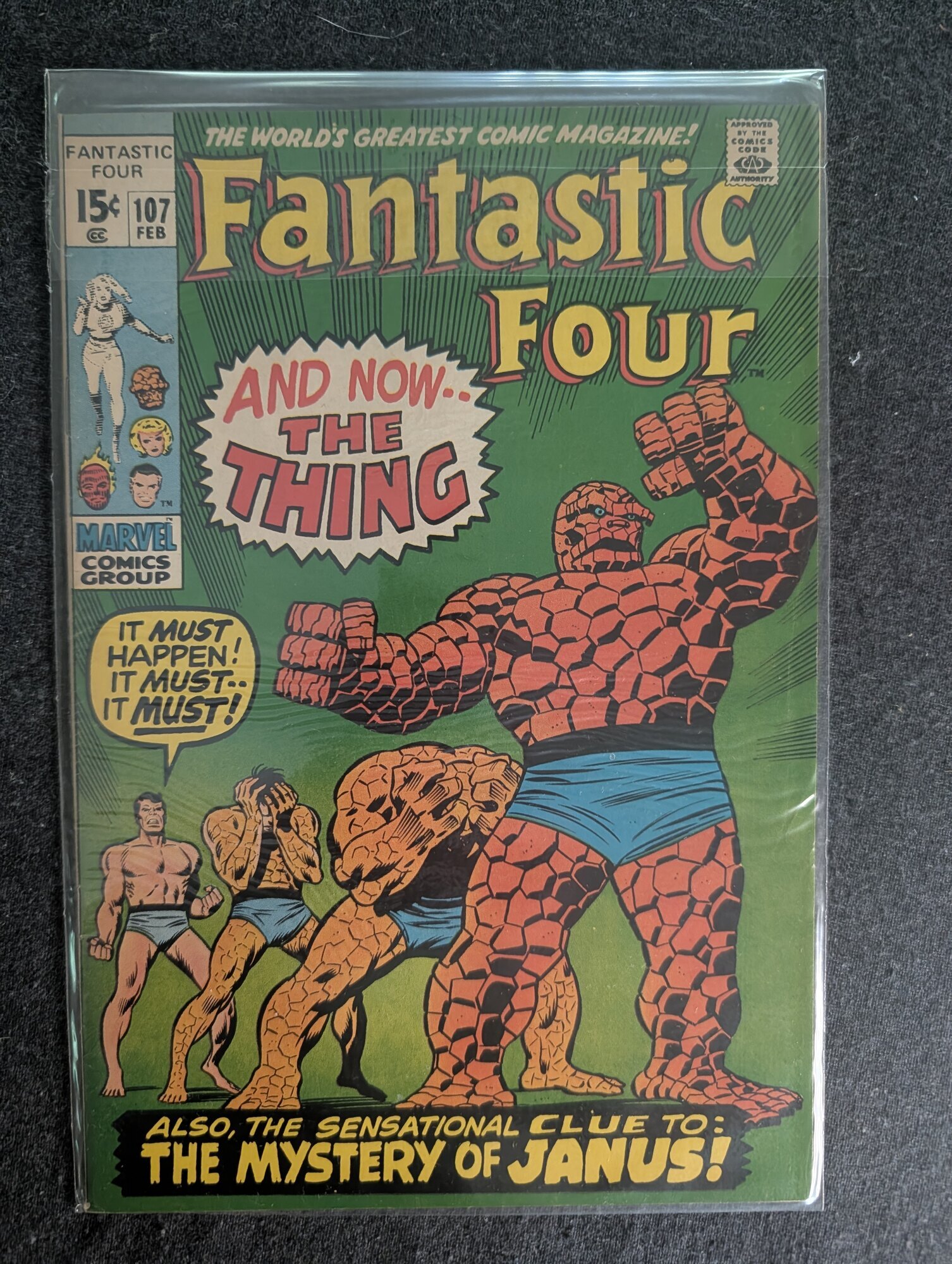
Approximate
Condition Profile
MARVEL COMICS · 2/71
UNIT ECA-039388
FANTASTIC FOUR #107
Bronze Age Fantastic Four from the Lee/Buscema transition, following Jack Kirby's departure from the title
// Unit specification
| Publisher | Cover date | Era | Variant | Key attribute | Status |
|---|---|---|---|---|---|
| Marvel Comics | February 1971 | Bronze | — | — | AVAILABLE |
// Copies in archive
| Unit | Grade | Variant | Status |
|---|---|---|---|
| ECA-028339 | ~8.5 | — | AVAILABLE |
| ECA-039388 | ~6.5 | — | AVAILABLE |
// Run position
// Condition analysis
Cover shows generally good color and gloss with no major creases visible, but there is noticeable corner wear at the top right and bottom right corners with slight blunting, and a faint diagonal crease line near the top edge above the logo. The spine appears mostly tight with only minor stress marks, no major ticks visible. Book is enclosed in a protective sleeve which limits full assessment of edge chipping; interior pages and back cover were not assessed.
// Valuation — market reference
| Bracket | Grade | Est. market value | Marker |
|---|---|---|---|
| LOW_RAW | 0.5 – 1.5 | $8 | |
| MID_RAW | 4.0 – 6.0 | $21 | |
| HIGH_CERT | 9.8 SLAB | $750 |
// Archive commentary
Fantastic Four #107 arrived in the immediate aftermath of Jack Kirby's exit from the series he had co-created and defined for nearly a decade. Scripted by Stan Lee with pencils by John Buscema and inks by Joe Sinnott, the issue represents the title finding its footing under a new principal art team, continuing the adventures of Mister Fantastic, the Invisible Girl, the Human Torch, and the Thing as Marvel's flagship superhero book pressed forward into the 1970s. It is not tied to a first appearance, an origin, or a landmark creative debut, and it does not carry a cover treated as a genre classic by price guides, so its interest rests chiefly on being a representative artifact of this pivotal creative handoff.
Market data shows a typical Bronze Age mid-run profile: values climb gradually through the mid grades, then accelerate sharply above 9.0, with the bulk of the 278-copy certified census clustered in the 6.0 to 9.4 range. Recorded sales activity is healthy at 9.2 and 9.4 (23 and 21 sales respectively) but thins dramatically at the top of the scale, where only a single 9.8 sale is on record against a census of just five copies at that grade. That scarcity, paired with steadily rising per-grade averages through 9.2 and 9.4, points to a meaningful premium for surviving 9.6 and 9.8 examples even though hard sales data at the summit is sparse.
This is a book for run-builders and Bronze Age Fantastic Four completists rather than speculators chasing a single defining moment; demand is steady rather than explosive, and pricing reflects a well-collected but non-key title. Lower and mid-grade raw copies remain widely available and trade at modest, accessible prices, making the issue an easy fit for readers assembling the post-Kirby FF run. Top-census CGC 9.8 examples, by contrast, are genuinely scarce and would be expected to draw active bidding whenever one surfaces, since so few exist relative to the overall population.
INQUIRE_ABOUT_THIS_UNIT
Institutional buyers, auction houses, and private collectors — direct line to the archive.