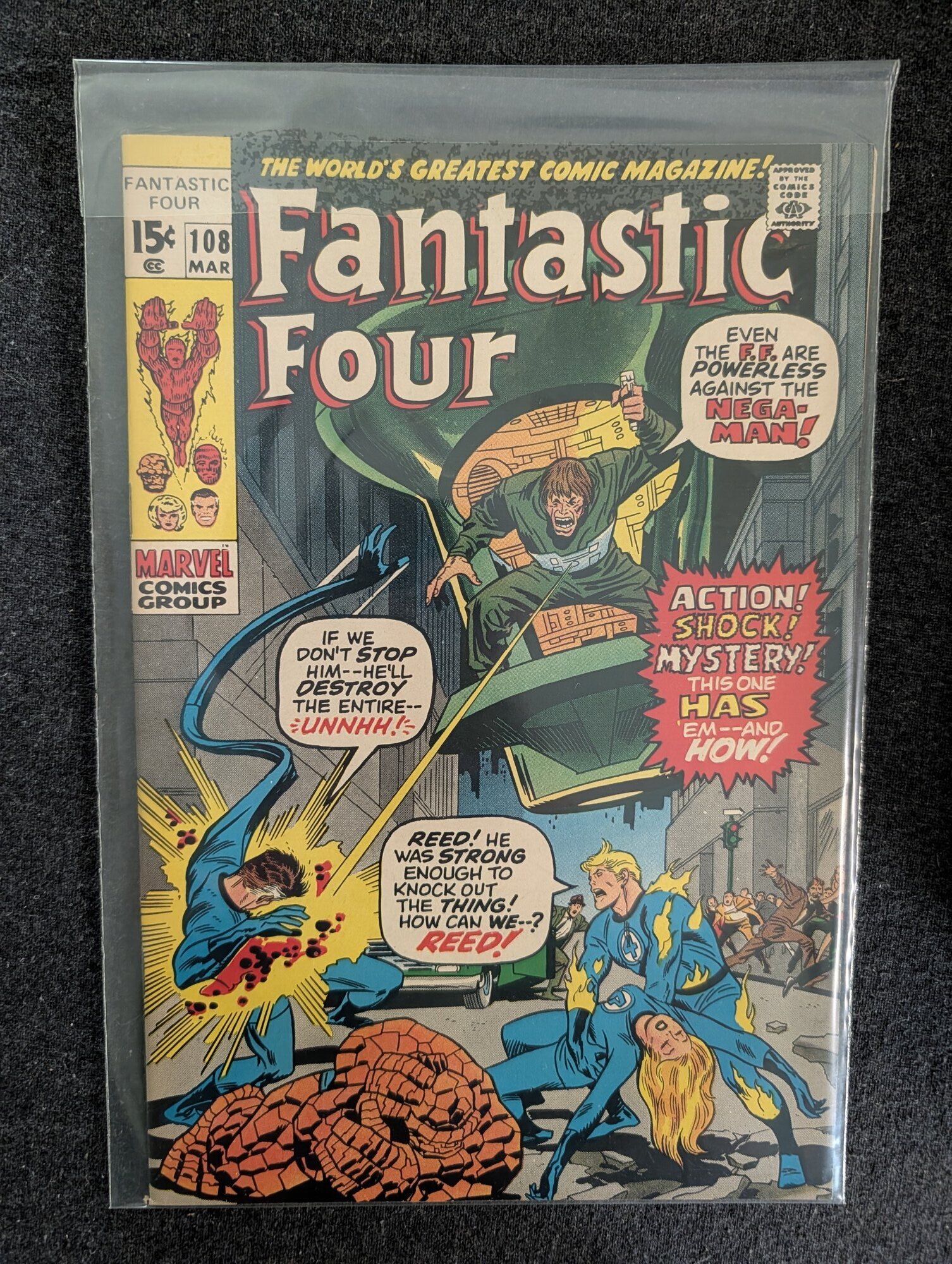
Approximate
Condition Profile
MARVEL COMICS · 3/71
UNIT ECA-028336
FANTASTIC FOUR #108
Bronze Age Fantastic Four from the early John Buscema era
// Unit specification
| Publisher | Cover date | Era | Variant | Key attribute | Status |
|---|---|---|---|---|---|
| Marvel Comics | March 1971 | Bronze | — | — | AVAILABLE |
// Copies in archive
| Unit | Grade | Variant | Status |
|---|---|---|---|
| ECA-028336 | ~7.5 | — | AVAILABLE |
| ECA-039401 | ~6.5 | — | AVAILABLE |
// Run position
// Condition analysis
Cover in a protective sleeve shows bright, glossy color with strong ink saturation and sharp corners. There is mild wear at the top edge and a couple of tiny surface indentations/spine ticks visible along the spine, with no major creases or color breaks apparent. The bottom left corner shows very slight blunting. Interior and back cover were not assessed, and the plastic sleeve may obscure minor surface defects.
// Valuation — market reference
| Bracket | Grade | Est. market value | Marker |
|---|---|---|---|
| LOW_RAW | 0.5 – 1.5 | $12 | |
| MID_RAW | 4.0 – 6.0 | $27 | |
| HIGH_CERT | 9.8 SLAB | $290 |
// Archive commentary
Fantastic Four #108 arrived in March 1971, part of the stretch of issues that followed Jack Kirby's departure from the title after a decade-long run that had defined the book and the Marvel Universe. Stan Lee continued as writer, with John Buscema handling the pencils and Joe Sinnott inking, a pairing that carried the series through much of the early 1970s and gave the book a smoother, more classically heroic look than the Kirby years. The issue does not introduce a major character or plot element that price guides flag as a landmark first appearance; its interest lies instead in its place within a highly collected Silver-to-Bronze Age transition run.
Market data shows a typical long-run superhero title profile: modest, steady demand across low and mid grades, with value climbing sharply only at the top of the census. Nearly 400 universal copies are graded, with sales activity spread fairly evenly through the 6.0-9.4 range before jumping at 9.6 and 9.8, where scarcity and condition sensitivity drive a premium many multiples above mid-grade pricing. This is consistent with a book collected primarily as part of a complete Fantastic Four run rather than chased individually for a key moment.
This issue suits Fantastic Four run collectors and Bronze Age completists more than speculative key-issue buyers. Lower and mid-grade copies trade as affordable reading or run-filler material, while a Universal 9.8 draws a real premium reflecting genuine scarcity at the top of the census. Expect steady, unspectacular movement across most grades, with the high end of the market driven almost entirely by condition rarity rather than character or story significance.
INQUIRE_ABOUT_THIS_UNIT
Institutional buyers, auction houses, and private collectors — direct line to the archive.