Approximate
Condition Profile
MARVEL COMICS · 10/94 · DIRECT EDITION
UNIT ECA-003794
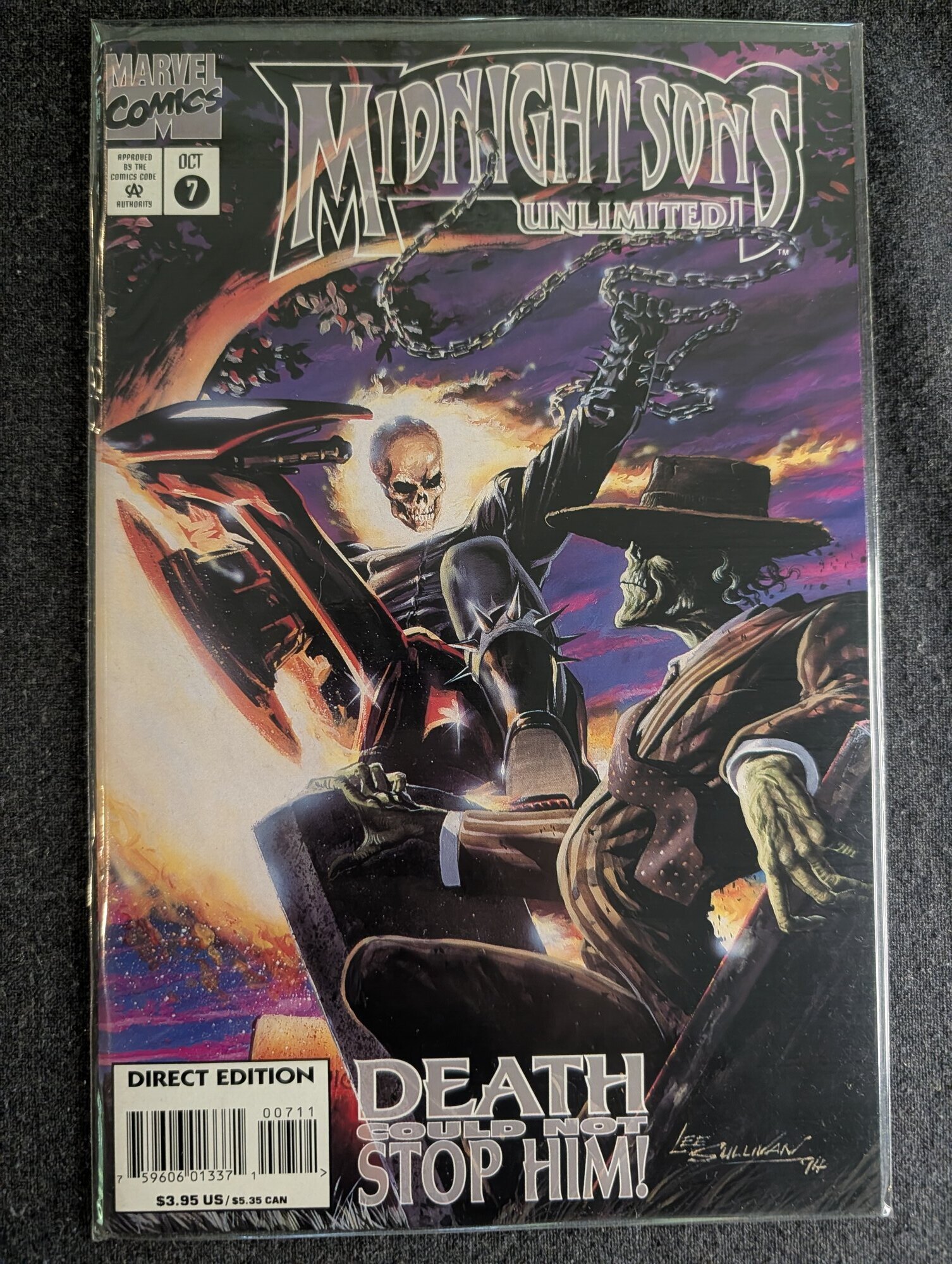
MIDNIGHT SONS UNLIMITED #7
Quarterly Midnight Sons anthology with the three-part Ghost Rider, Morbius, and Brother Voodoo team-up "When the Spirit Moves," cover by Lee Sullivan
// Unit specification
| Publisher | Cover date | Era | Variant | Key attribute | Status |
|---|---|---|---|---|---|
| Marvel Comics | October 1994 | Modern | Direct Edition | — | AVAILABLE |
// Run position
// Condition analysis
Cover shows strong, glossy color with no visible fading; corners appear sharp with no discernible whitening or blunting; spine appears tight with no visible stress lines or ticks in this view. The book is in a protective sleeve, which limits full assessment of edge wear and surface texture. No creases, tears, or stains are visible on the front cover; interior and back cover were not assessed.
// Valuation — market reference
| Bracket | Grade | Est. market value | Marker |
|---|---|---|---|
| LOW_RAW | 0.5 – 1.5 | $1 | |
| MID_RAW | 4.0 – 6.0 | $3 | |
| HIGH_CERT | 9.8 SLAB | $60 |
// Archive commentary
Midnight Sons Unlimited ran nine quarterly, 68-page issues between 1993 and 1995 as the anthology hub of Marvel's Midnight Sons horror line, servicing Ghost Rider, Spirits of Vengeance, Morbius, Nightstalkers, and Darkhold with material that sat between the monthlies. The October 1994 seventh issue, behind a Lee Sullivan cover, carries the three-part "When the Spirit Moves," scripted by Scott Benson with art by Daerick Gross, Andrew Pepoy, Duncan Rouleau, and Marie Severin, teaming Danny Ketch's Ghost Rider with Morbius and Jericho Drumm against the reanimated Nathaniel Mare and the houngan Ellery Snow, and pivoting on a 1952 flashback that reframes the pair's history. Published after the Siege of Darkness crossover, when the line's dagger cover branding was already being retired, it is a late-run continuity chapter rather than a launch or a milestone, and its supporting cast debuts have no downstream significance.
Demand here is driven by the characters rather than the issue. Ghost Rider, Morbius, and Brother Voodoo have all seen speculative attention tied to screen adaptations, which lifts search traffic across the whole Midnight Sons line, but that attention concentrates on the first appearances and the earliest crossover chapters. Sales data for this specific number is thin and flat: recorded transactions are almost entirely raw, in the near-mint band, at levels consistent with a mid-1990s prestige-format anthology that was printed in quantity and widely warehoused. Certification is effectively absent, so the high-grade figure reflects grading economics and low census scarcity rather than observed competitive bidding.
The realistic buyer base is the Midnight Sons run collector filling gaps toward a complete 1-9 set, plus Brother Voodoo and Morbius completists tracking appearances. Full runs trade more efficiently than single issues, and dealers generally do better bundling the title than listing individual numbers. Raw copies in any grade below very fine belong in reader and lot inventory; the practical premium begins only at strict near-mint, and even there the spread over a common copy is narrow. Slabbing is a speculative exercise on this issue, justifiable mainly for a registry-minded collector chasing a low-population certificate rather than for resale margin.
// Copies in archive
| Unit | Grade | Variant | Status |
|---|---|---|---|
| ECA-003794 | ~9.4 | Direct Edition | AVAILABLE |
INQUIRE_ABOUT_THIS_UNIT
Institutional buyers, auction houses, and private collectors — direct line to the archive.