Approximate
Condition Profile
MARVEL COMICS · 8/01
UNIT ECA-006500
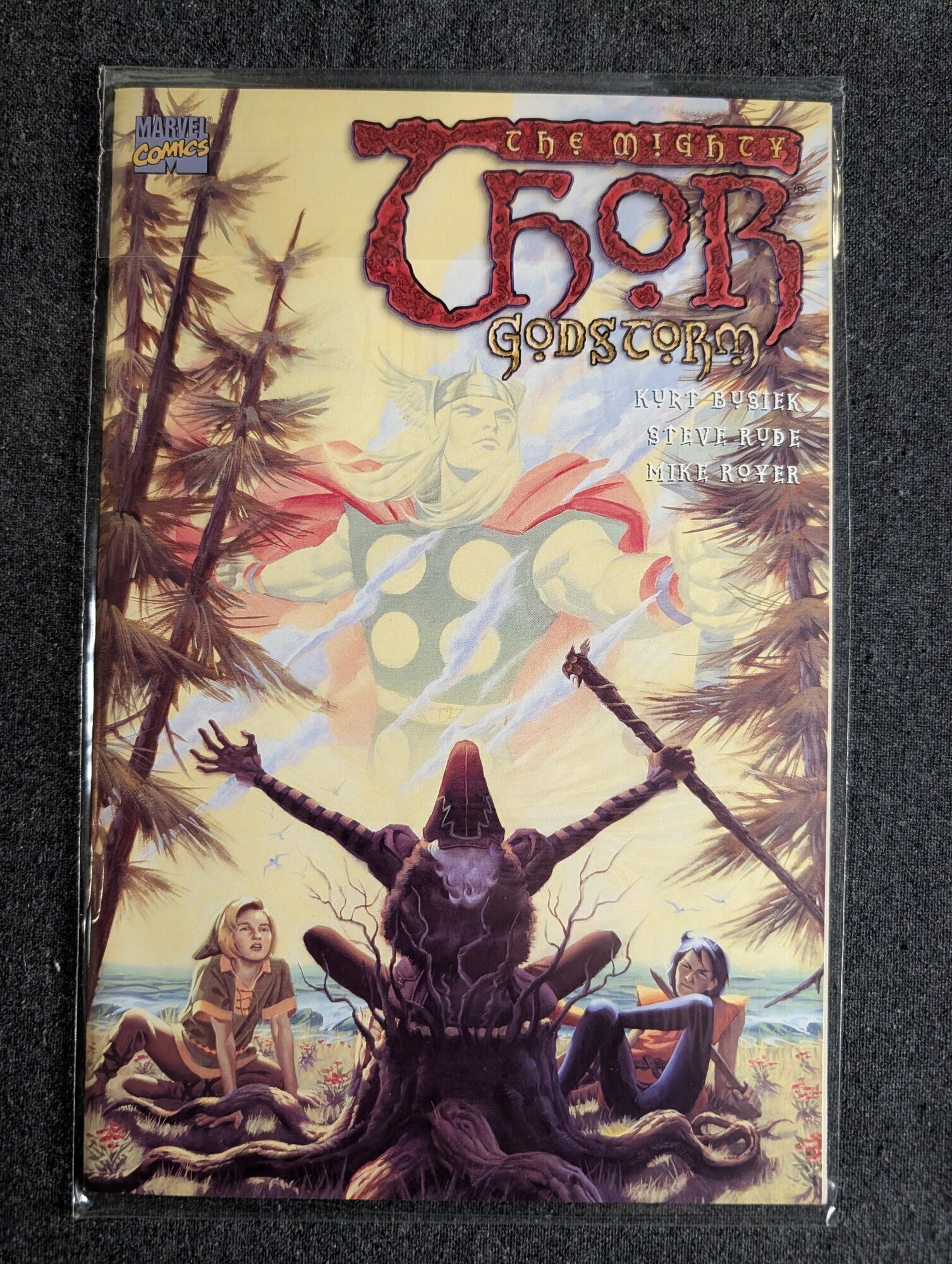
THOR: GODSTORM #1
Kurt Busiek and Steve Rude three-issue Thor mini-series, opening chapter with Rude painted cover
// Unit specification
| Publisher | Cover date | Era | Variant | Key attribute | Status |
|---|---|---|---|---|---|
| Marvel Comics | August 2001 | Modern | — | — | AVAILABLE |
// Condition analysis
Cover shows strong gloss and sharp corners with no visible creasing or color break; the spine area appears tight with no stress lines visible in this bagged photo. Minor edge wear cannot be fully assessed due to the protective sleeve and slight glare, and the book is presented in a plastic bag which may mask small defects. No stains, tears, or writing are visible on the front cover; interior and back cover were not assessed.
// Valuation — market reference
| Bracket | Grade | Est. market value | Marker |
|---|---|---|---|
| LOW_RAW | 0.5 – 1.5 | $2 | |
| MID_RAW | 4.0 – 6.0 | $3 | |
| HIGH_CERT | 9.8 SLAB | $70 |
// Archive commentary
Thor: Godstorm #1 opens a three-issue Marvel mini-series written by Kurt Busiek with art by Steve Rude, inks by Mike Royer, and a Rude painted cover. The story frames the Thunder God's history around a storm-spirit Thor once summoned and abandoned, using Loki as the agent who lets that mistake return across the centuries. Busiek was at a career high point in this period through his Avengers run, and the pairing with Rude, a stylist strongly associated with Jack Kirby's design language, gives the book a distinct look within Marvel's 2001 output. It carries no first appearances or origin material, and Royer's involvement as inker connects it visually to the Kirby lineage that the Thor mythos draws from.
Market profile is that of a modest early-2000s mini-series: plentiful supply, no speculative catalyst, and demand driven almost entirely by readers and by Steve Rude followers rather than by key-issue buyers. Copies circulate steadily in dealer stock and in complete three-issue sets, and pricing at the raw level sits close to bulk levels regardless of whether a copy presents well. Certified examples are scarce simply because the book was never worth submitting in volume, so census population is thin without that scarcity translating into competitive bidding. Attention rises marginally when Thor appears in film and television projects, but the lift historically attaches to established keys rather than to mini-series like this one.
Buyers are Thor completists assembling the full run, Rude collectors pursuing his relatively limited mainstream Marvel work, and dealers filling reader boxes. Across grades the book compresses sharply: the spread between a well-worn copy and a clean unslabbed near-mint copy is narrow enough that condition matters less here than in almost any vintage context, while a top-grade certified copy sells mainly on the convenience and permanence of the slab. For an archive, the practical role is as a supporting item in Thor or Busiek runs, or as part of a complete set, where the three issues together present better than any single number would suggest.
// Copies in archive
| Unit | Grade | Variant | Status |
|---|---|---|---|
| ECA-006500 | ~9.2 | — | AVAILABLE |
INQUIRE_ABOUT_THIS_UNIT
Institutional buyers, auction houses, and private collectors — direct line to the archive.