Approximate
Condition Profile
DC COMICS · 4/67
UNIT ECA-007665
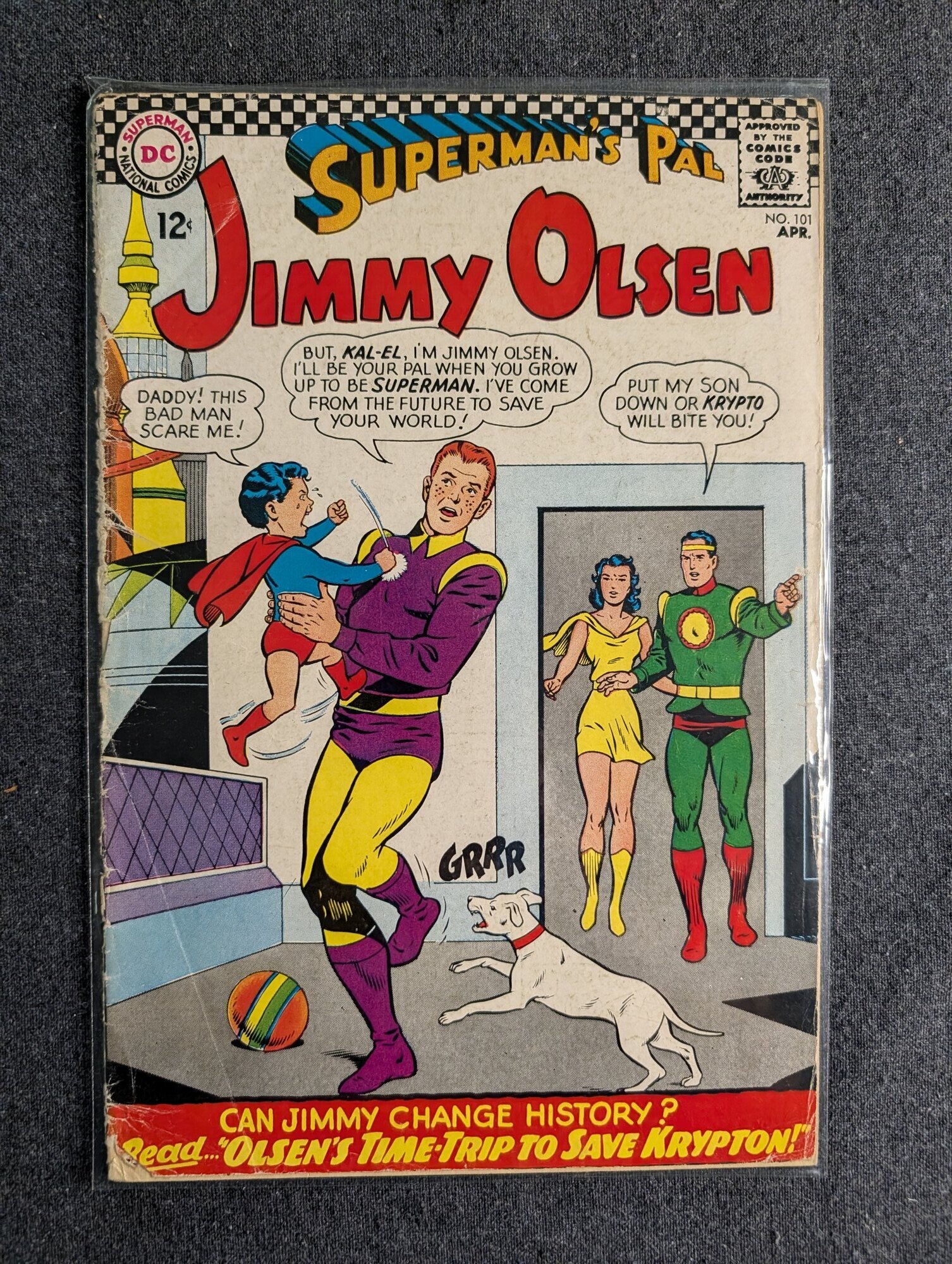
SUPERMAN’S PAL JIMMY OLSEN #101
Curt Swan and George Klein cover on a Mort Weisinger-era Krypton time-travel story drawn by Pete Costanza
// Unit specification
// Run position
// Condition analysis
This 1967 pre-Direct/Newsstand-split book shows a distinct vertical crease and spine stress along the left edge with some fraying and small chips at the top and bottom of the spine. There is noticeable wear and a small tear at the bottom left edge, along with general surface wear and slight discoloration/toning to the cover. Corners show light blunting rather than sharp points. Interior and back cover were not assessed from this photo, and the book is housed in a protective sleeve which may obscure minor edge defects.
// Valuation — market reference
| Bracket | Grade | Est. market value | Marker |
|---|---|---|---|
| LOW_RAW | 0.5 – 1.5 | $6 | |
| MID_RAW | 4.0 – 6.0 | $15 | |
| HIGH_CERT | 9.8 SLAB | $450 |
// Archive commentary
Superman's Pal, Jimmy Olsen #101 carries an April 1967 cover date and sits squarely in the late Mort Weisinger period of the title, when the Daily Planet cub reporter's adventures leaned on transformation gimmicks, time travel, and the expanding Krypton mythology. The cover is penciled by Curt Swan with inks by George Klein and lettering by Ira Schnapp, the house team that defined the visual identity of the Superman family titles for a generation. Inside, Robert Bernstein scripts "Olsen's Time-Trip to Save Krypton!" with art by Pete Costanza, sending Jimmy back to the doomed planet and putting him in the orbit of Jor-El, Lara, and the young Kal-El. It is a representative rather than a pivotal issue: no first appearances, origins, or deaths, and no cover that price guides single out as a classic.
Market behavior follows the pattern for mid-run Weisinger-era Superman family books. Demand is driven by run collectors filling the #100-110 stretch, by Curt Swan cover completists, and by Krypton-story readers rather than by speculators, so low- and mid-grade copies move steadily at modest levels and rarely fluctuate. Certified activity is sparse; what exists clusters in the 8.5 to 9.6 range and tracks the broader late-Silver DC market, where 12-cent books were read hard and returned in quantity, leaving genuinely high-grade survivors scarce relative to the number of copies printed. That scarcity, not the content, is what supports a meaningful premium at the top of the census.
Buyers at the bottom of the grade ladder are readers and set builders who want the issue present and complete, and copies in that condition trade quickly through dealer bargain bins, weekly auction houses, and eBay. The mid-grade band is the practical center of the market, where most transactions occur and where pricing is predictable enough to be quoted with confidence. Registry-minded collectors assembling a high-grade Jimmy Olsen run are the only constituency likely to pay a multiple, and for them the constraint is availability rather than price; a census-topping example surfacing at auction would set its own level, while anything below the top of the census is valued as a strong copy of a common book.
// Copies in archive
| Unit | Grade | Variant | Status |
|---|---|---|---|
| ECA-007665 | ~4.0 | — | AVAILABLE |
INQUIRE_ABOUT_THIS_UNIT
Institutional buyers, auction houses, and private collectors — direct line to the archive.