Approximate
Condition Profile
DC COMICS · 7/66
UNIT ECA-008114
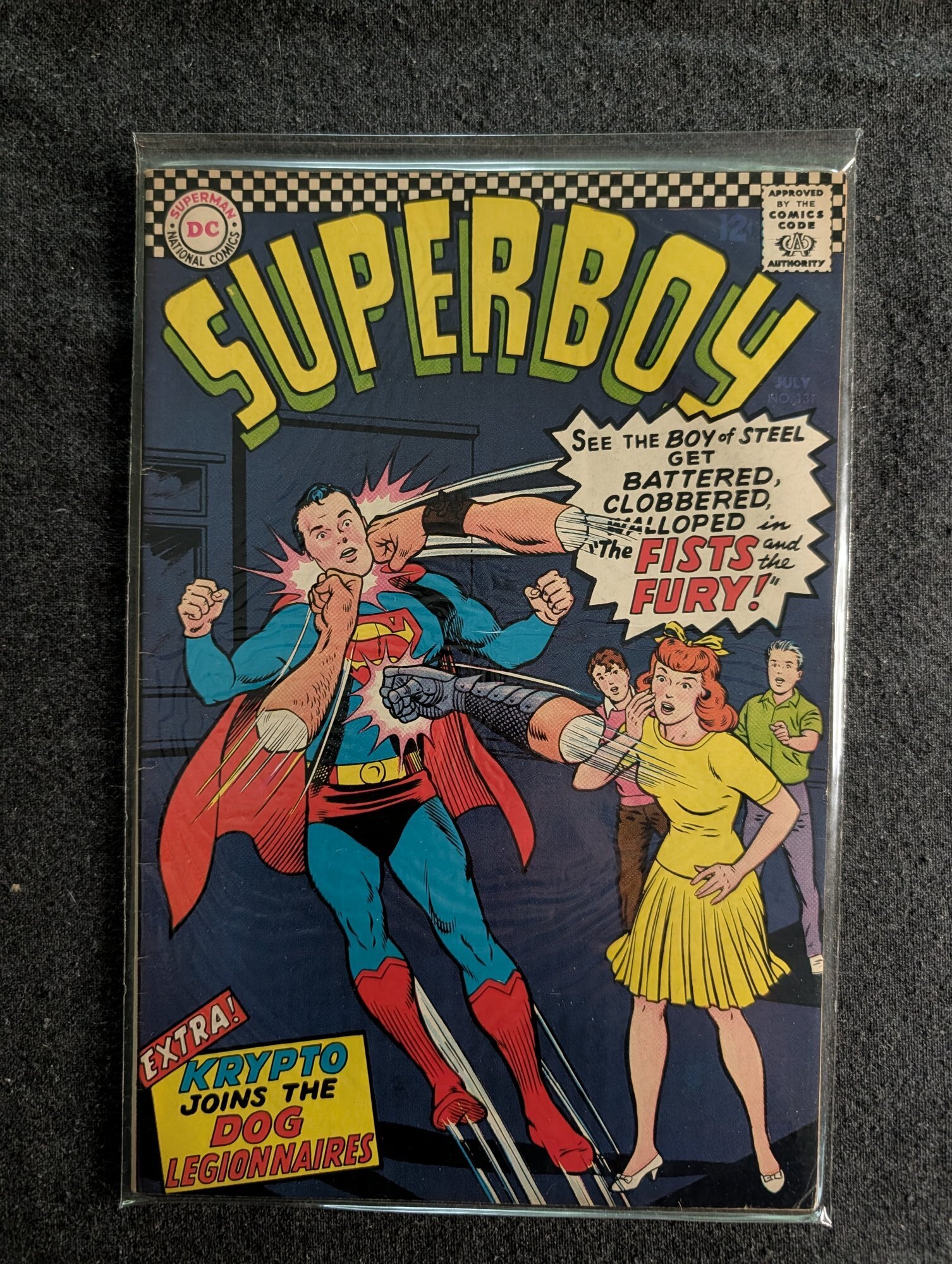
SUPERBOY #131
Mid-run Silver Age Superboy with Master Mxyzptlk and Lex Luthor, plus a Krypto backup story
// Unit specification
// Run position
// Condition analysis
Pre-1977 book so no direct/newsstand distinction applies. Cover shows a light vertical crease near the left edge and some minor surface wear along the top edge, with slight corner softening at top right and bottom right. Colors remain bright with good gloss, no major creases, tears, or color breaks visible, and no stains noted. Interior and back cover were not assessed.
// Valuation — market reference
| Bracket | Grade | Est. market value | Marker |
|---|---|---|---|
| LOW_RAW | 0.5 – 1.5 | $4 | |
| MID_RAW | 4.0 – 6.0 | $13 | |
| HIGH_CERT | 9.8 SLAB | $325 |
// Archive commentary
Cover-dated July 1966, Superboy #131 sits in the stretch of the title that DC was expanding to nine issues a year, with the Smallville formula running at full strength before the Legion of Super-Heroes took over the book in the 1970s. The lead story pits Superboy against Master Mxyzptlk, the fifth-dimensional imp whose powers Lex Luthor contrives to siphon for himself, leaving the Boy of Steel between two antagonists rather than facing either directly; a Krypto feature rounds out the issue. Curt Swan's cover work and George Papp's interior art define the visual house style of the period, and the issue draws on the young Luthor continuity that Superboy had been building since the 1960 Adventure-era retelling of his origin as Superboy's Smallville rival.
Demand for this book is run demand rather than key demand. Buyers pursuing it are generally completing a Superboy set, filling a 12-cent DC gap, or chasing early Luthor and Mxyzptlk appearances as thematic pickups, and the raw market reflects that: copies surface regularly on eBay in the mid grades and clear without competition, while low-grade reading copies move as bulk. Certified activity is close to nonexistent, and what high-grade supply exists for mid-1960s Superboy tends to trace back to pedigree hoards, so the certified end of the ladder is priced on scarcity of registered copies rather than on collector pressure. That combination produces a flat curve through the mid grades and a steep, thinly supported jump at the top.
The collecting outlook is stable and unspectacular. Set builders and Superman-family completists absorb the mid grades at guide-adjacent money, and there is little reason to expect that to change absent a media revival that brings Smallville-era Superboy back into circulation. The upside case rests entirely on condition rarity: a genuinely high-grade, white-page example of a 1966 DC that almost nobody saved in that state is a legitimate registry item and should be treated as an infrequent opportunity, while anything below the near-mint tier should be bought as an inexpensive run book and priced accordingly.
// Copies in archive
| Unit | Grade | Variant | Status |
|---|---|---|---|
| ECA-008114 | ~6.0 | — | AVAILABLE |
INQUIRE_ABOUT_THIS_UNIT
Institutional buyers, auction houses, and private collectors — direct line to the archive.