Approximate
Condition Profile
EPIC COMICS · 6/91
UNIT ECA-004146
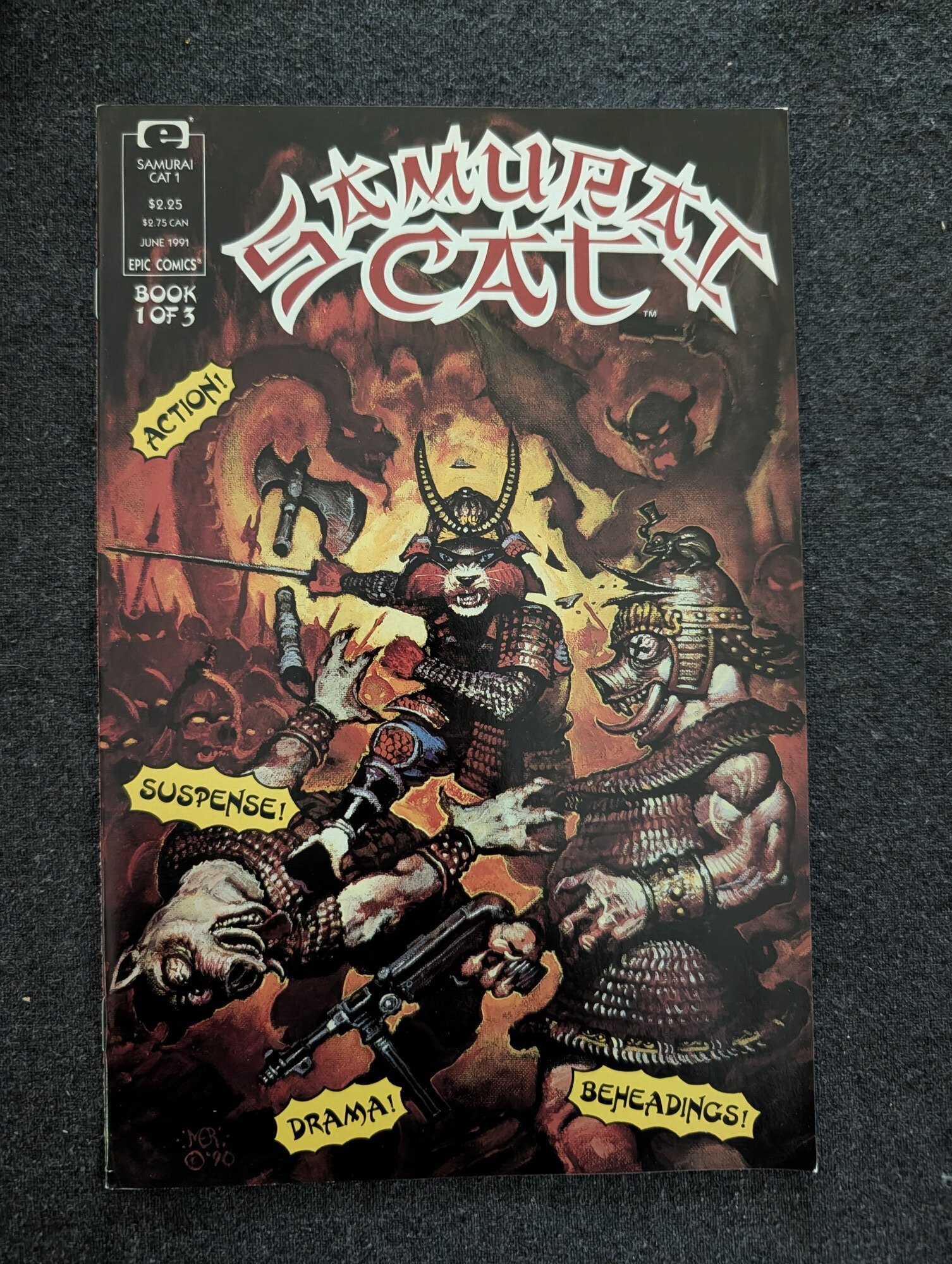
SAMURAI CAT #1
Mark E. Rogers' painted three-issue Epic adaptation of his Samurai Cat prose series, first issue
// Unit specification
| Publisher | Cover date | Era | Variant | Key attribute | Status |
|---|---|---|---|---|---|
| Epic Comics | June 1991 | Copper | — | — | AVAILABLE |
// Copies in archive
| Unit | Grade | Variant | Status |
|---|---|---|---|
| ECA-004146 | ~9.0 | — | AVAILABLE |
// Run position
// Condition analysis
Cover shows sharp corners and clean edges with no visible chipping or tears. Spine appears tight with no stress lines or ticks visible in this image. Colors are bright with no fading or staining apparent, though slight glare on the surface may be masking minor gloss loss. Interior and back cover were not assessed, so grade reflects front cover appearance only.
// Valuation — market reference
| Bracket | Grade | Est. market value | Marker |
|---|---|---|---|
| LOW_RAW | 0.5 – 1.5 | $2 | |
| MID_RAW | 4.0 – 6.0 | $4 | |
| HIGH_CERT | 9.8 SLAB | $70 |
// Archive commentary
Samurai Cat #1 opened a three-issue Epic Comics mini-series adapting Mark E. Rogers' prose-and-illustration franchise, which began with the 1984 Tor volume The Adventures of Samurai Cat. Rogers handled the property himself as writer and painter, carrying over the fully rendered airbrush-and-acrylic look of his book illustrations into sequential comics form and giving the issue a visual identity unlike most of Epic's line. The story follows Miaowara Tomokato, a feline ronin pursuing vengeance across a landscape of genre parody, and the comic marks the character's arrival in the comic book medium after several years of paperback and hardcover appearances. It sits in the last stretch of Epic's run as Marvel's creator-owned imprint, alongside other licensed and adapted properties issued in the 1990-1992 window.
Market-wise this is a quiet book. Print runs for 1991 Epic mini-series were substantial relative to surviving demand, copies turn up regularly in dealer stock and convention boxes, and there is no first appearance, death, or industry-defining creator credit to pull speculative money toward it. What demand exists comes from two narrow directions: Mark E. Rogers collectors assembling his comics work alongside the Tor novels and portfolios, and buyers of painted-art Copper Age curiosities. Certified copies are essentially absent from the marketplace, which means the high-grade bracket is governed by submission economics rather than by competitive bidding, and any slabbed example that surfaces trades on novelty and scarcity of the slab itself rather than on established price history.
For collectors, this is a completist and thematic purchase rather than an investment. Low-grade copies function purely as reading material and clear at pocket-change levels; mid-grade raw copies are the normal transaction, usually bought as part of a run with issues 2 and 3, since the set is far easier to place than a single issue. Anyone considering certification should weigh grading cost against realistic resale, as the spread between a sharp raw copy and a top-census slab is driven almost entirely by the cost of encapsulation. Dealers are best served treating it as attractive filler with a genuine hook – a painted, creator-driven adaptation with a small but loyal following – rather than as a book that will appreciate on its own.
INQUIRE_ABOUT_THIS_UNIT
Institutional buyers, auction houses, and private collectors — direct line to the archive.