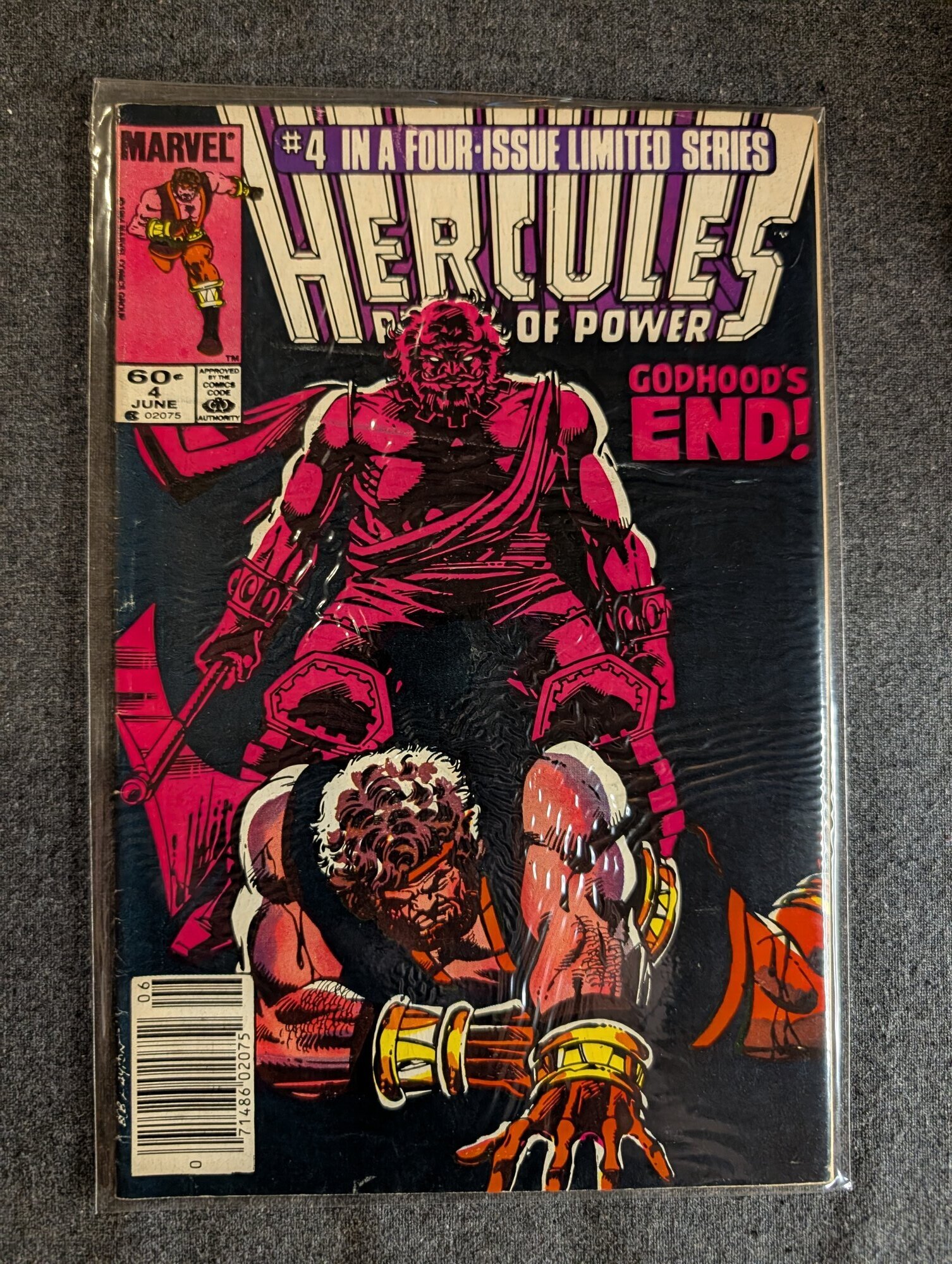
Approximate
Condition Profile
MARVEL COMICS · 6/84 · NEWSSTAND
UNIT ECA-004995
HERCULES: PRINCE OF POWER #4
Concluding issue of Bob Layton's 1984 Hercules limited series, "Godhood's End"
// Unit specification
| Publisher | Cover date | Era | Variant | Key attribute | Status |
|---|---|---|---|---|---|
| Marvel Comics | June 1984 | Copper | Newsstand | — | AVAILABLE |
// Run position
// Condition analysis
Only the front cover is visible (Photo 1), bagged in a protective sleeve; no back cover, spine, or interior photos were supplied to assess further. The cover shows strong gloss and sharp corners with no visible creases, tears, or color breaking; the newsstand barcode box shows no writing or price stickers. Minor surface glare from the plastic sleeve makes fine assessment of spine stress lines or corner blunting difficult. Based solely on this front cover image, the book appears to be in high-grade near-mint condition.
// Valuation — market reference
| Bracket | Grade | Est. market value | Marker |
|---|---|---|---|
| LOW_RAW | 0.5 – 1.5 | $2 | |
| MID_RAW | 4.0 – 6.0 | $3 | |
| HIGH_CERT | 9.8 SLAB | $45 |
// Archive commentary
Hercules: Prince of Power #4, cover-dated June 1984, closes the second of Bob Layton's two four-issue Hercules miniseries, with Layton handling script, pencils, inks and cover in a rare full-package credit. Titled "Godhood's End," the issue brings the far-future storyline to its resolution as Hercules returns to a Mount Olympus emptied by Zeus, who has turned on his own pantheon; Apollo, Hephaestus and Zeus himself appear alongside Layton's series regulars, including the Recorder and Skyppi, plus Eternals-adjacent guests Mentor and Starfox. The two Layton miniseries are remembered chiefly for their comic tone and cosmic scale rather than for continuity milestones, and the run was later collected in trade and hardcover form, keeping the material in print and reducing pressure on the original issues.
Market behavior reflects that status. This is a mid-1980s Marvel limited series printed in quantity and widely saved, so raw copies in any collectible grade are readily available and typically move as part of complete four-issue sets rather than as singles; shipping cost is frequently the larger share of a transaction. Demand comes from Layton completists, Hercules and Olympian-character collectors, and buyers assembling the 1982 and 1984 miniseries together. Certified copies are scarce on the census not because the book is hard to find in high grade but because the economics rarely justify grading, and the few slabs that reach the market clear at figures close to the cost of certification.
Collecting outlook is stable rather than dynamic. The book functions as an inexpensive run-filler at the low and middle grades, where condition matters less than completeness to the buyer, and there is little spread between a well-read copy and a solid mid-grade one. Upside is concentrated entirely at the top of the grade scale, where a high-grade newsstand copy with sharp corners and white pages can outperform its raw counterparts by a wide multiple, though liquidity there is limited to a handful of sales per year. Any broader movement would likely follow renewed screen or publishing attention to Hercules, which historically has lifted the 1982 first issue well before it reaches the later miniseries.
// Copies in archive
| Unit | Grade | Variant | Status |
|---|---|---|---|
| ECA-004995 | ~8.5 | Newsstand | AVAILABLE |
INQUIRE_ABOUT_THIS_UNIT
Institutional buyers, auction houses, and private collectors — direct line to the archive.