Approximate
Condition Profile
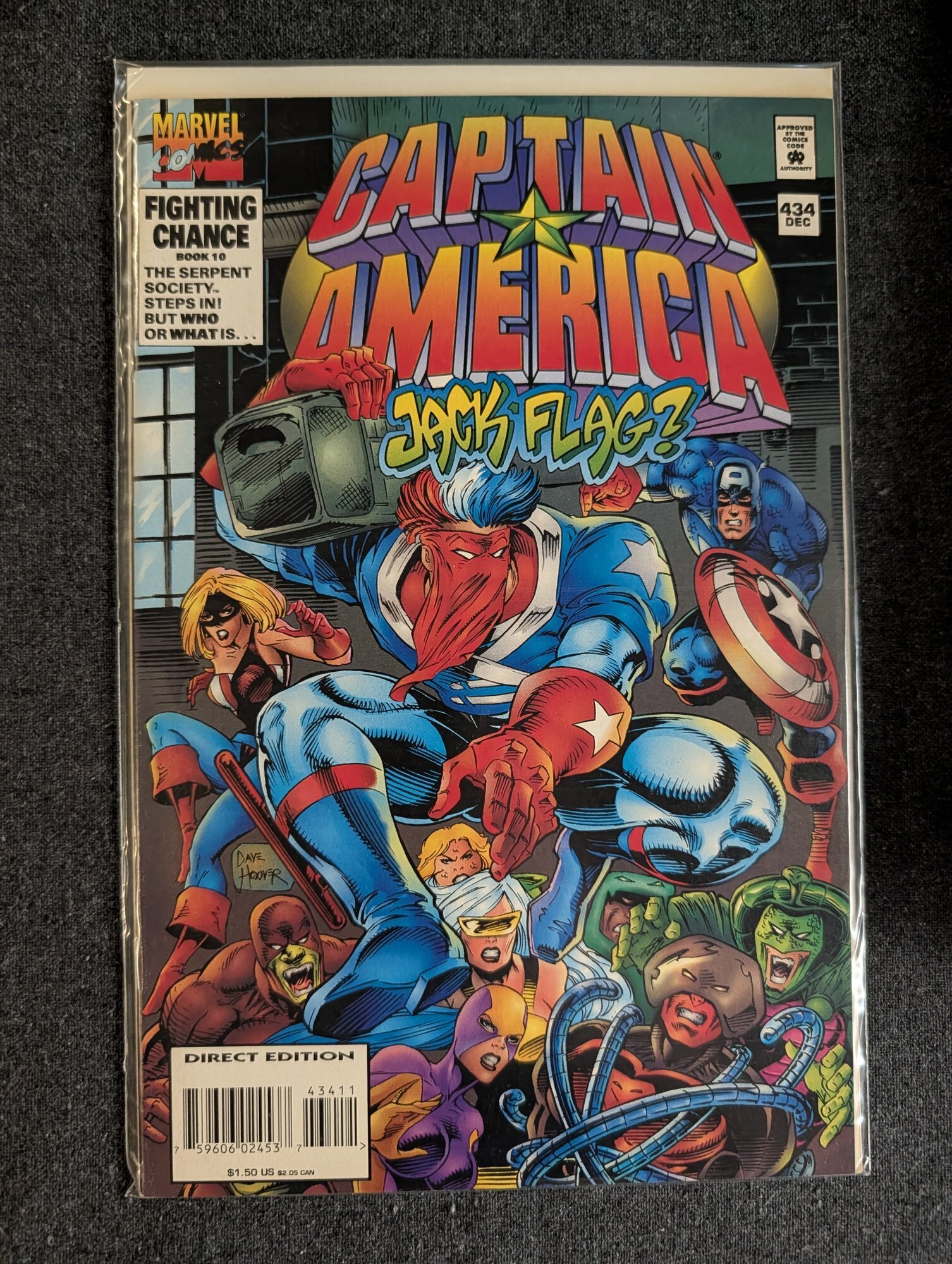
MARVEL COMICS · 12/94 · DIRECT EDITION
UNIT ECA-005861
CAPTAIN AMERICA #434
First appearance and origin of Jack Flag, from "Fighting Chance" Part 10 by Mark Gruenwald and Dave Hoover
// Unit specification
| Publisher | Cover date | Era | Variant | Key attribute | Status |
|---|---|---|---|---|---|
| Marvel Comics | December 1994 | Modern | Direct Edition | 1st appearance and origin of Jack Flag; "Fighting Chance" Part 10 of 12; Mark Gruenwald script, Dave Hoover cover | AVAILABLE |
// Run position
// Condition analysis
Cover shows sharp corners, strong glossy color, and no visible spine ticks or stress lines in this photo; the book is in a protective sleeve which limits close inspection of surface sheen. No creases, tears, or discoloration are visible on the front cover. Interior pages and back cover were not assessed, so the grade is based solely on this front image.
// Valuation — market reference
| Bracket | Grade | Est. market value | Marker |
|---|---|---|---|
| LOW_RAW | 0.5 – 1.5 | $3 | |
| MID_RAW | 4.0 – 6.0 | $5 | |
| HIGH_CERT | 9.8 SLAB | $75 |
// Archive commentary
Captain America #434, cover-dated December 1994, falls in the tenth chapter of "Fighting Chance," the year-long Mark Gruenwald storyline in which the Super-Soldier Serum turns against Steve Rogers and slowly breaks his body down. Scripted by Gruenwald with pencils and cover art by Dave Hoover and inks by Danny Bulanadi, the issue closes out Cap's Mexican pursuit of Helmut Zemo and Heike Zemo while introducing Jack Flag, a flag-suited street-level hero created in the wake of the Captain America Hotline subplot. Jack Flag went on to a long secondary life at Marvel, notably in Civil War-era stories and later alongside the Guardians of the Galaxy, which is why an otherwise routine mid-run issue is tracked as a first appearance and origin.
Market behavior here is typical of a 1994 direct-market Marvel with a minor-character debut. Print runs were large and surviving copies are plentiful in high grade, so raw copies trade as inexpensive want-list fills through eBay and mail-order dealers, with essentially no premium for anything short of sharp near-mint. The one real demand driver is certified top-grade material: the Jack Flag connection produced a speculative bump when the character was folded into on-screen Guardians of the Galaxy material, and slabbed 9.8 copies have held a modest but persistent premium over the raw market since. Interest is character-driven rather than creator- or cover-driven, and it moves with Marvel casting news rather than with the broader Captain America market.
Buyers divide into two groups. Run collectors assembling Gruenwald's decade-long Captain America tenure, and first-appearance completists chasing every Marvel debut of consequence, absorb raw copies cheaply and in volume; the book is a standard bulk-box and dollar-bin presence at conventions. At the certified end, the audience narrows to registry and speculation buyers who want the highest available grade of a recognized first appearance, and that is where nearly all of the book's value concentrates. The practical implication for sellers is that grading only makes economic sense on copies with a genuine shot at the top of the scale; everything below that is better moved raw.
// Copies in archive
| Unit | Grade | Variant | Status |
|---|---|---|---|
| ECA-005863 | ~9.4 | Direct Edition | AVAILABLE |
| ECA-005861 | ~9.2 | Direct Edition | AVAILABLE |
INQUIRE_ABOUT_THIS_UNIT
Institutional buyers, auction houses, and private collectors — direct line to the archive.