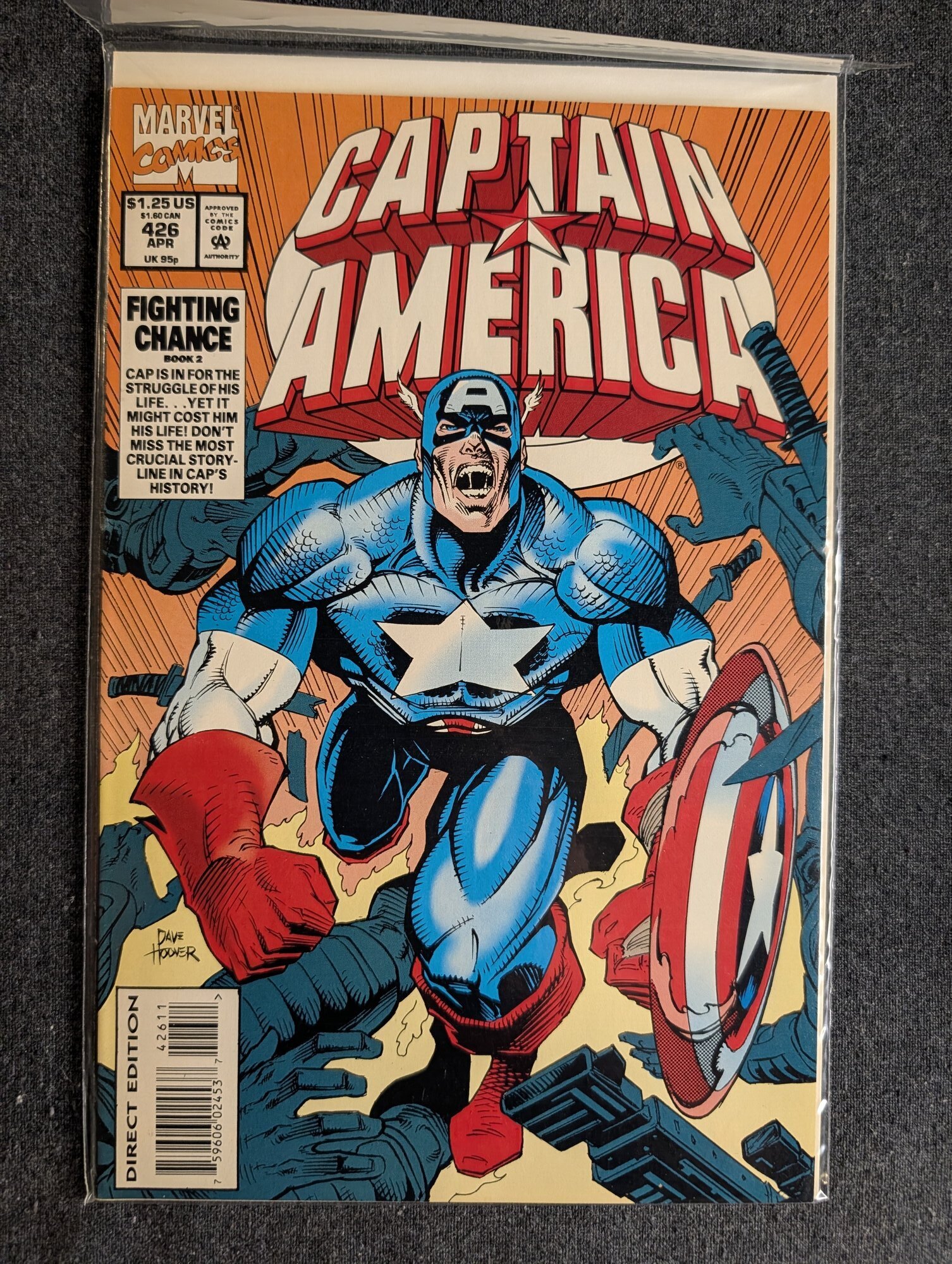
Approximate
Condition Profile
MARVEL COMICS · 4/94 · DIRECT EDITION
UNIT ECA-005821
CAPTAIN AMERICA #426
Fighting Chance Book 2, Gruenwald and Hoover, with Diamondback, the Falcon, and Dead Ringer
// Unit specification
| Publisher | Cover date | Era | Variant | Key attribute | Status |
|---|---|---|---|---|---|
| Marvel Comics | April 1994 | Modern | Direct Edition | — | AVAILABLE |
// Run position
// Condition analysis
Cover shows strong gloss and sharp corners with no visible creasing or color breaks at the spine. Slight bend visible at the top edge of the protective sleeve near the upper left corner, but this appears to be the bag rather than the book itself. Print registration and colors appear bright and unfaded; no stains or writing visible. Book is in a protective sleeve, and interior/back cover were not assessed.
// Valuation — market reference
| Bracket | Grade | Est. market value | Marker |
|---|---|---|---|
| LOW_RAW | 0.5 – 1.5 | $1 | |
| MID_RAW | 4.0 – 6.0 | $3 | |
| HIGH_CERT | 9.8 SLAB | $65 |
// Archive commentary
Captain America #426, cover-dated April 1994, is the second chapter of "Fighting Chance," the long-form Mark Gruenwald storyline in which the Super-Soldier Serum in Steve Rogers' body begins to break down and slowly cripple him. Dave Hoover handles the art in the clean, heavily rendered house style of the period, with George Roussos on color and Joe Rosen lettering. The issue itself is a connective chapter: Rogers settles into new Brooklyn Heights quarters, talks over his changing circumstances with Diamondback, and consults Sam Wilson about an impostor operating in his colors, while Dead Ringer works an armored-car robbery. It carries no first appearance or origin, and its interest rests on its place in one of the longer, better-remembered arcs of Gruenwald's decade-plus tenure on the title.
Market behavior is typical of direct-market Marvel product from the print-glut years. Copies were produced in quantity, survived in quantity, and high-grade raw examples remain easy to source, so the raw market functions as a dollar-box and want-list market rather than an auction market. The certified population is negligible because the economics discourage submission: grading and shipping costs exceed what a slab of a non-key 1994 Captain America returns, and the few slabs that trade do so on the strength of the label rather than the issue. Demand is driven almost entirely by run collectors filling the 400s and by readers chasing the complete "Fighting Chance" sequence, which is more often pursued as a set than issue by issue.
Buyers are Gruenwald-era completists, Captain America run builders, and dealers assembling story-arc lots; the issue is a straightforward want-list purchase rather than a speculative hold. Low-grade copies have effectively no premium over bulk pricing and are worth stocking only as reading or filler material. Mid-grade and near-mint raw copies trade within a narrow band, meaning presentation and shipping cost influence realized price more than the grade spread does. Certified copies should be approached as a registry or personal-preference purchase, since the certified bracket is supported by a handful of transactions rather than a liquid market, and resale generally depends on finding a run collector who specifically wants the issue slabbed.
// Copies in archive
| Unit | Grade | Variant | Status |
|---|---|---|---|
| ECA-005819 | ~9.2 | Direct Edition | AVAILABLE |
| ECA-005821 | ~9.2 | Direct Edition | AVAILABLE |
INQUIRE_ABOUT_THIS_UNIT
Institutional buyers, auction houses, and private collectors — direct line to the archive.