Approximate
Condition Profile
DARK HORSE COMICS · 4/98 · DIRECT EDITION
UNIT ECA-004068
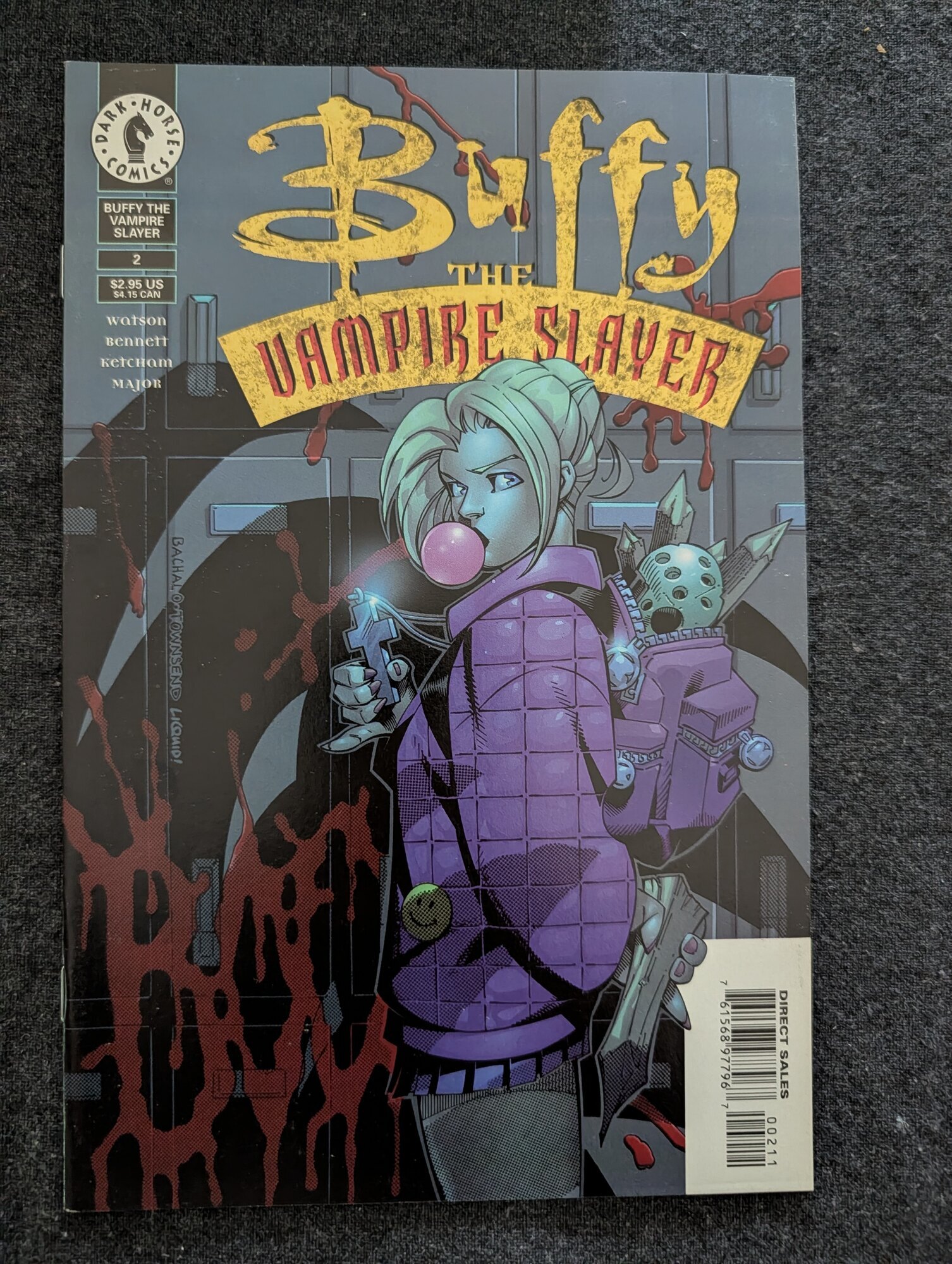
BUFFY THE VAMPIRE SLAYER #2
Second issue of Dark Horse's 1998 Buffy the Vampire Slayer ongoing, direct edition, written by Andi Watson with art by Joe Bennett and Rick Ketcham
// Unit specification
| Publisher | Cover date | Era | Variant | Key attribute | Status |
|---|---|---|---|---|---|
| Dark Horse Comics | April 1998 | Modern | Direct Edition | — | AVAILABLE |
// Copies in archive
| Unit | Grade | Variant | Status |
|---|---|---|---|
| ECA-004068 | ~9.0 | Direct Edition | AVAILABLE |
// Run position
// Condition analysis
Cover shows strong gloss and sharp corners with no visible creasing or spine stress; slight indentation possible at bottom left edge but otherwise clean. Barcode area shows normal wear typical of direct edition stock. No fading, tears, or writing visible on the front cover. Interior and back cover were not assessed, so grade is capped conservatively.
// Valuation — market reference
| Bracket | Grade | Est. market value | Marker |
|---|---|---|---|
| LOW_RAW | 0.5 – 1.5 | $2 | |
| MID_RAW | 4.0 – 6.0 | $4 | |
| HIGH_CERT | 9.8 SLAB | $65 |
// Archive commentary
Dark Horse launched its Buffy the Vampire Slayer ongoing in 1998, at the point where the television series had moved from cult curiosity to a genuine cultural presence, and issue #2 continues the opening arc scripted by Andi Watson with pencils by Joe Bennett and inks by Rick Ketcham. The line was licensed rather than creator-owned, and its editorial remit was to run alongside the show rather than reshape it, so the early issues function as in-continuity side stories featuring Buffy Summers, Willow Rosenberg, Xander Harris and Rupert Giles. The character's comics debut belongs to the Dark Horse Presents Annual 1998, and the series' collectible weight sits with issue #1 and its variant covers; #2 is an early-run supporting issue rather than a first appearance or origin.
Demand here is driven by set-building and by television nostalgia rather than by speculation. Print runs for the late-1990s Dark Horse licensed line were healthy, distribution through the direct market was wide, and surviving high-grade copies are common, which keeps raw pricing flat across a broad band of conditions: a well-worn copy and a solidly presentable one trade within a couple of dollars of each other because the buyer is filling a run either way. Certified copies are scarce on the census only because almost nobody submits the book, not because the paper is fragile, so a slab in top grade prices off scarcity of submissions and off the halo from issue #1 rather than off any independent key status. Movement is steady but shallow, concentrated on eBay and dealer wall stock, with essentially no auction-house presence.
The buyer pool is Buffy completists assembling the full Dark Horse run, television-property collectors who cross-shop Angel and the later Season Eight material, and dealers who bulk this era into discount boxes. Across grades the spread is compressed at the bottom and steep only at the very top, which means raw copies are best treated as inventory and certification is rarely economic unless the copy is already destined for a registry-style run set. Longer term, the book's trajectory tracks the franchise's broader standing more than the comics market: renewed screen activity would lift the whole run, while in a quiet market this issue behaves as ordinary modern-age stock with a recognizable name on the cover.
INQUIRE_ABOUT_THIS_UNIT
Institutional buyers, auction houses, and private collectors — direct line to the archive.