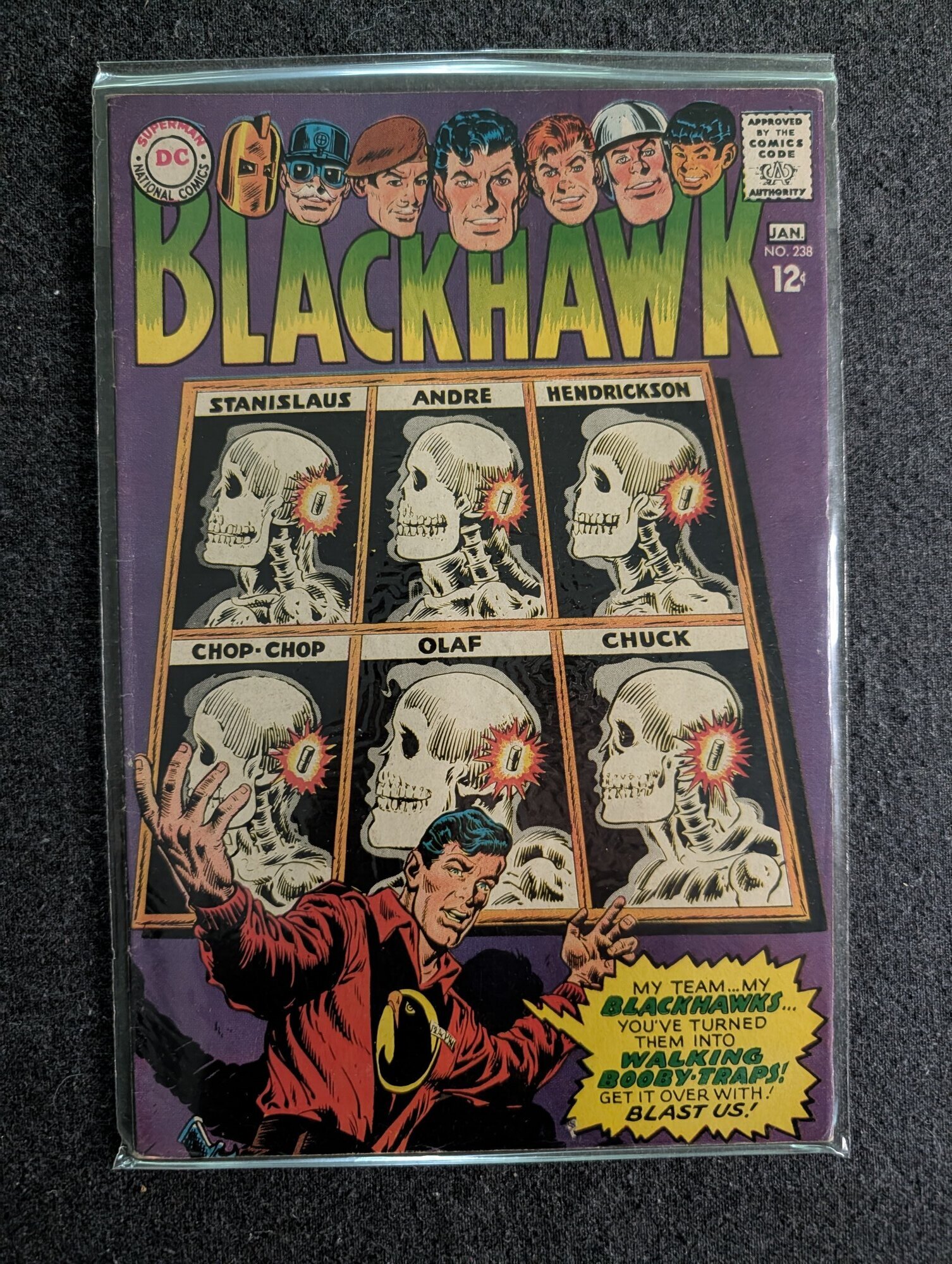
Approximate
Condition Profile
DC COMICS · 1/68
UNIT ECA-008331
BLACKHAWK #238
Late 'New Blackhawk Era' issue with the squadron in costumed super-hero identities, cover-dated January 1968
// Unit specification
// Run position
// Condition analysis
Cover shows moderate wear consistent with a 1968 silver age book: slight corner softness at top right and bottom corners, a few faint surface scuffs across the purple background, and mild edge wear along the right side. Colors remain bright with no major fading, and there are no visible tears, creases, or spine splits in this photo, though the book is in a protective sleeve which limits full assessment of the spine. Interior pages and back cover were not visible and were not assessed.
// Valuation — market reference
| Bracket | Grade | Est. market value | Marker |
|---|---|---|---|
| LOW_RAW | 0.5 – 1.5 | $4 | |
| MID_RAW | 4.0 – 6.0 | $12 | |
| HIGH_CERT | 9.8 SLAB | $260 |
// Archive commentary
Blackhawk #238 falls deep into the so-called New Blackhawk Era, the 1967-68 experiment in which DC retooled its veteran aviation squadron into a costumed super-team working for the government agency G.E.O.R.G.E. Blackhawk operated as the Big Eye, Stanislaus as the Golden Centurion, Andre as M'sieu Machine, Hendrickson as the Weapons-Master, Olaf as the Leaper, Chuck as the Listener, and Chop-Chop as Dr. Hands. The visual house style of the period came from Dick Dillin, working with longtime Blackhawk inker Chuck Cuidera, who had drawn the characters since their Quality Comics debut. The run is remembered less for its stories than for what it documents: DC chasing Marvel's costumed-hero market with a war-adventure property, a course correction that the letter columns of the day openly resisted and that ended with the title's cancellation at #243.
Market demand here is driven by set completion rather than key-issue speculation. The Blackhawk certified market concentrates almost entirely on Military Comics #1 and the early Quality issues, with the DC run trading as affordable Silver Age material; issues from the 230s and 240s move steadily but quietly through dealer inventories and marketplace auctions in the single digits to low teens for mid-grade copies. High-grade certified examples are scarce simply because almost no one submitted late-run Blackhawk to grading, which creates a thin, erratic top of the market: a top-census slab can bring a multiple of guide, but only when two registry-minded buyers happen to be in the room at the same time.
The natural buyers are Blackhawk run collectors, DC Silver Age completists, and collectors documenting the late-1960s super-hero conversion of non-super-hero titles. Across grades, the book behaves like most late Silver Age DC mid-run material: worn copies function as inexpensive reading and filler stock, mid-grade copies are the workhorse of the run and the easiest bracket to buy and resell, and anything at the top of the census is a speculative, low-liquidity proposition priced by scarcity rather than by underlying character demand. Renewed film or television attention to the Blackhawk property would lift the whole run, but the keys would absorb most of that movement before a mid-run issue like this one saw meaningful gains.
// Copies in archive
| Unit | Grade | Variant | Status |
|---|---|---|---|
| ECA-008331 | ~6.5 | — | AVAILABLE |
INQUIRE_ABOUT_THIS_UNIT
Institutional buyers, auction houses, and private collectors — direct line to the archive.