Approximate
Condition Profile
DC COMICS · 10/88
UNIT ECA-001670
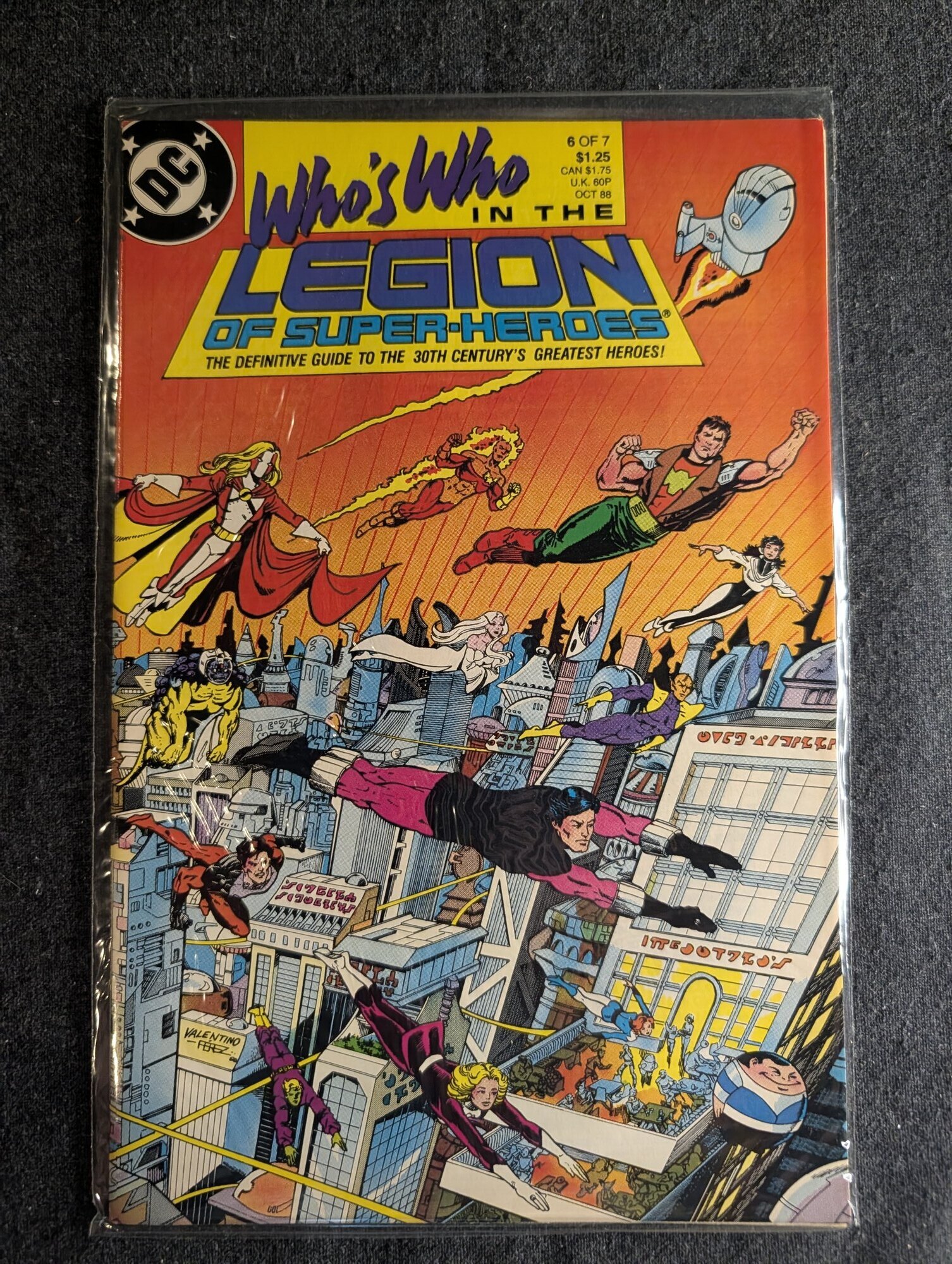
WHO’S WHO IN THE LEGION OF SUPER-HEROES #6
Sixth issue of DC's seven-part 1988 Legion character encyclopedia, covering entries Seerons through Timber Wolf, with wraparound cover
// Unit specification
// Condition analysis
Cover shows strong gloss and vibrant color with sharp corners and no visible creases or spine stress; slight bend or stress line is not evident in this photo. The book is protected in a plastic sleeve, and no major surface wear, staining, or tears are visible on the front cover. Minor handling wear cannot be ruled out due to glare and reflection from the protective sleeve. Interior pages and back cover were not assessed.
// Valuation — market reference
| Bracket | Grade | Est. market value | Marker |
|---|---|---|---|
| LOW_RAW | 0.5 – 1.5 | $2 | |
| MID_RAW | 4.0 – 6.0 | $3 | |
| HIGH_CERT | 9.8 SLAB | $50 |
// Archive commentary
Who's Who in the Legion of Super-Heroes ran seven issues in 1988 as a dedicated companion to DC's broader Who's Who project, cataloging the 30th century's heroes, villains, supporting cast, worlds, and hardware in alphabetical entries. This installment covers Seerons through Timber Wolf and gathers profiles of Bouncing Boy, Duo Damsel, Comet Queen, Crystal Kid, Nightwind, Shadow Kid, and Timber Wolf, plus location and organization features tied to Metropolis, the Legion Academy, and the Time Institute. The format's appeal for collectors lies in its contributor list rather than its narrative: each entry was drawn by a different hand, so a single issue collects short pieces by artists including Dan Jurgens, Kerry Gammill, Greg LaRocque, Ken Steacy, Kyle Baker, Mike Zeck, Jim Valentino, and Win Mortimer, with text by Paul Levitz, Mark Waid, and Barbara Randall Kesel. It carries no first appearances and no story continuity, functioning instead as the reference spine of the Levitz-era Legion.
Market behavior matches the book's role. Print runs from mid-1988 were large, direct-market distribution kept copies in bags rather than on spinner racks, and high-grade raw examples remain easy to source, which caps the ceiling in every bracket. Most transactions occur as complete #1-7 sets or as filler within Legion runs, and single-issue sales are infrequent enough that individual data points carry little weight. Certification is rare: submitters have had no economic reason to slab an index issue with no key content, so the census is effectively empty and any certified price reflects grading cost far more than collector competition. Demand is driven almost entirely by Legion completists and by readers who still use the series as a lookup tool for pre-Zero Hour continuity.
Buyers are Legion specialists assembling the full title set, reference collectors who value the annotated character data, and occasionally artist collectors chasing a specific contributor's pin-up work. Across grades the spread is unusually flat, since condition scarcity is minimal and even sharp copies compete with abundant supply; the practical consequence is that a well-preserved raw copy captures nearly all the available value, while a heavily read example still moves as set filler. Dealers are better served offering this issue inside a complete run, where the seven-book set commands more attention than any single number, and holding certified submissions for cases where a Legion collector specifically wants the title represented in a slabbed collection.
// Copies in archive
| Unit | Grade | Variant | Status |
|---|---|---|---|
| ECA-001670 | ~9.2 | — | AVAILABLE |
INQUIRE_ABOUT_THIS_UNIT
Institutional buyers, auction houses, and private collectors — direct line to the archive.