Approximate
Condition Profile
DC COMICS · 12/74
UNIT ECA-007951
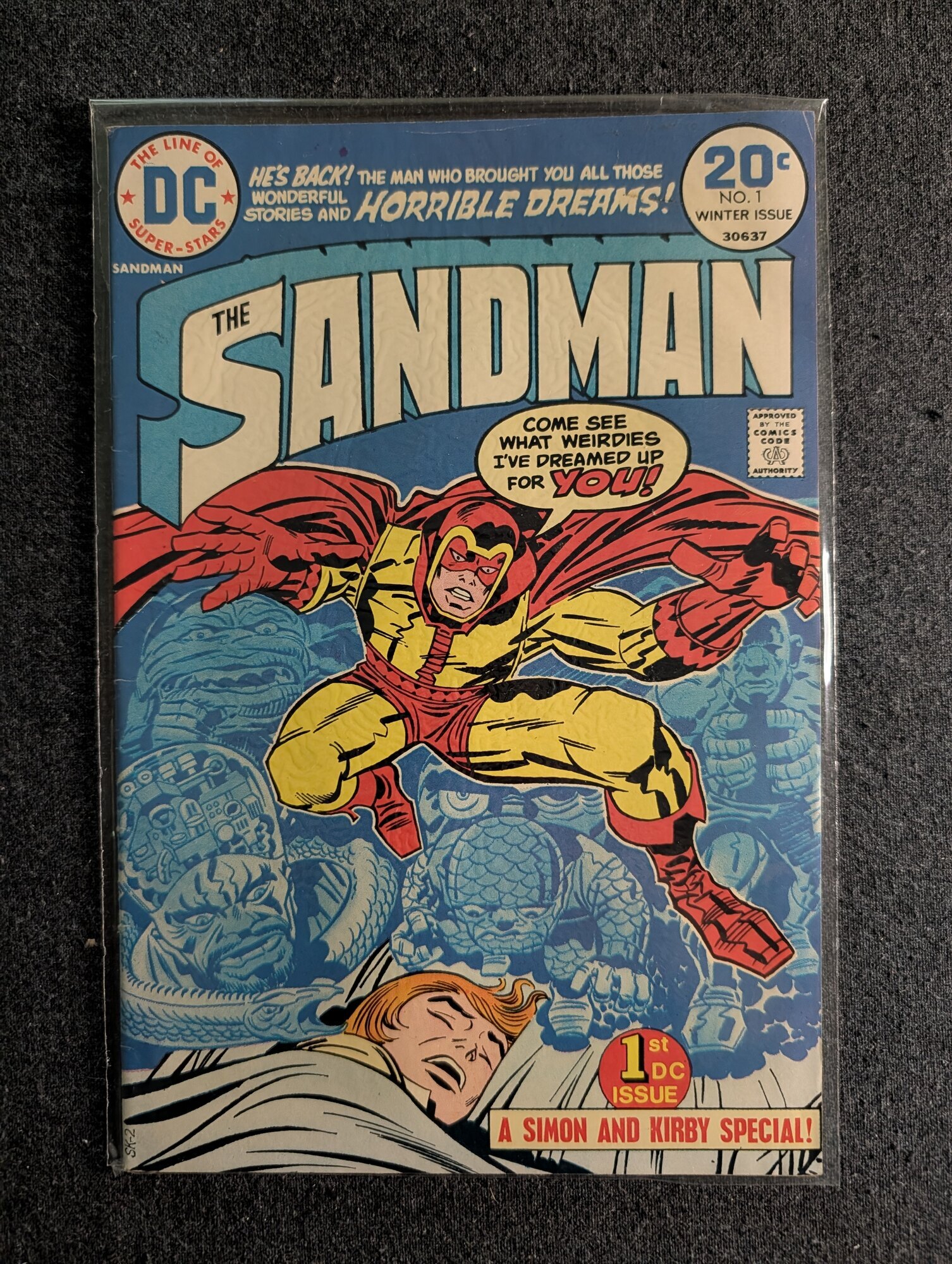
THE SANDMAN #1
First appearance of Jack Kirby's Sandman, Garrett Sanford, plus Brute and Glob
// Unit specification
| Publisher | Cover date | Era | Variant | Key attribute | Status |
|---|---|---|---|---|---|
| DC Comics | December 1974 | Bronze | — | First appearance of Jack Kirby's Sandman (Garrett Sanford); first appearance of Brute and Glob | AVAILABLE |
// Copies in archive
| Unit | Grade | Variant | Status |
|---|---|---|---|
| ECA-007951 | ~6.5 | — | AVAILABLE |
// Condition analysis
Cover shows moderate wear consistent with a mid-grade Bronze Age book: visible surface creasing and wrinkling across the central figure and speech balloon area, a vertical crease running through the lower left corner, and slight softness/rounding at the corners. There is minor edge wear along the spine and right border, with no major tears or color breaks noted. The book is in a protective sleeve which obscures fine edge detail; interior pages and back cover were not assessed.
// Valuation — market reference
| Bracket | Grade | Est. market value | Marker |
|---|---|---|---|
| LOW_RAW | 0.5 – 1.5 | $10 | |
| MID_RAW | 4.0 – 6.0 | $20 | |
| HIGH_CERT | 9.8 SLAB | $250 |
// Archive commentary
The Sandman #1 (December 1974) introduced Jack Kirby's dream-themed creation for DC, distinct from the later Neil Gaiman/Vertigo character of the same name. Kirby wrote and drew the series with inker Mike Royer, casting Garrett Sanford as the title hero who patrols the Dream Dimension with his companions Brute and Glob, guarding against the mad god Morpheus and other threats emerging from the boundary between waking and sleeping worlds. The issue arrived during Kirby's mid-1970s DC tenure, following his New Gods and Kamandi work, and reflects the same high-energy cosmic-mythic sensibility applied to a more whimsical, younger-reader premise.
The book trades as a plentiful, affordable Bronze Age title rather than a blue-chip key. Census population is large, with well over a thousand certified copies and slabs common through the mid grades, keeping raw and low-grade values modest and stable across years of sales data. Demand concentrates at the top of the grading curve: the jump from strong near-mint copies to CGC 9.8 is steep, reflecting how few copies survive in true gem condition relative to the print run, and recent sales activity at 9.8 shows continued, if moderate, collector interest in top-tier examples.
Collecting interest centers on Kirby completists and Bronze Age DC specialists rather than mainstream key-issue investors, since the character never achieved lasting prominence beyond this short-lived series. Mid- and low-grade copies remain readily available and inexpensively priced, suitable for reading copies or series runs, while 9.8 examples command a real premium and are the copies worth pursuing for grade-sensitive buyers. The book functions best in a collection as a Kirby-signature curiosity and a first appearance footnote rather than as a headline investment piece.
INQUIRE_ABOUT_THIS_UNIT
Institutional buyers, auction houses, and private collectors — direct line to the archive.