Approximate
Condition Profile
DC COMICS · 12/68
UNIT ECA-008185
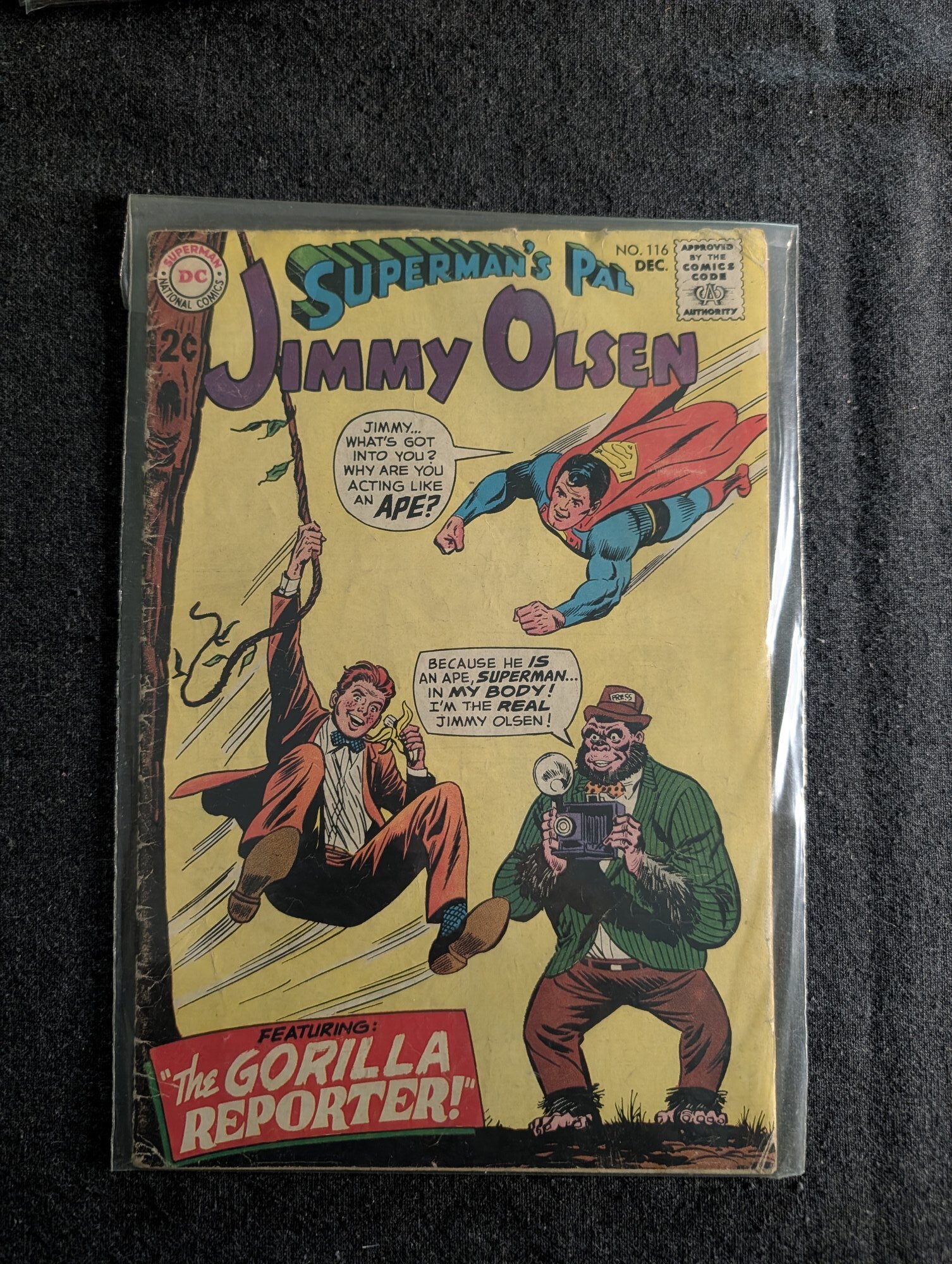
SUPERMAN’S PAL JIMMY OLSEN #116
Silver Age Superman-family issue with the "Gorilla Reporter" cover story and a Brainiac growth-ray adventure
// Unit specification
// Copies in archive
| Unit | Grade | Variant | Status |
|---|---|---|---|
| ECA-008185 | ~3.5 | — | AVAILABLE |
// Run position
// Condition analysis
Cover shows overall yellowing/browning typical of Silver Age paper, with a noticeable dark spine roll and vertical spine wear along the left edge with small chips/ticks. There is a crease/soft corner at the lower right and general surface wear with slight loss of gloss. No major tears or stains are visible, but the spine stress suggests multiple read/handling cycles. Interior and back cover were not assessed, so grade could shift once those are examined.
// Valuation — market reference
| Bracket | Grade | Est. market value | Marker |
|---|---|---|---|
| LOW_RAW | 0.5 – 1.5 | $5 | |
| MID_RAW | 4.0 – 6.0 | $18 | |
| HIGH_CERT | 9.8 SLAB | $450 |
// Archive commentary
Superman's Pal Jimmy Olsen #116 arrives at the tail end of the Mort Weisinger era, cover-dated December 1968 and on sale that October. The lead, "The Gorilla Reporter," plays the formula the title had refined for a decade and a half, transforming the Daily Planet's cub reporter into the month's novelty and letting Superman sort out the consequences; a companion story pits Jimmy, his fan club, and Superman against Brainiac and an enlarging ray that inflates a fragment of green kryptonite. Scripting falls to house regulars including E. Nelson Bridwell and Otto Binder, with Curt Swan handling the cover imagery and Pete Costanza among the interior artists, and E. Nelson Bridwell serving as Weisinger's assistant editor. It sits two years ahead of the run's celebrated turn, when Jack Kirby took over with #133 and introduced Darkseid in #134.
Commercially the issue behaves as a mid-run book in a widely collected series rather than a key. Demand comes from Superman-family completists filling the 100-to-132 gap, from buyers who track the late-1960s DC covers with an eye to the Swan and Neal Adams cover program of those years, and from gorilla-cover specialists, a small but persistent collecting niche in DC's Weisinger period. Sales volume is thin but steady, and the observable market is almost entirely raw: low-grade and mid-grade copies circulate freely at bulk-to-modest prices on eBay and through dealer want-list inventory, while certified examples appear rarely enough that any single high-grade result carries outsized weight.
The collecting outlook is grade-driven rather than character-driven. Reading copies and structurally complete low-grade examples move quickly to run builders and are best sold in groups; the 4.0-6.0 band is the trading heart of the issue, where most copies survive and where pricing is well established. Above about 9.0, supply collapses, since twelve-cent Superman-family books were read hard and rarely saved flat, and that scarcity, not the content, is what justifies the premium attached to top-census copies. Buyers pursuing the run for grade should expect long waits for high-grade material and should regard certification as worthwhile only at the upper end of the scale.
INQUIRE_ABOUT_THIS_UNIT
Institutional buyers, auction houses, and private collectors — direct line to the archive.