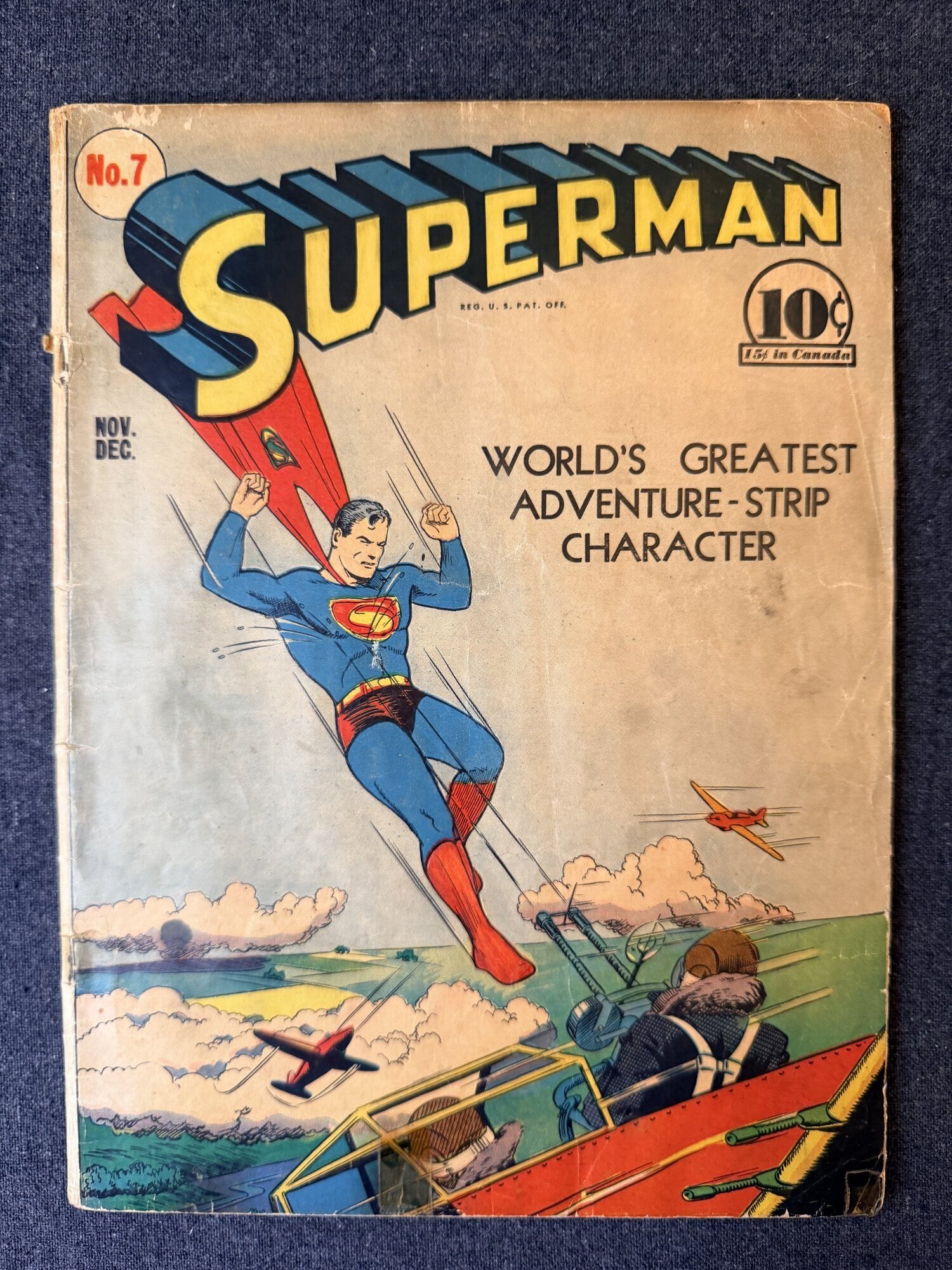
Approximate
Condition Profile
DC COMICS · 11/40
UNIT ECA-000518
SUPERMAN #7
Golden Age Superman featuring the first appearance of Daily Planet editor Perry White.
// Unit specification
| Publisher | Cover date | Era | Variant | Key attribute | Status |
|---|---|---|---|---|---|
| DC Comics | November 1940 | Golden | — | First appearance of Perry White; early Golden Age Superman title; Siegel and Shuster | AVAILABLE |
// Run position
// Condition analysis
This Golden Age Superman #7 (1940) shows heavy overall wear consistent with its age: significant surface soiling and discoloration across the cover, multiple creases and stress lines radiating through the artwork, and visible fraying/chipping along the top and right edges. There is a small loss/tear at the upper right corner area and general softness to all corners. The spine area (running along the top of this rotated image) shows wear and minor splitting. Interior pages and back cover were not visible in this photo and were not assessed.
// Valuation — market reference
| Bracket | Grade | Est. market value | Marker |
|---|---|---|---|
| LOW_RAW | 0.5 – 1.5 | $833 | |
| MID_RAW | 4.0 – 6.0 | $2,020 | |
| HIGH_CERT | 9.8 SLAB | $85,000 |
// Archive commentary
Published in late 1940 by Jerry Siegel and Joe Shuster's fledgling superhero enterprise, Superman #7 belongs to the earliest run of the character's self-titled book, launched only two years after his Action Comics debut. This issue is chiefly remembered for introducing Perry White, the gruff editor-in-chief of the Daily Planet, a supporting figure who would become permanent fixtures of the Superman mythos across comics, radio, film and television. As an early Siegel-and-Shuster-era title from the formative period when the medium's conventions were still being invented, it carries the historical weight collectors attach to pre-war Superman material.
The surviving certified population skews heavily toward mid and lower grades, with the census topping out at 7.5 and no high-grade copies recorded above that mark. Demand across the range is steady and grade-sensitive: value climbs modestly through the well-populated 4.0-6.0 band, then accelerates sharply into the scarce 7.0-7.5 tier, reflecting how few clean copies of a 1940 newsstand book survive. Lower grades trade at accessible levels that draw registry builders and Golden Age generalists, while the thinly populated upper end commands disproportionate premiums.
This is a book with broad appeal: entry-level Golden Age buyers pursue complete-looking mid-grade copies, while advanced Superman and first-appearance specialists chase the handful of high-end examples. Restored and lower-grade copies keep the issue attainable, but any genuine high grade is effectively a trophy given the census ceiling, and such a copy would trade well beyond the certified sales record on rarity alone.
// Copies in archive
| Unit | Grade | Variant | Status |
|---|---|---|---|
| ECA-000518 | ~1.8 | — | AVAILABLE |
INQUIRE_ABOUT_THIS_UNIT
Institutional buyers, auction houses, and private collectors — direct line to the archive.