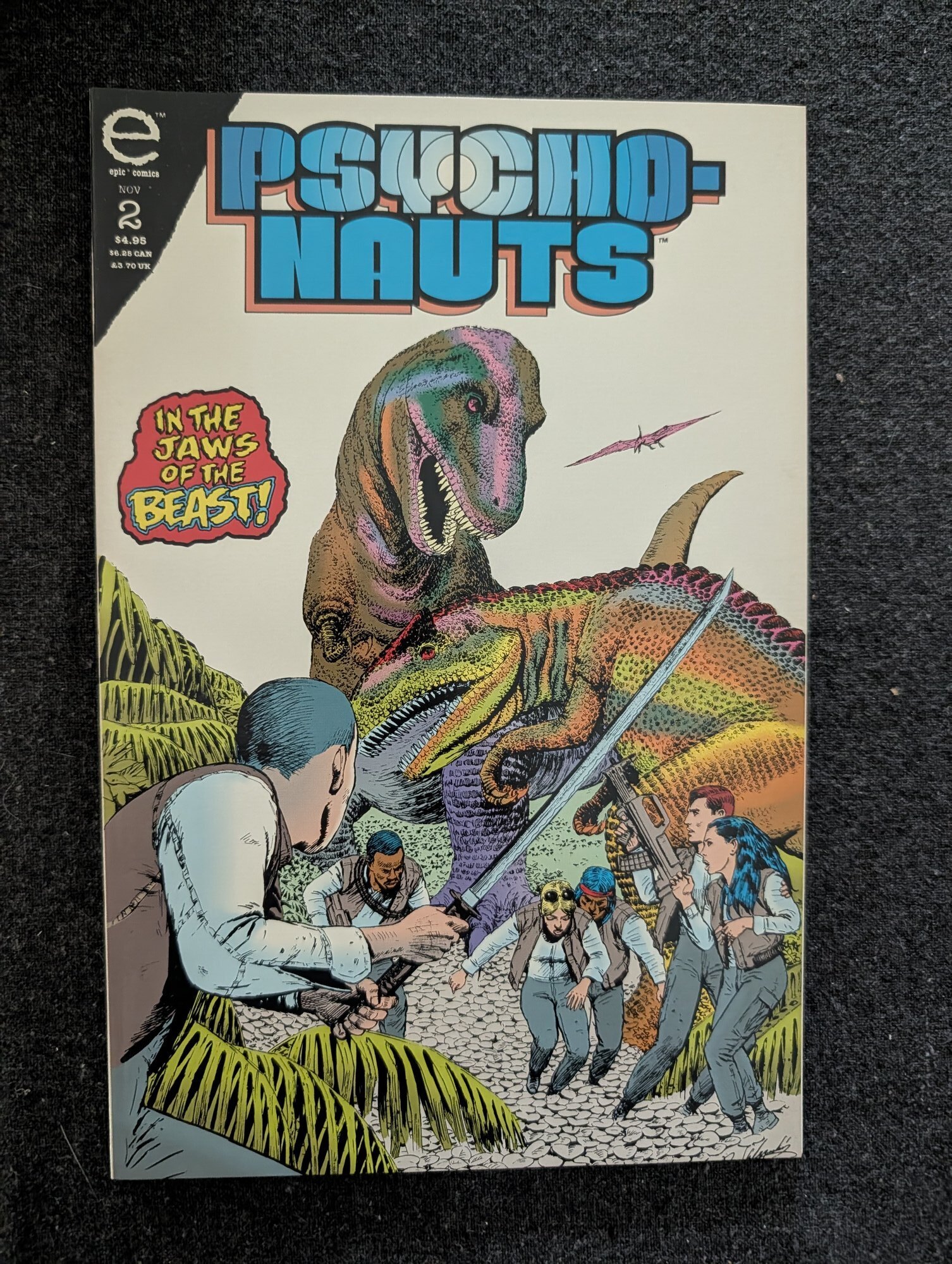
Approximate
Condition Profile
EPIC COMICS · 11/96
UNIT ECA-004169
PSYCHO-NAUTS #2
Epic Comics prestige-format sci-fi miniseries by Alan Grant, Tony Luke and Motofumi Kobayashi, promoted as an early American-Japanese co-production
// Unit specification
| Publisher | Cover date | Era | Variant | Key attribute | Status |
|---|---|---|---|---|---|
| Epic Comics | November 1996 | Modern | — | — | AVAILABLE |
// Condition analysis
Cover shows sharp corners and strong color with no visible creases or spine stress. Slight glare on the lower right near the artist signature obscures a small area but no defects appear evident there. No stains, tears, or writing visible on the front; interior and back cover were not assessed, so grade is capped conservatively.
// Valuation — market reference
| Bracket | Grade | Est. market value | Marker |
|---|---|---|---|
| LOW_RAW | 0.5 – 1.5 | $2 | |
| MID_RAW | 4.0 – 6.0 | $4 | |
| HIGH_CERT | 9.8 SLAB | $60 |
// Archive commentary
Psycho-Nauts was a four-issue, 48-page prestige-format limited series from Marvel's Epic Comics line, scripted by Alan Grant and Tony Luke with art by Motofumi Kobayashi and marketed as one of the first American-Japanese creatively co-produced comic books. The premise is post-apocalyptic science fiction with horror overtones: humanity has abandoned a diseased, decaying Earth for orbital cities, and a team of psychically gifted operatives returns to determine whether the planet can be reclaimed. The second chapter continues that survey mission, escalating the hostility of what the crew finds waiting for them on the surface. Grant was at a career high point from his Judge Dredd and Batman work, and Kobayashi would later become better known internationally for his military manga, giving the run a creator pairing more interesting than its sales history suggests.
Market profile is that of late-Epic filler rather than a collected key. The series arrived as the Epic imprint was winding down, in a premium format at a premium cover price, into a market saturated with speculative product, and it never developed a following. Dealer inventory and online completed sales show mid- and high-grade raw copies trading at or barely above original cover price, with complete four-issue runs routinely offered as inexpensive lots. Demand drivers are narrow: Alan Grant completists, collectors assembling full Epic imprint runs, and buyers pursuing early East-West co-productions as a publishing curiosity. Certification is essentially absent from the market, and there is no established premium tier to reference.
For collectors, this is a run-filler bought by title, not a book bought by grade. Low-grade copies have nominal value and are best moved in lots; mid-grade copies trade at bargain-box levels because the format's stiff card stock means clean copies remain plentiful, compressing the spread that normally rewards condition. The theoretical high-certified figure reflects the cost of grading and slab scarcity rather than genuine collector competition, and submitting a copy is difficult to justify economically. The realistic path to value here is a complete set sold to an Epic or Grant collector, and dealers should catalog it accordingly.
// Copies in archive
| Unit | Grade | Variant | Status |
|---|---|---|---|
| ECA-004169 | ~9.0 | — | AVAILABLE |
INQUIRE_ABOUT_THIS_UNIT
Institutional buyers, auction houses, and private collectors — direct line to the archive.