Approximate
Condition Profile
DC COMICS · 2/68
UNIT ECA-007930
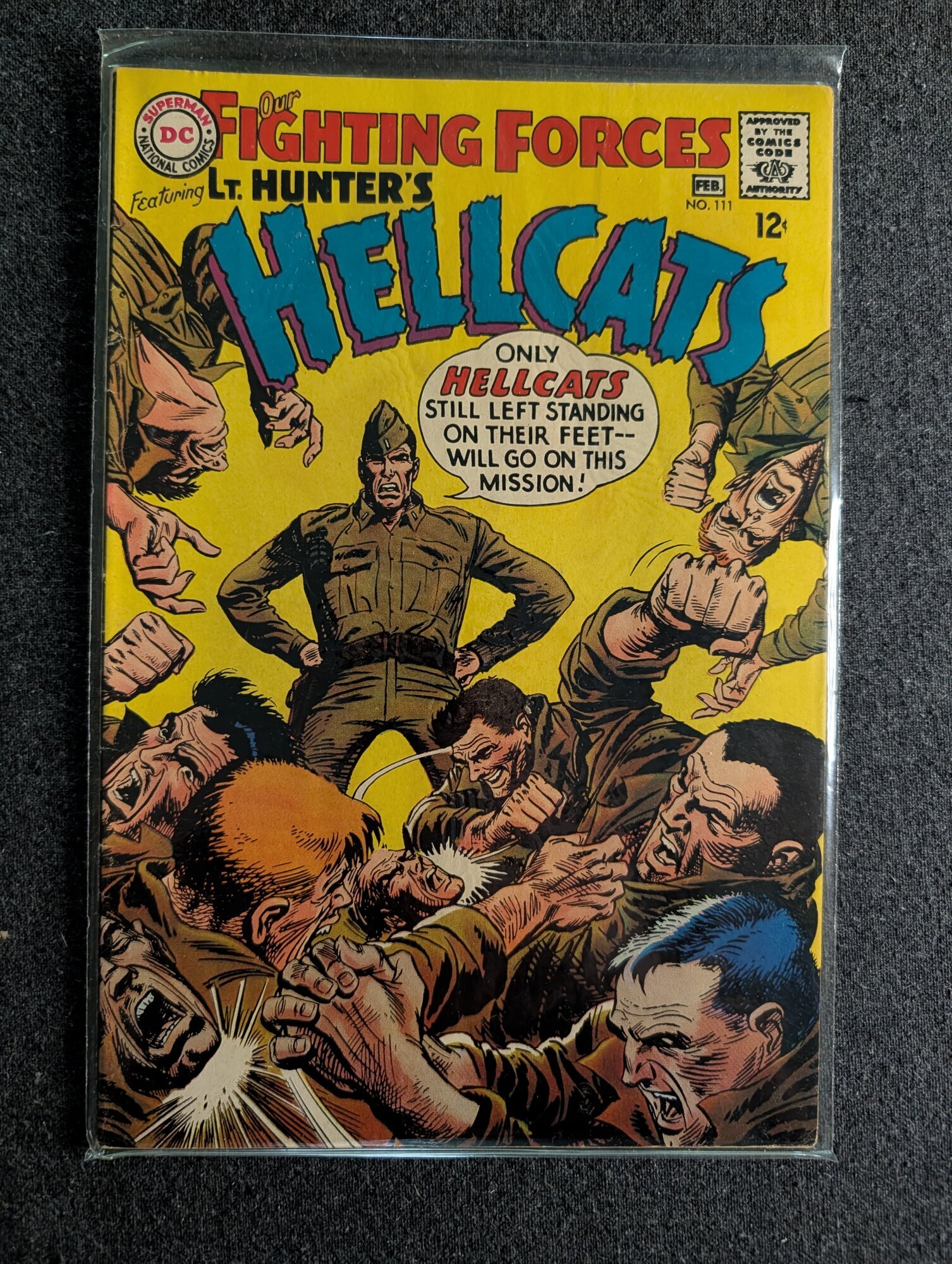
OUR FIGHTING FORCES #111
Silver Age DC war issue featuring Lt. Hunter's Hellcats, with a Joe Kubert cover
// Unit specification
// Run position
// Condition analysis
Cover shows moderate general wear consistent with a Silver Age book: some surface scuffing and minor color rub at the corners, a faint diagonal crease line visible in the lower right quadrant, and slight softness at the top and bottom edges. No major tears or missing pieces are visible, and the bright yellow background shows only mild fading. Spine appears mostly intact from this angle with minor stress lines, though it cannot be fully assessed from a straight-on front photo. Interior and back cover were not assessed, so grade could shift once those are examined.
// Valuation — market reference
| Bracket | Grade | Est. market value | Marker |
|---|---|---|---|
| LOW_RAW | 0.5 – 1.5 | $5 | |
| MID_RAW | 4.0 – 6.0 | $14 | |
| HIGH_CERT | 9.8 SLAB | $250 |
// Archive commentary
Our Fighting Forces #111 falls in the middle of the Lt. Hunter's Hellcats run, the feature that occupied the title from #106 through #123 and gave DC its answer to the "Dirty Dozen" premise: a commando unit assembled from military prisoners, led by Lt. Ben Hunter, father of the earlier Capt. Philip Hunter. The Hellcats format let the editorial team retreat from the contemporary Southeast Asian setting that had complicated the Capt. Hunter stories and return to World War II Europe, where the squad of specialists — Brute, Juggler, Light Fingers, Snake-Oil and Swinger — could be run through self-contained missions. This issue's story turns on Hunter discovering that the French Resistance leader code-named Alouette, the target of the Hellcats' rescue assignment, is a woman he knew before the war, one of the personal-stakes plots the feature used to differentiate itself from the anonymous squad tales elsewhere on DC's war line. Joe Kubert's cover work for the title in this period is the strongest visual argument the book makes; Robert Kanigher's scripting and Kubert's editorial hand anchor the issue in the same shop that produced Sgt. Rock and Enemy Ace.
The market treats this as run material rather than a key. There is no first appearance, origin, or death here, and the Hellcats never developed the crossover profile of the Losers, who displaced them in the title at #123 and carry most of the speculative attention in this series. Demand comes from two directions: collectors assembling complete Our Fighting Forces runs, and Kubert cover completists who buy across DC's war titles regardless of interior content. Raw copies surface regularly and are frequently offered in multi-issue lots, which caps realized prices in low and mid grades well beneath sellers' asking figures. Certified copies are scarce not because the book is rare but because grading costs exceed likely returns, leaving the census shallow and high-grade price discovery unreliable.
The collecting outlook is steady rather than dynamic. Low-grade copies function as inexpensive slot-fillers for run builders and are best acquired in groups; mid-grade copies, which represent the practical ceiling for most buyers, trade quickly at modest levels and are the sensible entry point for anyone who wants the issue to read or display. The interesting risk-reward sits at the top of the grade scale, where a genuinely high-grade example faces almost no competing supply — 12-cent DC war books were read hard and rarely survive with sharp corners and clean spines — but also a small, patient bidder pool, so results depend heavily on the right two collectors meeting at the right auction. Dealers should catalog this as solid DC war inventory with cover-artist appeal, priced to move in the lower brackets and offered opportunistically in high grade.
// Copies in archive
| Unit | Grade | Variant | Status |
|---|---|---|---|
| ECA-007930 | ~6.0 | — | AVAILABLE |
INQUIRE_ABOUT_THIS_UNIT
Institutional buyers, auction houses, and private collectors — direct line to the archive.