Approximate
Condition Profile
DC COMICS · 3/71
UNIT ECA-007918
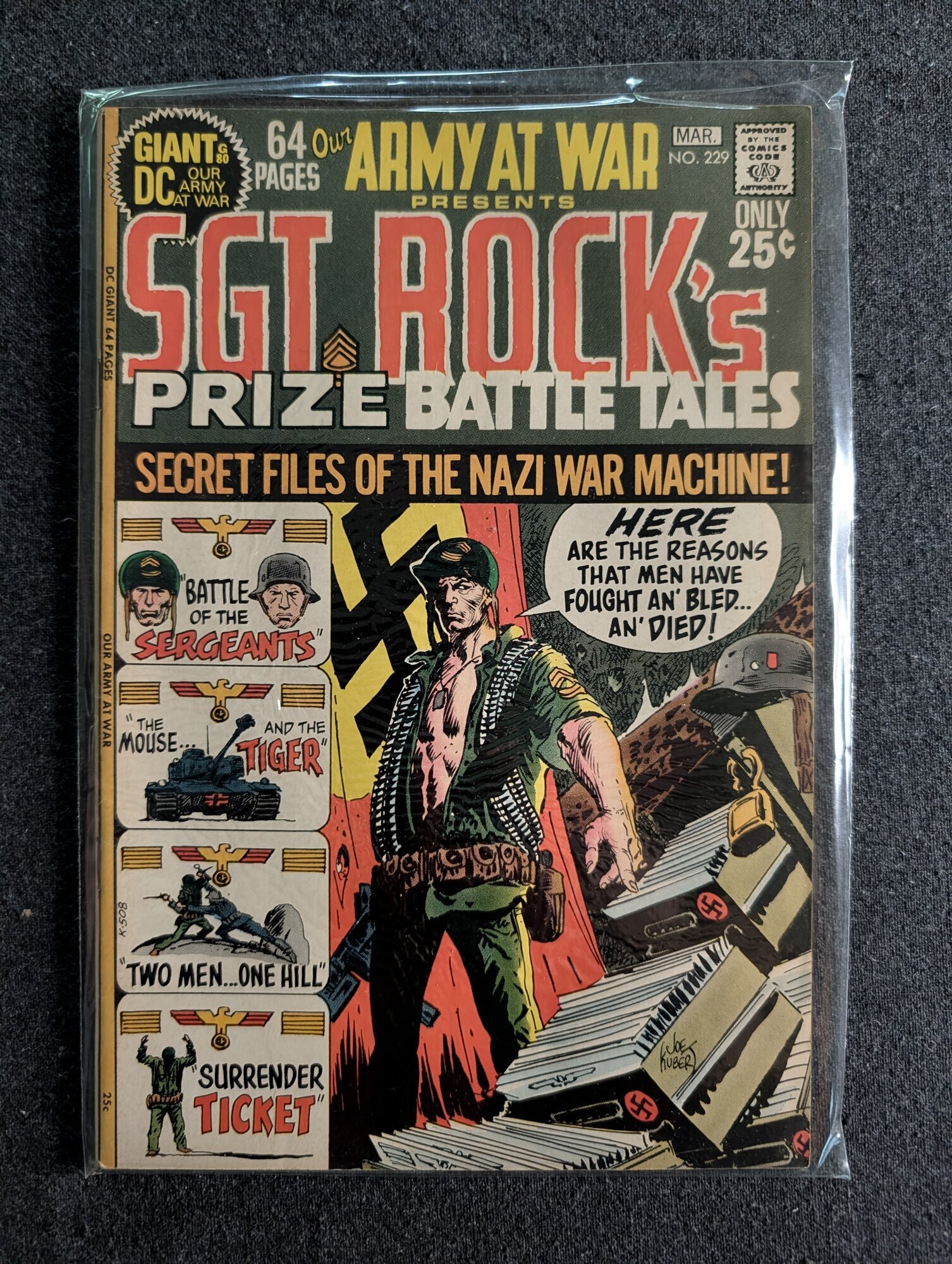
OUR ARMY AT WAR #229
Bronze Age DC war anthology issue from the long-running Our Army at War title
// Unit specification
// Run position
// Condition analysis
Cover shows moderate wear consistent with a mid-grade Bronze Age book: some spine stress lines visible along the left edge, mild corner softness at top right, and light surface wear/scuffing across the dark green background. Colors remain bright with no major creases or tears visible, and no writing or stains noted on the front cover. Book is in a protective sleeve which obscures fine detail; interior pages and back cover were not assessed.
// Valuation — market reference
| Bracket | Grade | Est. market value | Marker |
|---|---|---|---|
| LOW_RAW | 0.5 – 1.5 | $3 | |
| MID_RAW | 4.0 – 6.0 | $8 | |
| HIGH_CERT | 9.8 SLAB | $425 |
// Archive commentary
Our Army at War #229 arrived in March 1971 as part of DC's long-running war anthology line, a title best known as the home of Sgt. Rock and Easy Company throughout the Silver and Bronze Ages. By 1971 the series had settled into a steady rhythm of combat-driven short stories, typically illustrated by DC's stable of war-comics specialists, with covers designed to convey battlefield tension rather than superhero spectacle. This issue reflects that house style: a working installment of a dependable anthology rather than a landmark single issue.
Market data for the issue is thin but consistent with its status as a mid-run war comic rather than a sought-after key. Sales cluster in the 9.4–9.6 range, with a notable jump from about $110 at 9.4 to roughly $300 at 9.6, indicating that demand is concentrated among high-grade completists building full Our Army at War or Sgt. Rock runs rather than driven by any first appearance or landmark story. The near-total absence of FMV data below 8.5 confirms that lower-grade copies see little transactional volume, trading instead as inexpensive filler for long-box browsers and series collectors.
This is a book for war-comics specialists and DC Bronze Age run-builders rather than crossover investors. Lower-grade raw copies remain inexpensive and are typically acquired to fill gaps in a run, while mid-grade copies see modest, steady interest from the same audience. High-grade certified copies, particularly at the top of the small census, command a real premium due to genuine scarcity in top grade, but the ceiling remains modest compared to true keys — pricing here tracks census rarity and run-completion demand rather than character-driven speculation.
// Copies in archive
| Unit | Grade | Variant | Status |
|---|---|---|---|
| ECA-007918 | ~6.5 | — | AVAILABLE |
INQUIRE_ABOUT_THIS_UNIT
Institutional buyers, auction houses, and private collectors — direct line to the archive.