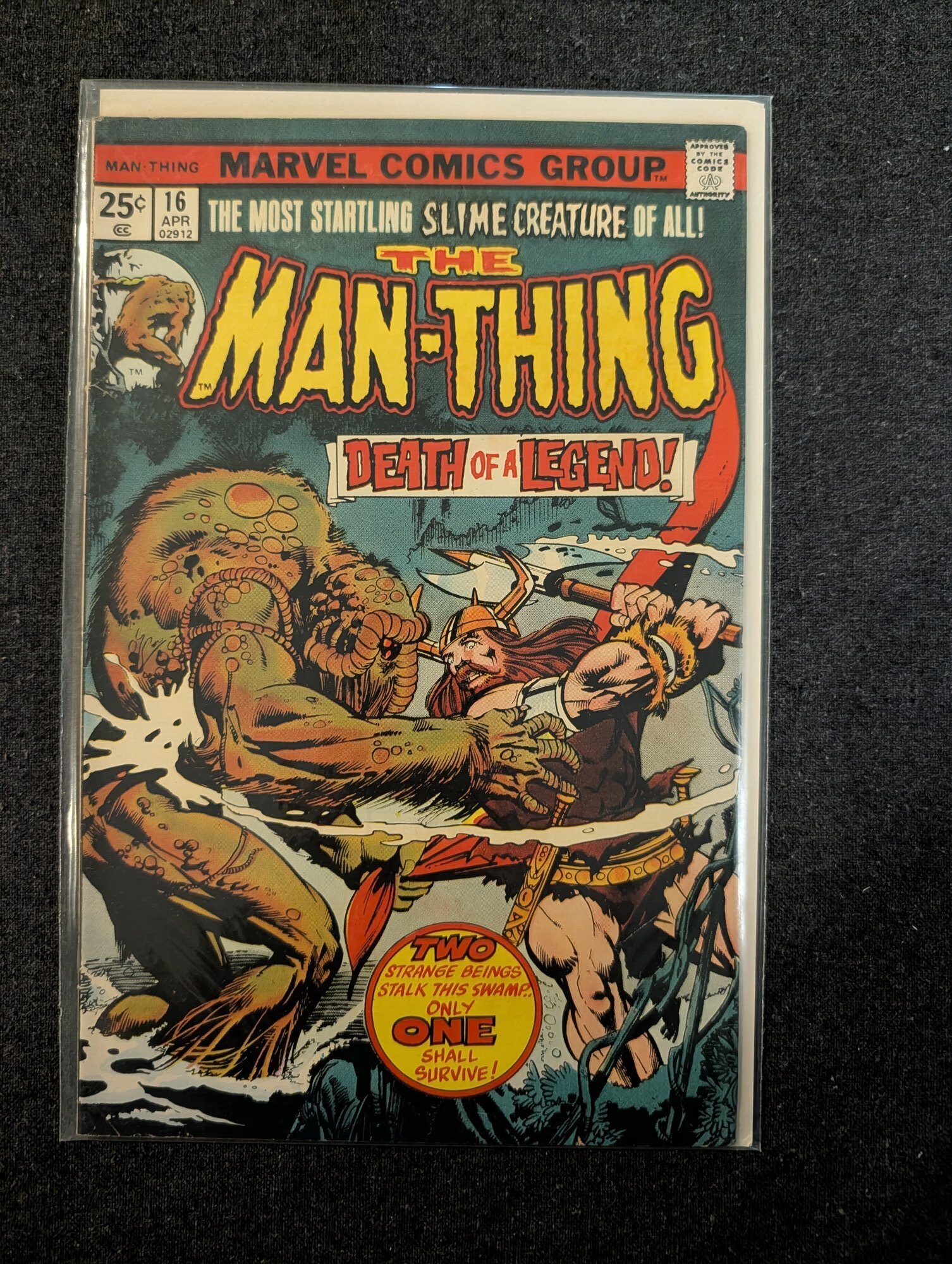
Approximate
Condition Profile
MARVEL COMICS · 4/75
UNIT ECA-009751
MAN-THING #16
First appearance of Howard the Duck
// Unit specification
| Publisher | Cover date | Era | Variant | Key attribute | Status |
|---|---|---|---|---|---|
| Marvel Comics | April 1975 | Bronze | — | 1st appearance of Howard the Duck, created by Steve Gerber and Val Mayerik | AVAILABLE |
// Copies in archive
| Unit | Grade | Variant | Status |
|---|---|---|---|
| ECA-009751 | ~8.0 | — | AVAILABLE |
// Run position
// Condition analysis
Cover shows strong gloss and vivid colors with sharp corners and no visible creases or color breaks. There is minor edge wear at the top and bottom left corners and slight surface handling wear consistent with a well-preserved bagged copy. No stains, tears, or spine stress lines are visible in this photo; interior and back cover were not assessed.
// Valuation — market reference
| Bracket | Grade | Est. market value | Marker |
|---|---|---|---|
| LOW_RAW | 0.5 – 1.5 | $20 | |
| MID_RAW | 4.0 – 6.0 | $50 | |
| HIGH_CERT | 9.8 SLAB | $220 |
// Archive commentary
Man-Thing #16 holds a fixed place in Bronze Age collecting as the first appearance of Howard the Duck, introduced by writer Steve Gerber and artist Val Mayerik within a swamp-monster horror title otherwise known for its brooding tone. The duck's brief, satirical cameo amid the Man-Thing's grim mythos became one of the more improbable launch points in Marvel history, leading directly to Howard's own feature and, decades later, a Marvel Studios film credit that reintroduced the character to a mass audience. The issue's importance rests entirely on that first appearance rather than on cover imagery or a landmark story arc for Man-Thing himself.
Market data shows a census of 67 tracked CGC Universal copies with active trading concentrated in the upper grades: 9.4 through 9.8 show recorded sales and a clear premium curve, with 9.8 commanding roughly two to three times the 9.4 price. Demand is driven almost entirely by Howard the Duck's continuing cultural visibility rather than by general Bronze Age horror interest, which keeps the book liquid across grade tiers even though overall population is modest for a mid-1970s Marvel title. Lower and mid-grade raw copies see less frequent public sale data but retain meaningful value because the first-appearance premium persists independent of condition.
The book attracts two overlapping buyer groups: character-specific collectors assembling Howard the Duck material regardless of grade, and Bronze Age key-issue collectors building out first-appearance runs alongside better-known 1970s Marvel debuts. High-grade certified copies, especially those approaching or at 9.8, draw the strongest competitive bidding given the relatively thin population at the top of the census. Raw copies in low and mid grades remain accessible entry points for buyers who prioritize owning the appearance itself over top condition, and they tend to trade steadily rather than spike, reflecting a key issue with durable rather than speculative demand.
INQUIRE_ABOUT_THIS_UNIT
Institutional buyers, auction houses, and private collectors — direct line to the archive.