Approximate
Condition Profile
DC COMICS · 9/91
UNIT ECA-001986
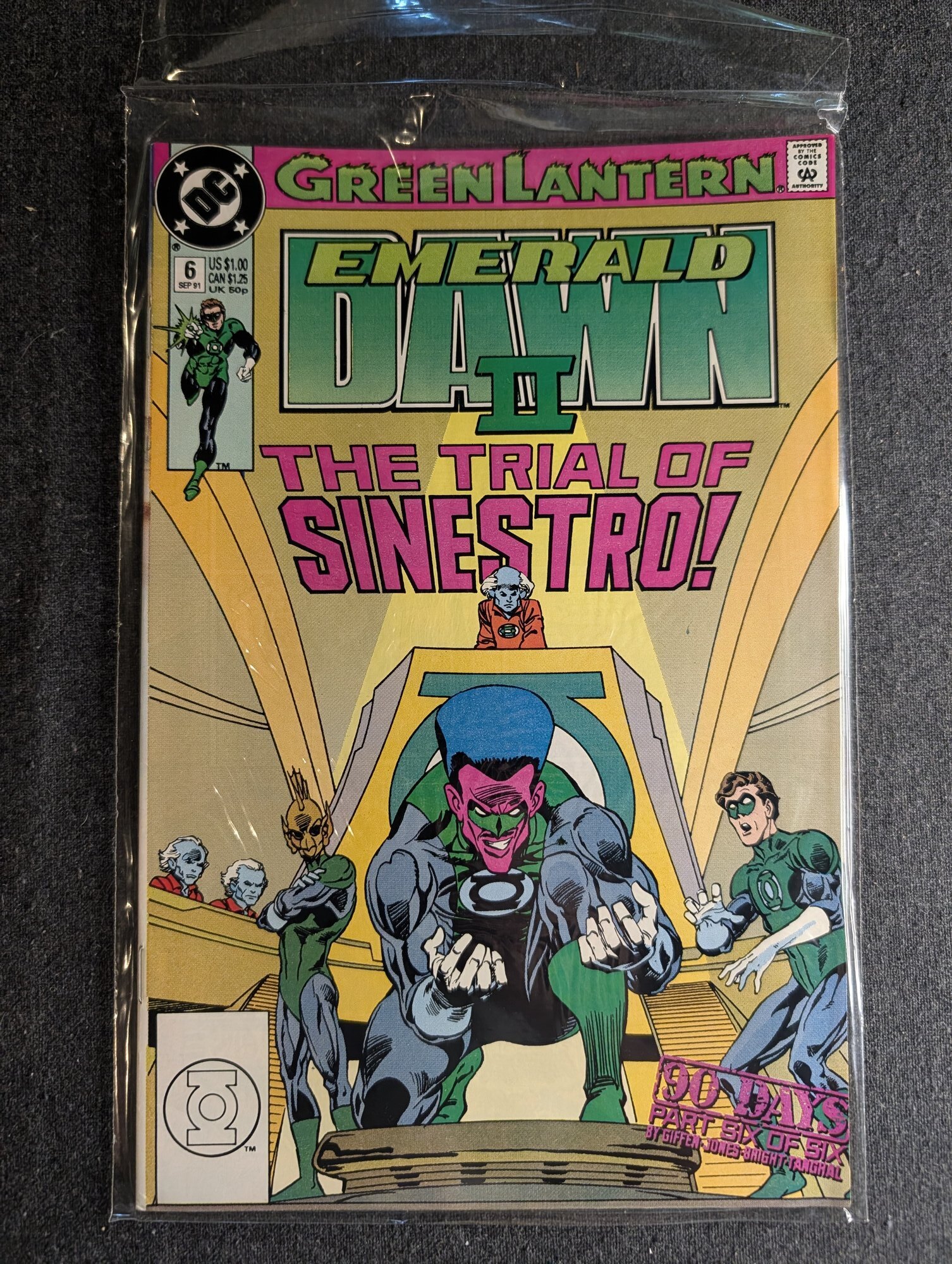
GREEN LANTERN #6
Early chapter of the Hal Jordan/Guy Gardner Oa storyline from the 1990 Green Lantern relaunch, with the rogue Guardian Appa Ali Apsa
// Unit specification
// Copies in archive
| Unit | Grade | Variant | Status |
|---|---|---|---|
| ECA-001986 | ~9.2 | — | AVAILABLE |
// Run position
// Condition analysis
Cover shown through a protective sleeve appears glossy with sharp corners and strong color, no visible creases, folds, or spine stress lines. Minor glare from the plastic sleeve obscures fine detail in a few spots, and there is a small edge nick near the top left corner of the sleeve itself rather than the book. Interior pages and back cover were not assessed, so grade is based solely on the visible front cover condition.
// Valuation — market reference
| Bracket | Grade | Est. market value | Marker |
|---|---|---|---|
| LOW_RAW | 0.5 – 1.5 | $1 | |
| MID_RAW | 4.0 – 6.0 | $3 | |
| HIGH_CERT | 9.8 SLAB | $55 |
// Archive commentary
Gerard Jones and Pat Broderick's Green Lantern #6 continues the opening year of the 1990 relaunch that reestablished Hal Jordan as the lead of an ongoing title after a decade of Corps-centered and Justice League-centered books. Guy Gardner reaches the outskirts of Oa at Hal's summons as the renegade Guardian Appa Ali Apsa, the Old Timer, tears whole cities from their home planets and deposits them on the ruined homeworld of the Guardians. The issue matters chiefly as scaffolding: it advances the storyline that produced the transplanted patchwork world of Oa and, in turn, John Stewart's assignment there and the 1992 Green Lantern: Mosaic series. Broderick pencils over his own cover with Mark Nelson, with Bruce Patterson inking interiors, Anthony Tollin on color and Albert DeGuzman lettering, under editors Andrew Helfer and Kevin Dooley. Tomar-Tu, introduced one issue earlier, returns here, and Rose and Toby Hardin carry the Hope Springs subplot forward.
Commercially this is a late-Copper-Age direct-market book from a period of heavy print runs and high survival rates in near-mint condition. Raw copies function as run-filler and are typically bought as part of multi-issue lots rather than individually, and mid-grade examples carry no premium over very fine because unread copies remain plentiful. Certification is rare to nonexistent: the census shows no meaningful population, which means the top bracket is a theoretical figure driven by submission cost and the willingness of a Green Lantern completist to pay for a registry-style slab, not by an active bidding market. Demand for the 1990 series concentrates almost entirely on issue #1, the Emerald Dawn tie-ins, and later Kyle Rayner keys, leaving mid-run chapters like this one dependent on storyline collectors.
The buyer for this book is a run collector assembling the 1990-2004 volume, a John Stewart or Mosaic-storyline reader, or a dealer filling wall-lot inventory. Across grades the spread is compressed at the bottom, where handling wear costs little because supply is deep, and stretched at the top only because the cost of grading sets an artificial floor. Best treated as inexpensive completist stock rather than an appreciating asset; upside would require renewed screen attention to the Mosaic material or to Guy Gardner and John Stewart specifically.
INQUIRE_ABOUT_THIS_UNIT
Institutional buyers, auction houses, and private collectors — direct line to the archive.