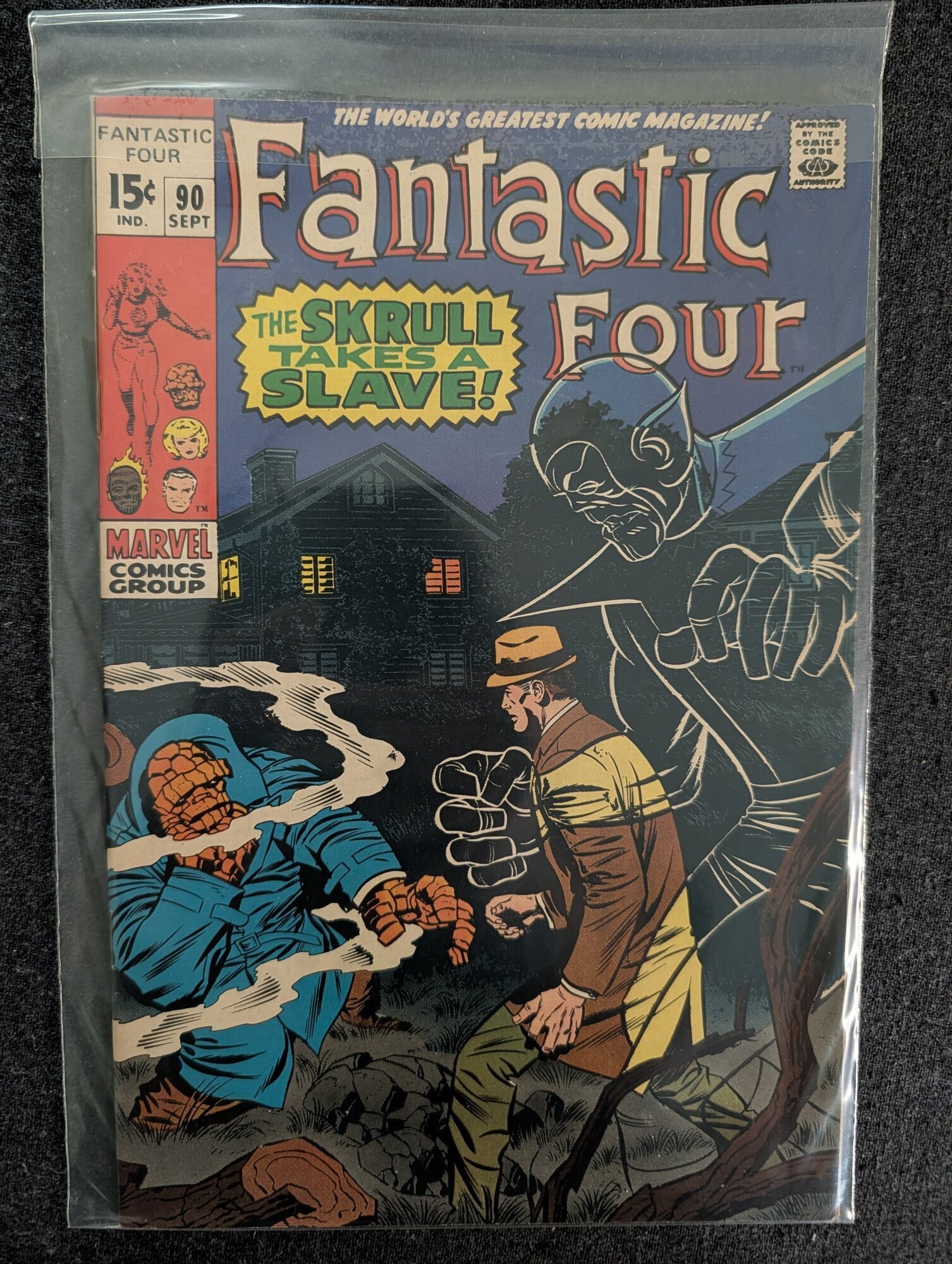
Approximate
Condition Profile
MARVEL COMICS · 9/69
UNIT ECA-028389
FANTASTIC FOUR #90
Fantastic Four #90 – Kirby/Buscema-era Marvel Silver Age adventure
// Unit specification
| Publisher | Cover date | Era | Variant | Key attribute | Status |
|---|---|---|---|---|---|
| Marvel Comics | September 1969 | Silver | — | — | AVAILABLE |
// Copies in archive
| Unit | Grade | Variant | Status |
|---|---|---|---|
| ECA-028389 | ~6.0 | — | AVAILABLE |
// Run position
// Condition analysis
Cover shows moderate wear typical of a Silver Age book: some minor surface soiling and slight loss of gloss, mild spine stress with a few faint ticks along the spine edge, and small edge wear at corners without major color break. No major tears, creases, or writing visible on the front cover. The book is protected in a plastic sleeve, and interior pages and back cover were not assessed, so grade is based solely on visible front-cover condition.
// Valuation — market reference
| Bracket | Grade | Est. market value | Marker |
|---|---|---|---|
| LOW_RAW | 0.5 – 1.5 | $12 | |
| MID_RAW | 4.0 – 6.0 | $23 | |
| HIGH_CERT | 9.8 SLAB | $750 |
// Archive commentary
Fantastic Four #90 arrived in September 1969 during the tail end of the title's foundational Silver Age run, produced under Stan Lee's plotting and scripting with art chores split between the Kirby studio's John Buscema and inker Joe Sinnott, a combination that gave the book a polished, dynamic look distinct from but complementary to Jack Kirby's core stretch on the series. The issue falls within the multi-part storyline that sets up the team's discovery of the mysterious estate that would introduce Agatha Harkness a few issues later, making it a connective chapter in one of the title's more memorable late-1960s arcs rather than a stand-alone landmark. It has no first appearance, origin, or death associated with it, and its cover, while representative of the era's dynamic house style, is not among the covers singled out by price guides as a genre classic.
Market data shows a well-populated census of over 300 CGC Universal copies with steady sales activity across nearly every grade tier, reflecting the book's status as a dependable mid-run Fantastic Four issue rather than a speculative or scarce item. Demand is driven primarily by Fantastic Four run-builders and Silver Age Marvel collectors filling out the Lee/Kirby-adjacent era rather than by key-issue investors, and pricing climbs steadily but non-explosively from low grade through the mid-9 range before accelerating sharply near the top of the census, consistent with typical late-Silver-Age Marvel behavior where high-grade survivors are disproportionately scarce relative to demand from registry collectors.
This issue trades as a straightforward collected-run book: entry-level and reading copies move cheaply and steadily, mid-grade raw copies attract series completists at modest premiums, and true high-grade or CGC 9.8 examples command a real rarity premium driven almost entirely by registry-set competition rather than storyline significance. It is best positioned in inventory as a solid, liquid piece of a broader Fantastic Four Silver Age offering rather than as a standalone highlight, appealing most to buyers assembling a complete run of the title's late-1960s issues.
INQUIRE_ABOUT_THIS_UNIT
Institutional buyers, auction houses, and private collectors — direct line to the archive.