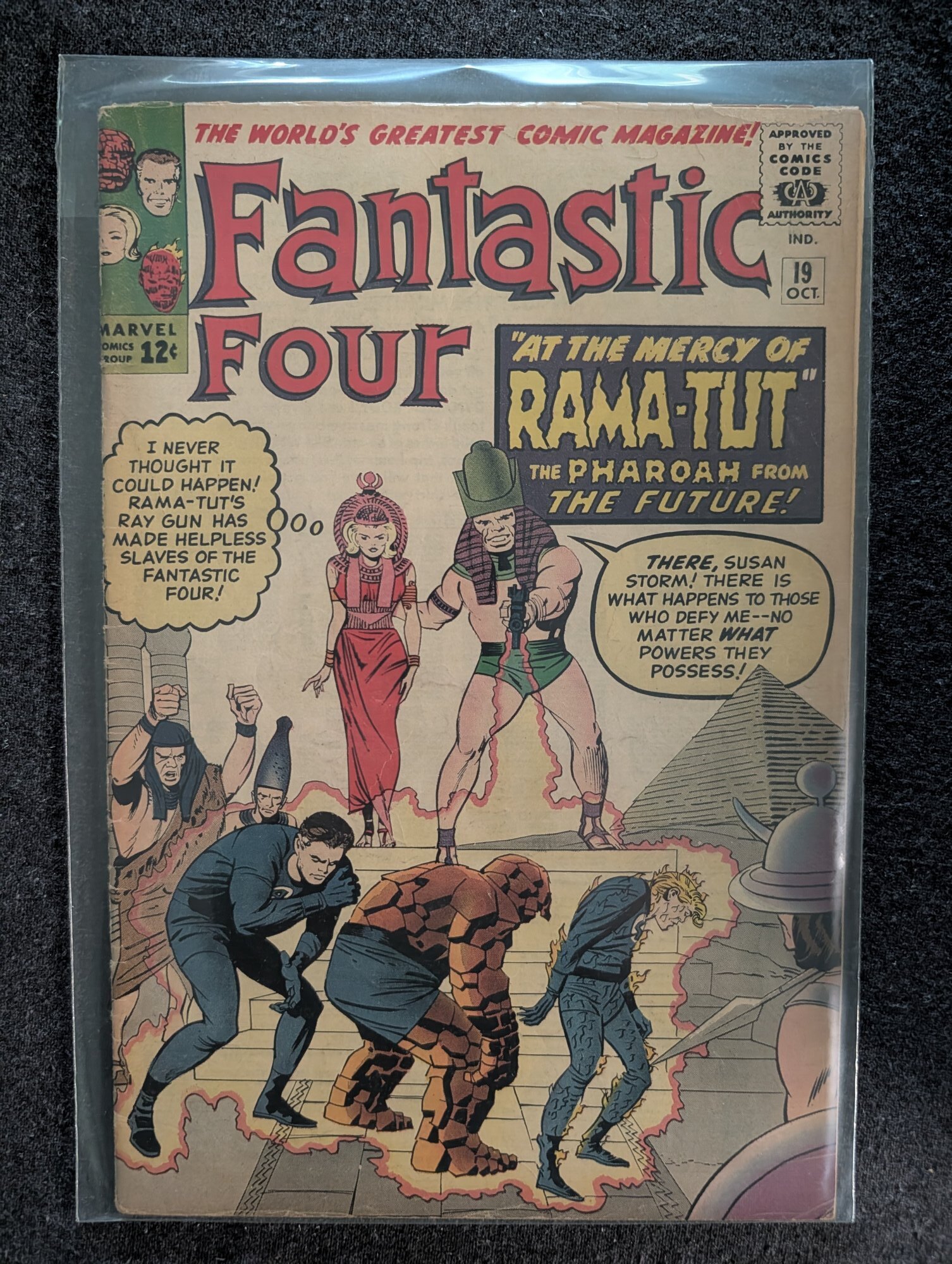
Approximate
Condition Profile
MARVEL COMICS · 10/63
UNIT ECA-028569
FANTASTIC FOUR #19
First appearance of the Puppet Master
// Unit specification
| Publisher | Cover date | Era | Variant | Key attribute | Status |
|---|---|---|---|---|---|
| Marvel Comics | October 1963 | Silver | — | First appearance of the Puppet Master | AVAILABLE |
// Copies in archive
| Unit | Grade | Variant | Status |
|---|---|---|---|
| ECA-028569 | ~4.5 | — | AVAILABLE |
// Run position
// Condition analysis
Cover shows noticeable overall wear consistent with a Silver Age book: soft, rounded corners, general surface toning/yellowing, and a slight vertical crease running through the lower right portion of the cover. Spine shows some minor stress but no major color-breaking ticks visible in this image; there is light waviness near the top edge suggesting handling. The book is in a protective sleeve which adds some glare but does not obscure major defects; interior and back cover were not assessed.
// Valuation — market reference
| Bracket | Grade | Est. market value | Marker |
|---|---|---|---|
| LOW_RAW | 0.5 – 1.5 | $63 | |
| MID_RAW | 4.0 – 6.0 | $234 | |
| HIGH_CERT | 9.8 SLAB | $15,000 |
// Archive commentary
Fantastic Four #19 (Marvel, October 1963) introduces the Puppet Master, one of the team's earliest recurring villains, in a story scripted by Stan Lee with pencils by Jack Kirby and inks by Chic Stinnett (credited as Sinnott). The issue arrives during the foundational stretch of the FF's run, when Lee and Kirby were rapidly expanding the book's rogues' gallery and establishing the title as Marvel's flagship team book. Its historical weight rests less on any single dramatic cover image than on the character debut and the creative team's ongoing work during this formative period of the Marvel Universe.
Market activity reflects a book that trades steadily across a wide grade spread, with well over a thousand certified copies on census and hundreds of recorded sales in nearly every grade tier. Demand is concentrated in the mid-to-high grades, where prices climb sharply once a copy clears 8.0, and the scarcity of true gem examples — only a single 9.8 currently certified with no recorded sale — creates a pronounced premium at the top of the population. Lower and mid-grade copies move in a fairly predictable band, consistent with an actively collected but not top-tier key issue.
This is a book pursued primarily by Fantastic Four run collectors and Silver Age Marvel specialists rounding out a complete villain-debut set, rather than a crossover grail chased by generalist investors. Raw copies in low and mid grade are readily available and change hands in modest, well-supported price bands, while a true 9.8 would be a census-defining rarity commanding outsized interest given the total absence of comparable sales at that grade.
INQUIRE_ABOUT_THIS_UNIT
Institutional buyers, auction houses, and private collectors — direct line to the archive.