Approximate
Condition Profile
MAJOR MAGAZINES · 7/67
UNIT ECA-000816
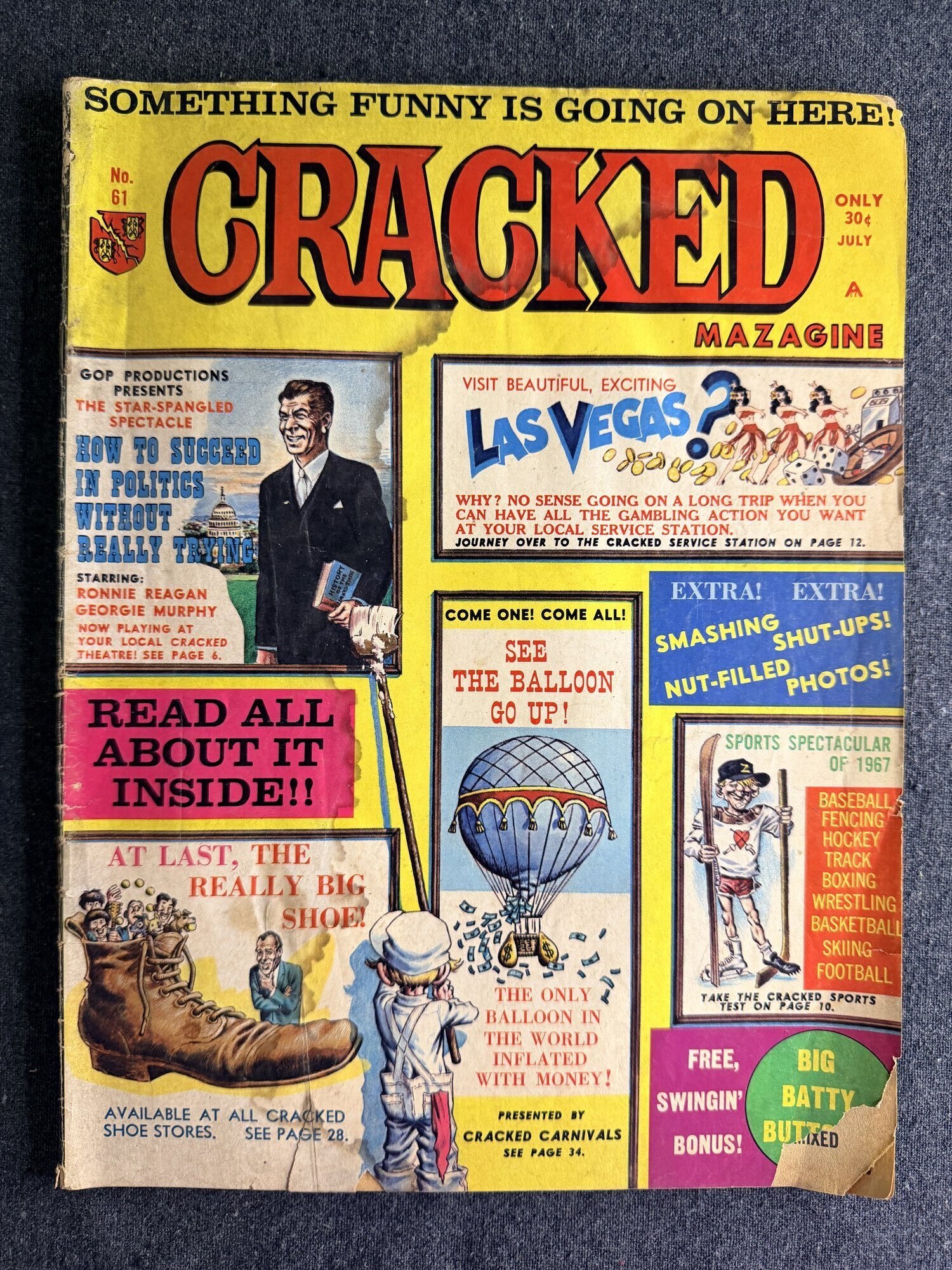
CRACKED #61
Cracked #61 (Major Magazines, July 1967) — Silver Age MAD-style satire magazine with John Severin artwork.
// Unit specification
| Publisher | Cover date | Era | Variant | Key attribute | Status |
|---|---|---|---|---|---|
| Major Magazines | July 1967 | Silver | — | — | AVAILABLE |
// Copies in archive
| Unit | Grade | Variant | Status |
|---|---|---|---|
| ECA-000816 | ~2.5 | — | AVAILABLE |
// Condition analysis
This pre-1977 magazine-format humor comic shows significant wear: a large chunk missing from the upper right corner with a visible tear/chip through the cover stock, moisture staining along the left edge that has caused discoloration and slight cover distortion, and general surface wear with soft corners throughout. There are also faint stains near the center-left of the cover. Spine area is not clearly visible in this shot. Interior and back cover were not assessed, so grade reflects front cover defects only.
// Valuation — market reference
| Bracket | Grade | Est. market value | Marker |
|---|---|---|---|
| LOW_RAW | 0.5 – 1.5 | $6 | |
| MID_RAW | 4.0 – 6.0 | $18 | |
| HIGH_CERT | 9.8 SLAB | $225 |
// Archive commentary
Cracked #61 is a mid-run issue of Major Magazines' long-running satire title, launched in 1958 as the most durable of the many magazines chasing MAD's success. By 1967 the book had settled into its signature formula of movie and television parodies, gag features, and mascot Sylvester P. Smythe, anchored by the meticulous line work of John Severin, whose detailed illustration defined the magazine's look for decades. As a standard newsstand humor magazine rather than a comic book, it sits outside the superhero-driven Silver Age market and is collected primarily for nostalgia and completeness.
The market for this issue is quiet and driven almost entirely by raw copies changing hands through general online marketplaces. Demand is steady but shallow: buyers are run collectors and nostalgia purchasers, not speculators, and certified examples are scarce because the cost of grading a humor magazine rarely justifies the return. Condition sensitivity is high, since magazine-format paper, spine roll, and mailing labels commonly depress grades, making genuinely high-grade copies disproportionately hard to locate even if the underlying demand is modest.
Collecting outlook favors patient assembly of runs rather than single-issue investment. Low- and mid-grade copies trade readily and cheaply, appealing to readers and set builders, while a certified high-grade slab is a niche purchase that commands a substantial premium mostly on rarity of preservation. This is a solid mid-run periodical rather than a key, and it should be catalogued and priced accordingly.
INQUIRE_ABOUT_THIS_UNIT
Institutional buyers, auction houses, and private collectors — direct line to the archive.