Approximate
Condition Profile
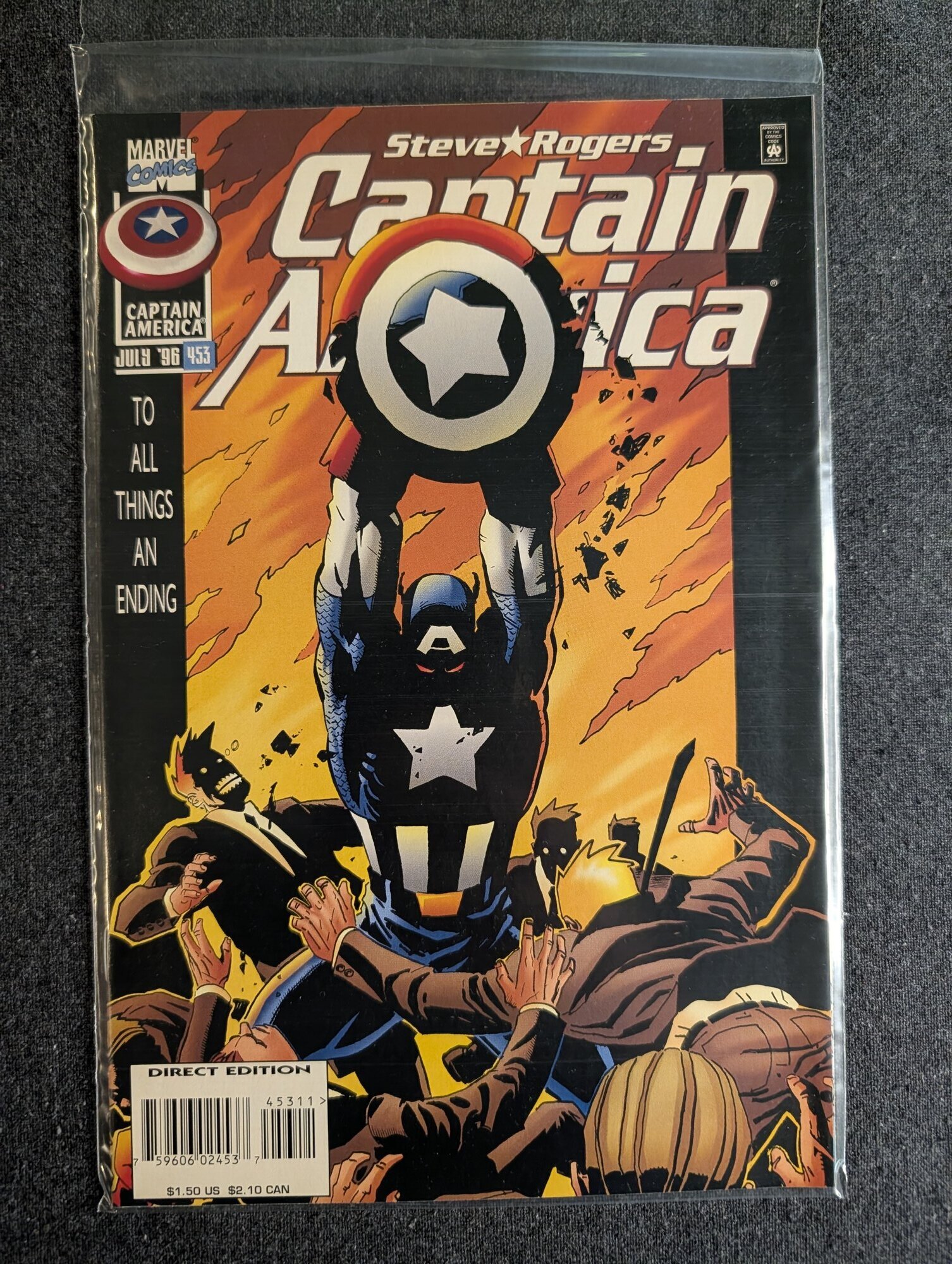
MARVEL COMICS · 7/96 · DIRECT EDITION
UNIT ECA-005066
CAPTAIN AMERICA #453
Penultimate issue of the original Captain America volume, from the Mark Waid and Ron Garney "Man Without a Country" arc
// Unit specification
| Publisher | Cover date | Era | Variant | Key attribute | Status |
|---|---|---|---|---|---|
| Marvel Comics | July 1996 | Modern | Direct Edition | — | AVAILABLE |
// Copies in archive
| Unit | Grade | Variant | Status |
|---|---|---|---|
| ECA-005066 | ~9.2 | Direct Edition | AVAILABLE |
| ECA-026959 | ~9.2 | Direct Edition | AVAILABLE |
| ECA-005068 | ~9.0 | Direct Edition | AVAILABLE |
// Run position
// Condition analysis
Cover shows strong gloss and vibrant color with sharp corners and no visible creasing or spine stress in this photo; the book is protected in a plastic sleeve which limits full surface inspection due to slight glare. No tears, folds, or discoloration are apparent along the visible edges. Interior pages and back cover were not assessed, so grade is based solely on the front cover appearance.
// Valuation — market reference
| Bracket | Grade | Est. market value | Marker |
|---|---|---|---|
| LOW_RAW | 0.5 – 1.5 | $1 | |
| MID_RAW | 4.0 – 6.0 | $3 | |
| HIGH_CERT | 9.8 SLAB | $60 |
// Archive commentary
Published with a July 1996 cover date, Captain America #453 falls near the close of the title's original 1968-1996 numbering. Mark Waid writes, with pencils by Ron Garney and Pino Rinaldi, inks by Scott Koblish, and color by John Kalisz. The issue belongs to the "Man Without a Country" storyline, in which Steve Rogers is stripped of his citizenship and forced to operate abroad while Machinesmith advances a scheme against a S.H.I.E.L.D. helicarrier. The Waid-Garney partnership is well regarded among readers of the period for restoring a straightforward heroic register to the character after the Fighting Chance years, and this run is the immediate lead-in to Onslaught and the Heroes Reborn relaunch, which ended the volume one issue later at #454.
Commercially the book behaves like the rest of the era: print runs were small by earlier standards, but survival rates in high grade are high because most copies were bought by direct-market collectors and bagged on arrival. Raw copies move as run filler and are commonly absorbed into lot sales rather than sold individually. What demand exists is driven by two narrow constituencies, collectors assembling a complete original-volume run and readers following the Waid-Garney arc into its conclusion, neither of which supports meaningful price pressure. Certified copies are scarce on the census not because the book is hard to find in top condition but because grading fees exceed any plausible return, which is precisely why the handful of 9.8 examples that do surface trade well above the raw market.
This is a run book, not a key. Buyers are completists, Waid or Garney followers, and dealers filling want lists; the practical trading pattern is a low flat price across every raw grade band, with condition mattering only at the extremes. The one place where grade genuinely changes the equation is the top of the scale, where a certified near-mint copy becomes a registry-style purchase rather than a reading copy. Anyone building the final years of volume one should expect to source this issue easily and cheaply in raw form, and to pay a disproportionate multiple only if a slabbed example is required.
INQUIRE_ABOUT_THIS_UNIT
Institutional buyers, auction houses, and private collectors — direct line to the archive.