Approximate
Condition Profile
MARVEL COMICS · 9/01 · DIRECT EDITION
UNIT ECA-006096
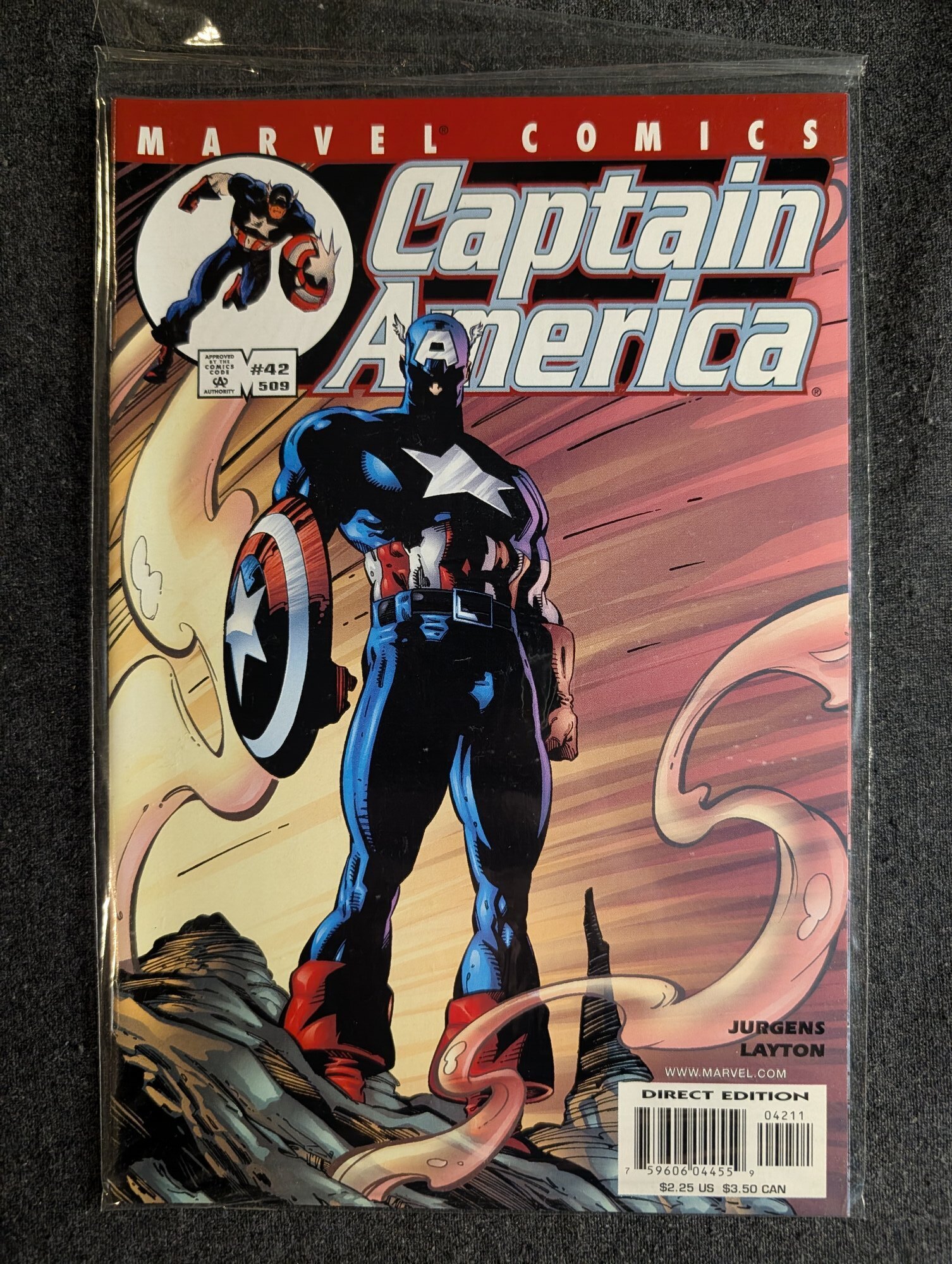
CAPTAIN AMERICA #42
Dan Jurgens-written and -penciled Cap issue with the Crimson Dynamo, bearing Marvel's newly reinstated legacy number 509
// Unit specification
| Publisher | Cover date | Era | Variant | Key attribute | Status |
|---|---|---|---|---|---|
| Marvel Comics | September 2001 | Modern | Direct Edition | — | AVAILABLE |
// Copies in archive
| Unit | Grade | Variant | Status |
|---|---|---|---|
| ECA-006096 | ~9.2 | Direct Edition | AVAILABLE |
// Run position
// Condition analysis
Cover shows strong gloss and sharp corners with no visible creases or spine stress lines; colors appear vibrant and unfaded. The book is protected in a plastic sleeve which limits full assessment of edges, and a small glare spot appears near the top corner from the sleeve reflection. No visible tears, stains, or writing on the front cover. Interior and back cover were not assessed, so grade is capped conservatively.
// Valuation — market reference
| Bracket | Grade | Est. market value | Marker |
|---|---|---|---|
| LOW_RAW | 0.5 – 1.5 | $1 | |
| MID_RAW | 4.0 – 6.0 | $2 | |
| HIGH_CERT | 9.8 SLAB | $40 |
// Archive commentary
Captain America #42 falls in the Dan Jurgens stretch of the third volume, with Jurgens supplying script, pencils and cover and Bob Layton inking. The chapter, "Fractured," continues the Ferrari storyline that occupied Jurgens's run, pitting Steve Rogers against a Crimson Dynamo while Sharon Carter, Nick Fury and S.H.I.E.L.D. work the espionage side of the plot. The issue also carries a piece of publishing trivia collectors track: it is part of the batch in which Marvel restored legacy numbering to its covers, making this book Captain America #509 as well as #42. No first appearance, origin or death occurs here, and the volume itself is remembered less for keys than for its steady, workmanlike superhero-spy storytelling in the years just before Marvel Knights relaunched the character.
Market behavior matches that profile. The third volume was printed in the low-circulation environment of 2001, so raw copies are not physically abundant in the way late-1980s Marvel is, yet demand is thin enough that supply comfortably exceeds it. Copies move through dealer back-issue boxes and multi-issue online lots rather than as standalone offerings, and the practical result is that condition matters very little between a well-read copy and a clean one: both trade close to the handling floor. Certification is rare because grading fees exceed any realistic resale, which means the small number of high-grade slabs that do exist are priced by the cost of getting them encapsulated rather than by collector competition for the issue itself.
Buyers are run collectors filling the 1998-2002 volume, Jurgens and Layton completists, and readers pursuing the story arc reprinted in the Jurgens omnibus. Dual-numbering collectors chasing the legacy-numbered Captain America sequence provide a modest secondary source of interest. Across grades the spread is compressed at the bottom and only widens at the certified top, so the sensible acquisition strategy is bulk purchase of unslabbed copies; paying a grading premium here is a discretionary aesthetic choice rather than a value decision, and any upside would depend on renewed attention to this era of the character rather than on the issue's own scarcity.
INQUIRE_ABOUT_THIS_UNIT
Institutional buyers, auction houses, and private collectors — direct line to the archive.