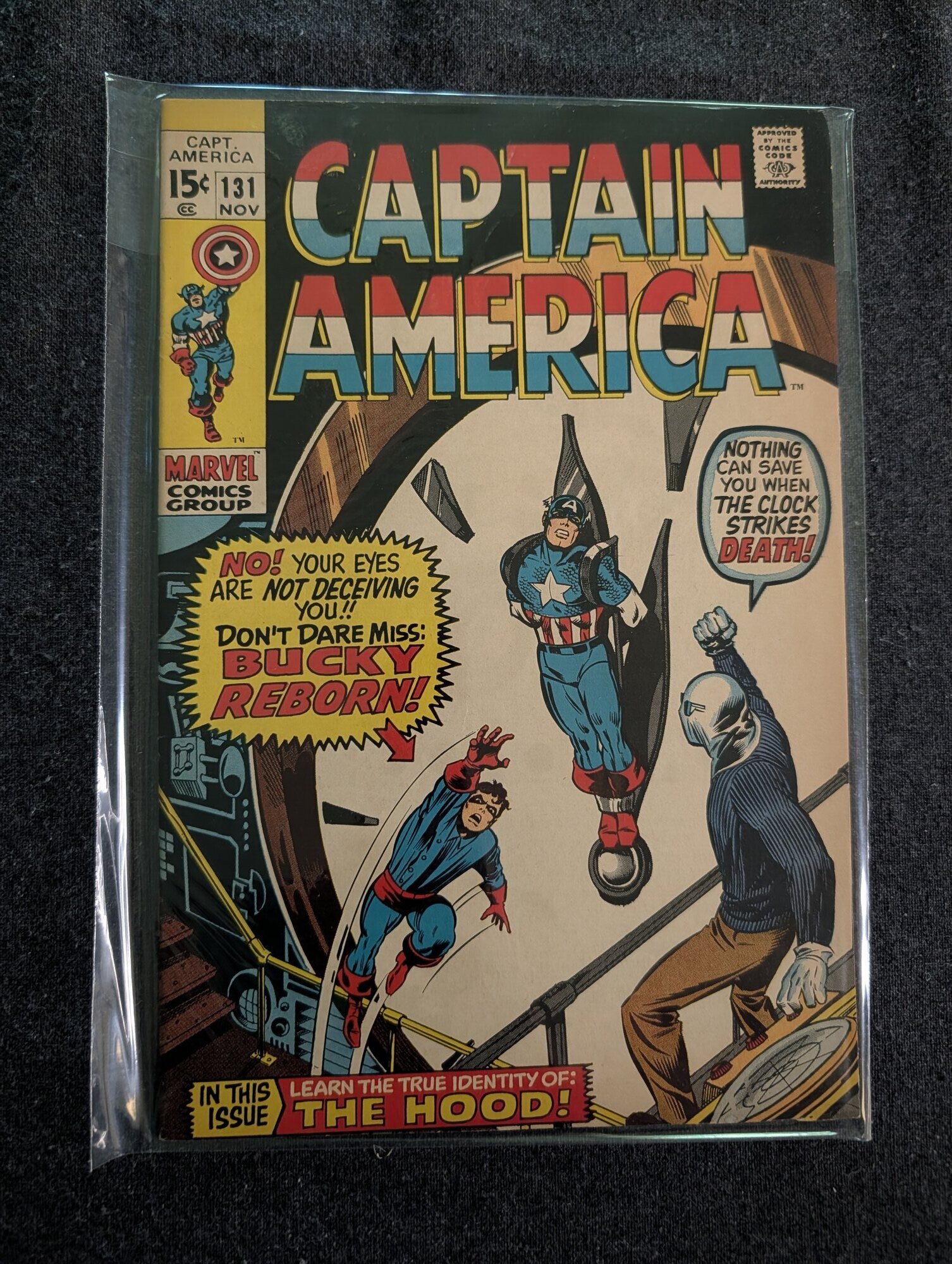
Approximate
Condition Profile
MARVEL COMICS · 11/70
UNIT ECA-013742
CAPTAIN AMERICA #131
Bronze Age Captain America ongoing issue from the Gary Friedrich/Gene Colan run, cover-dated November 1970
// Unit specification
| Publisher | Cover date | Era | Variant | Key attribute | Status |
|---|---|---|---|---|---|
| Marvel Comics | November 1970 | Bronze | — | — | AVAILABLE |
// Copies in archive
| Unit | Grade | Variant | Status |
|---|---|---|---|
| ECA-013742 | ~7.5 | — | AVAILABLE |
// Run position
// Condition analysis
Cover shows strong gloss and bright color with sharp corners overall; slight softening visible at the top right corner and minor edge wear along the top and right border. There is a faint vertical crease/waviness near the left edge of the cover and slight spine stress at the top of the spine, but no major color breaks are evident. The book is in a protective sleeve, obscuring fine surface detail; interior pages and back cover were not assessed.
// Valuation — market reference
| Bracket | Grade | Est. market value | Marker |
|---|---|---|---|
| LOW_RAW | 0.5 – 1.5 | $13 | |
| MID_RAW | 4.0 – 6.0 | $20 | |
| HIGH_CERT | 9.8 SLAB | $450 |
// Archive commentary
Captain America #131 arrived during the early Bronze Age stretch of the Star-Spangled Avenger's solo title, produced in the period when Gary Friedrich handled scripting duties and Gene Colan's kinetic, shadow-heavy pencils defined the book's visual identity. The issue sits within the run leading up to the title's rebrand as Captain America and the Falcon, a stretch collectors track for the deepening partnership between Cap and Sam Wilson as Marvel began building toward greater diversity in its central superhero line. It carries no first appearance, death, or origin moment, and its cover is not among the guides' widely cited classics, placing it squarely as a representative rather than pivotal issue of the run.
Demand centers on completists building the 1968-1978 Captain America volume 1 run and Gene Colan admirers rather than speculators chasing a key. The FMV curve is instructive: values stay compressed and modest through the mid grades, with 8.0 and below all clustering in the low-$20s to low-$30s range, then begin to separate meaningfully at 9.0 and above as census population thins. The jump from 9.4 to 9.6 nearly doubles value, and the near-total absence of certified 9.8s (seven copies, effectively no trackable sales) signals that top-end demand is real but supply-starved, a pattern typical of common Bronze Age issues that were not preserved with modern care standards.
This is a book for run-builders and Colan/Friedrich-era Cap collectors rather than investment-grade key hunters. Raw copies in low and mid grades trade as inexpensive filler, priced for accessibility rather than scarcity, and most transacting happens in bulk lots or as part of larger run acquisitions. At the top of the certified population, however, the thin 9.6-9.8 tier rewards patience: with so few high-grade copies existing, a genuine 9.8 would likely draw competitive bidding disproportionate to the issue's modest mid-grade footprint, making the extremes of the grade spectrum the only points where this book behaves like anything other than a common vintage backfill title.
INQUIRE_ABOUT_THIS_UNIT
Institutional buyers, auction houses, and private collectors — direct line to the archive.