Approximate
Condition Profile
DC COMICS · 10/59
UNIT ECA-037914
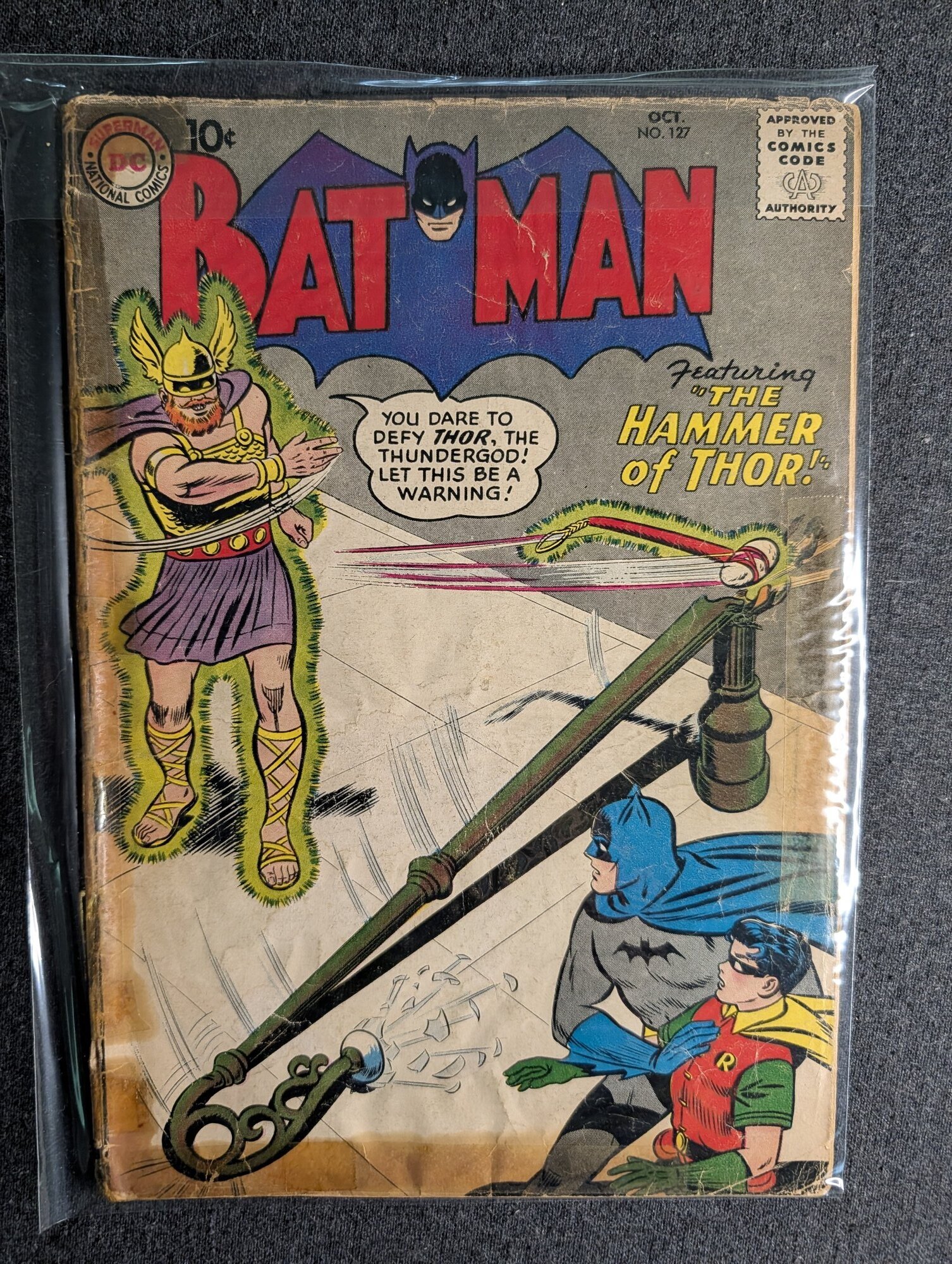
BATMAN #127
Standard Silver Age Batman anthology issue, October 1959, with no 9.8 yet recorded on the certified census
// Unit specification
// Copies in archive
| Unit | Grade | Variant | Status |
|---|---|---|---|
| ECA-037914 | ~2.5 | — | AVAILABLE |
// Run position
// Condition analysis
This 1959 Golden/Silver Age issue shows significant wear consistent with its age: heavy spine stress with multiple tears and roll along the spine edge, notable creasing and a chip at the top left corner, staining and discoloration across the cover (especially bottom right corner darkening), and general surface wear with color rubbing on the spine and edges. There is also a visible tear/split at the bottom left spine area. Interior and back cover were not assessed from this photo, and the book appears to be in a protective sleeve which may obscure some minor edge wear.
// Valuation — market reference
| Bracket | Grade | Est. market value | Marker |
|---|---|---|---|
| LOW_RAW | 0.5 – 1.5 | $50 | |
| MID_RAW | 4.0 – 6.0 | $112 | |
| HIGH_CERT | 9.8 SLAB | $13,500 |
// Archive commentary
Batman #127 arrived in October 1959, deep in the anthology-format era of the Batman title when each issue typically bundled two or three short adventures of Batman and Robin rather than a single extended arc. Editorial oversight fell to Jack Schiff, with contributions from the era's regular Bat-office talent, including Bill Finger on scripts and Sheldon Moldoff ghosting pencils under the studio's Bob Kane credit, with Charles Paris supplying inks — the standard creative pipeline for Batman comics of the late 1950s. The issue carries no first appearance, death, or origin story that collectors or price guides single out, placing it squarely among the run's serviceable, well-crafted but non-key issues from the pre-New Look period.
Demand for the book tracks general Silver Age Batman collecting rather than any key-driven spike. The certified population is substantial — over 150 CGC Universal copies — with the bulk of activity clustered in the 3.0 to 7.5 range, where sale prices sit close together and grade-to-grade gains are modest. Above 8.0, however, the FMV curve steepens sharply: each half-grade increment roughly doubles in price, and copies at 9.0 and above become scarce, with only a handful graded 9.0 or higher and none yet certified at 9.8. That absence of a top-of-census slab is itself a market factor, meaning any future 9.6 or 9.8 submission would likely command a premium disproportionate to the existing curve.
The book suits generalist Silver Age Batman collectors building a run rather than key-issue speculators, and it functions well as an affordable, attractive title-page entry for a longer box or binder collection. Raw copies in low and mid grades trade steadily but without urgency, reflecting ample supply and no speculative pressure. High-grade copies are a different market entirely: with population thinning quickly above 8.5 and no certified 9.8 to anchor pricing, a top-tier submission would draw competitive bidding from census-completists and high-grade Batman specialists, making the top of the grade curve the primary source of any real appreciation for this issue.
INQUIRE_ABOUT_THIS_UNIT
Institutional buyers, auction houses, and private collectors — direct line to the archive.