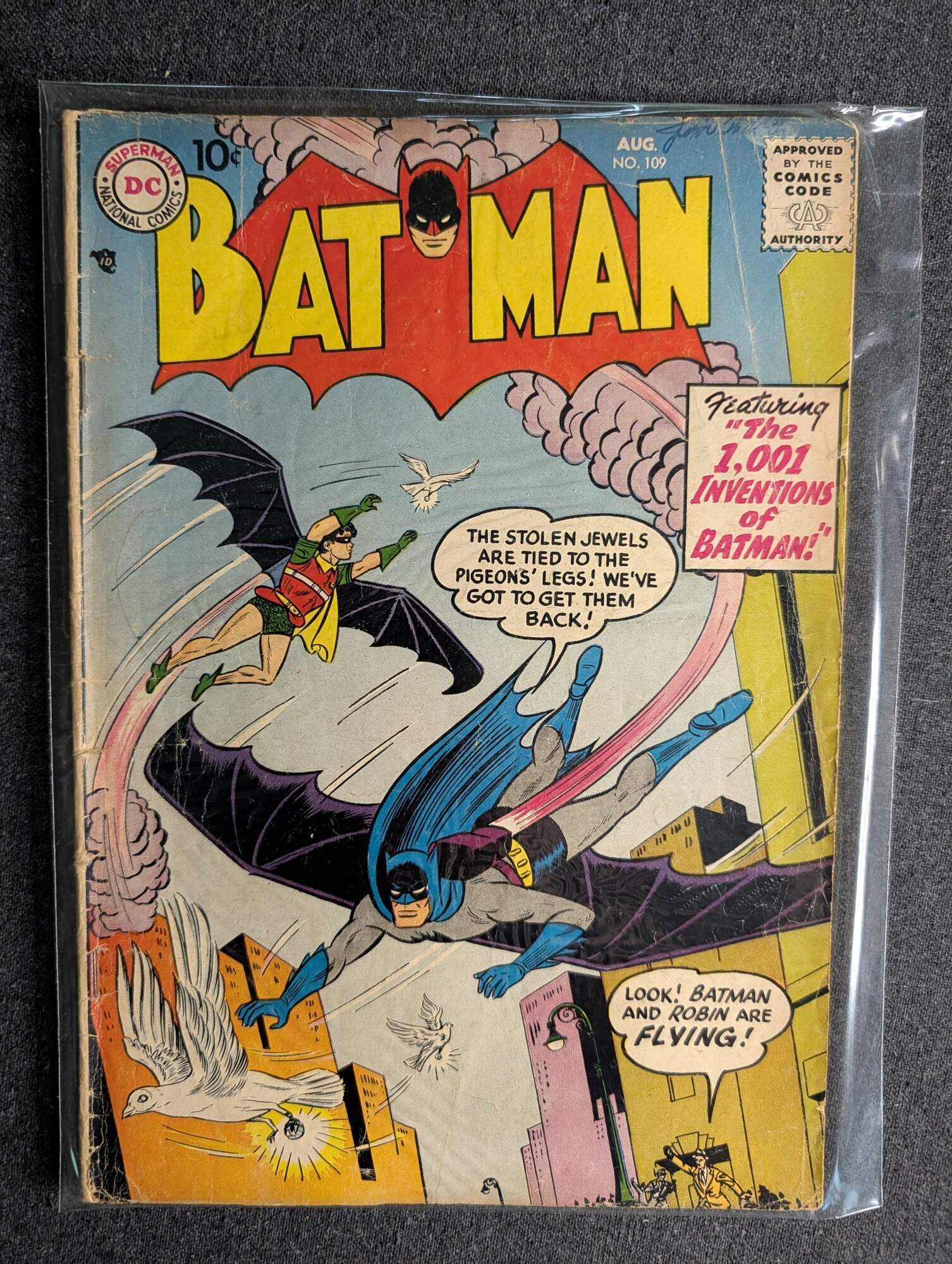
Approximate
Condition Profile
DC COMICS · 8/57
UNIT ECA-038394
BATMAN #109
Three 1957 Batman stories, including “The 1,001 Inventions of Batman”
// Unit specification
// Copies in archive
| Unit | Grade | Variant | Status |
|---|---|---|---|
| ECA-038394 | ~3.0 | — | AVAILABLE |
| ECA-040063 | ~1.5 | — | LISTED ON EBAY ↗ (opens eBay in a new tab) |
// Run position
// Condition analysis
Cover shows significant wear consistent with a 1950s Silver Age book: heavy spine stress with multiple ticks and small splits along the spine edge, notable creasing across the upper portion of the cover, a small tear/crease near the top right corner, and general surface wear with some soiling. Corners show blunting and rounding, particularly the top corners. There is a small pen or ink mark near the top of the cover. Interior and back cover were not assessed from this photo, and the book is housed in a protective sleeve.
// Valuation — market reference
| Bracket | Grade | Est. market value | Marker |
|---|---|---|---|
| LOW_RAW | 0.5 – 1.5 | $90 | |
| MID_RAW | 4.0 – 6.0 | $230 | |
| HIGH_CERT | 9.8 SLAB | $9,000 |
// Archive commentary
Batman #109 (DC Comics, August 1957) holds three stories: "Three Crimes Against Batman," in which a thief named Bagley uses his electromagnetic Dragon Fly craft to steal Batman-themed objects, the Bat-Signal among them; "Follow the Batman," in which a crook takes Batman's place after a Batmobile crash; and "The 1,001 Inventions of Batman," in which a copy of Batman's Flying Eye device falls into criminal hands. It is typical of the high-concept, gadget-driven storytelling DC leaned on during the mid-1950s as superhero sales cooled.
Market data shows a tight, actively traded census of 98 Universal copies, with the bulk concentrated in the 3.5 to 6.5 range and pricing that climbs sharply as grade improves — the jump from a 5.0 to a 7.0 more than triples fair market value on recent sales. Demand is driven by the general collectibility of 1950s Batman issues from a period when few copies survive above the mid-grade band. The complete absence of any certified copy at 9.2 or above, despite a substantial graded population, underscores how condition-sensitive and scarce truly high-grade examples of this era remain.
The book suits 1950s Batman collectors and generalists rounding out a run. Lower and mid-grade raw copies move steadily as reading/display pieces and trade close to the documented FMV curve, while any copy graded above the current 9.0 census ceiling would represent an unprecedented condition census entry, commanding a significant premium over any previously recorded sale for the issue.
INQUIRE_ABOUT_THIS_UNIT
Institutional buyers, auction houses, and private collectors — direct line to the archive.