Approximate
Condition Profile
DC COMICS · 5/83 · NEWSSTAND
UNIT ECA-002208
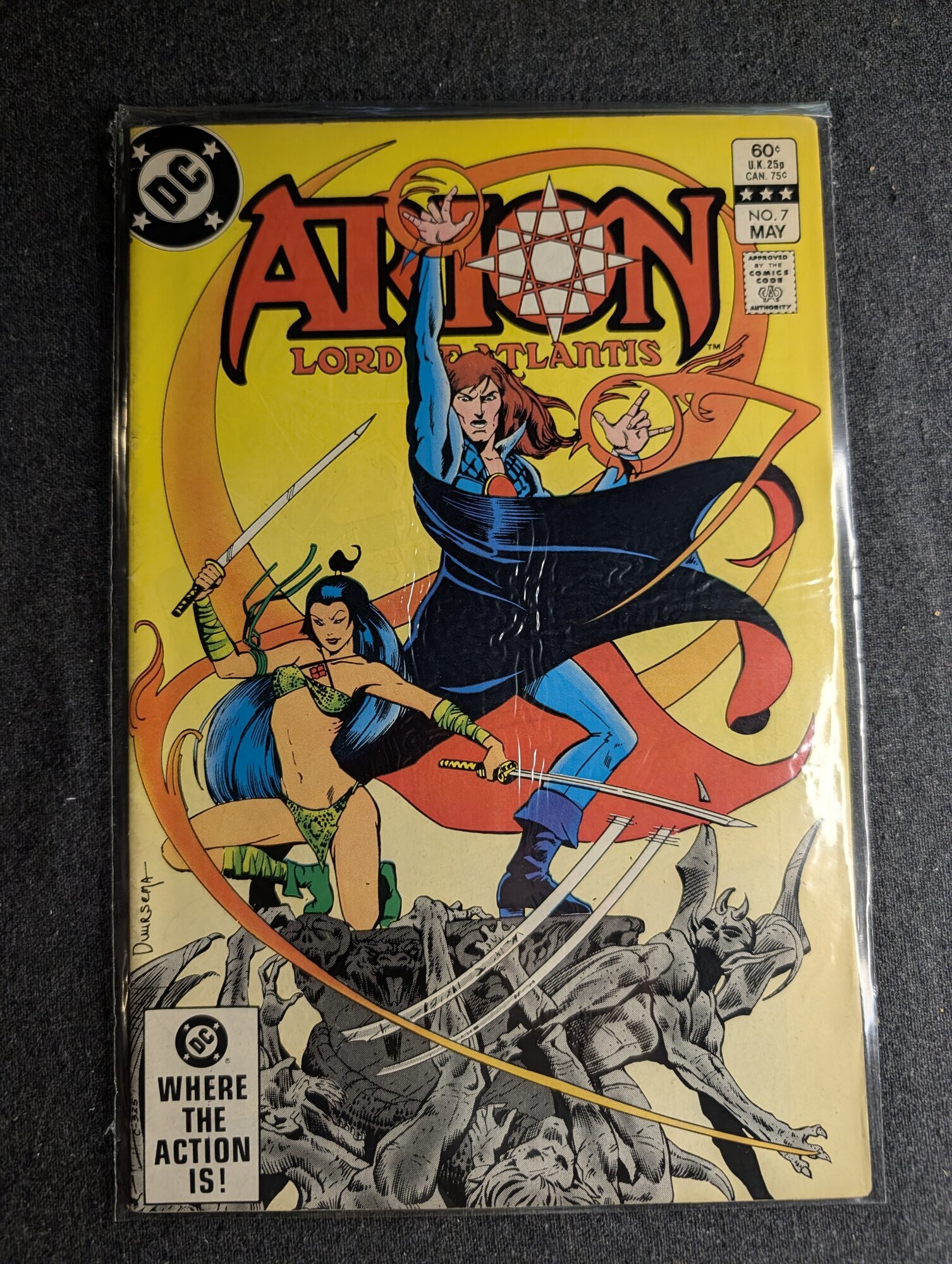
ARION, LORD OF ATLANTIS #7
Bronze Age DC sword-and-sorcery mid-run issue, "The Darkworld Demon," scripted by Doug Moench with Jan Duursema cover and pencils
// Unit specification
// Copies in archive
| Unit | Grade | Variant | Status |
|---|---|---|---|
| ECA-002208 | ~8.5 | Newsstand | AVAILABLE |
// Run position
// Condition analysis
Cover shows strong gloss and vibrant color with sharp corners and no visible creases or spine stress lines. There is a faint diagonal glare/reflection across the center that may be plastic sleeve sheen rather than a surface defect, and slight waviness near the spine edge is noted but not a hard crease. No tears, stains, or writing are visible on the front cover; interior pages and back cover were not assessed.
// Valuation — market reference
| Bracket | Grade | Est. market value | Marker |
|---|---|---|---|
| LOW_RAW | 0.5 – 1.5 | $1 | |
| MID_RAW | 4.0 – 6.0 | $3 | |
| HIGH_CERT | 9.8 SLAB | $55 |
// Archive commentary
Arion, Lord of Atlantis #7 (May 1983) falls in the middle of the guest-writing stretch in which Doug Moench took over scripting from co-creator Paul Kupperberg, with Jan Duursema supplying the cover and pencils and Tom Mandrake inking. The story, "The Darkworld Demon," sends the Atlantean sorcerer and his companions Lady Chian and Wyynde into an underground city, continuing the run's blend of pre-cataclysm Atlantean politics and occult menace. Arion had been created by Kupperberg and Duursema as a Warlord back-up feature two years earlier and graduated to his own title in late 1982; this issue carries no first appearance, origin, or death, and its interest rests on the Moench interlude and on Duursema's early professional work before her long association with Star Wars comics.
Market activity on this number is minimal. The title was a modest seller in its day and never developed the speculative following that attaches to DC's other Bronze Age fantasy books, so raw copies circulate as back stock and in multi-issue lots rather than as individually tracked sales. Certification is correspondingly rare — the census for mid-run Arion issues is thin to empty, which means high-grade valuation is a matter of inference from the series' first issue and from Warlord #55 rather than from any comparable sale of #7 itself. The newsstand designation carries no premium here: in 1983 newsstand distribution still accounted for the bulk of DC's print run, and direct-market copies of this title are the scarcer of the two formats.
Buyers are run collectors completing the 35-issue series, Duursema and Mandrake completists, and readers pursuing Moench's DC work of the period. Across the grade spectrum the book behaves like most non-key early-1980s DC: low- and mid-grade copies are effectively interchangeable and priced as filler, while the entire premium sits in genuinely high-grade, well-centered copies with sharp spines — a narrow slice of the surviving population given the era's press quality. Slabbing is difficult to justify economically unless a copy is a strong candidate for the top of a very small census, and even then liquidity is limited to a handful of interested collectors at any given time.
INQUIRE_ABOUT_THIS_UNIT
Institutional buyers, auction houses, and private collectors — direct line to the archive.