Approximate
Condition Profile
DC COMICS · 9/63
UNIT ECA-001332
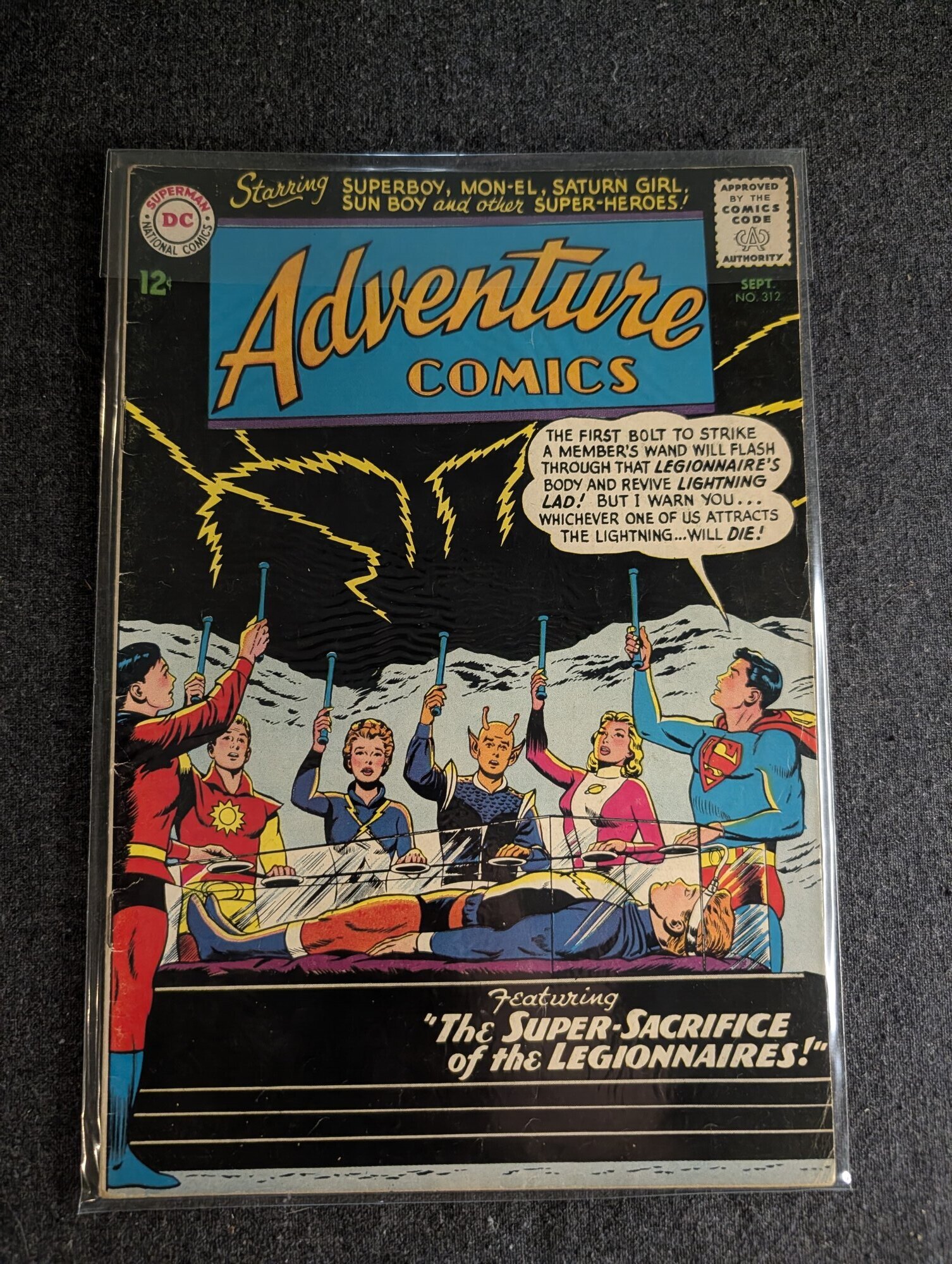
ADVENTURE COMICS #312
Conclusion of the Death of Lightning Lad arc — Lightning Lad revived and Proty sacrificed, Curt Swan cover
// Unit specification
| Publisher | Cover date | Era | Variant | Key attribute | Status |
|---|---|---|---|---|---|
| DC Comics | September 1963 | Silver | — | Resurrection of Lightning Lad, killed in Adventure Comics #304; death of Proty; concludes the four-part Death of Lightning Lad storyline; early Legion of Super-Heroes lead feature; Curt Swan cover | AVAILABLE |
// Run position
// Condition analysis
This 1963 pre-direct/newsstand-split issue shows moderate wear: rounded and slightly frayed corners, a visible crease/soft spine roll near the top left, and a small stain or discoloration in the upper left corner of the cover. The spine shows some minor ticking and stress along its length, and the overall gloss appears diminished with light surface wear consistent with handling. The book is in a protective sleeve, so edges are somewhat obscured, and interior pages and back cover were not assessed.
// Valuation — market reference
| Bracket | Grade | Est. market value | Marker |
|---|---|---|---|
| LOW_RAW | 0.5 – 1.5 | $22 | |
| MID_RAW | 4.0 – 6.0 | $70 | |
| HIGH_CERT | 9.8 SLAB | $2,400 |
// Archive commentary
Adventure Comics #312 closes out the four-part Legion of Super-Heroes storyline that began with Lightning Lad's death in issue #304 and continued through #305 and #308. Edmond Hamilton scripts and John Forte draws "The Super-Sacrifice of the Legionnaires!", in which the Legion attempts a resurrection ritual that requires a member to trade lives with the fallen Lightning Lad; Proty, Chameleon Boy's shape-changing pet, takes the sacrifice in secret, and Lightning Lad returns to the roster. The cover is penciled by Curt Swan with inks by George Klein, and the issue sits in the early stretch of the Legion's tenure as the lead feature in Adventure Comics, the run that turned a Superboy backup concept into DC's most heavily followed team property of the decade. Death, resurrection, and consequence handled this seriously were uncommon in early-1960s DC superhero comics, and the sequence is regularly cited as the moment the Legion's future setting acquired real narrative weight.
Demand comes almost entirely from Legion completists and Silver Age DC collectors assembling the Adventure run from #300 forward, and the pricing reflects that: the book trades as a secondary story key, well behind #247, #300, #346, and the Legion first appearances, but consistently above ordinary mid-run issues of the same period. Twelve-cent DC newsstand distribution means surviving copies skew to mid grades with the usual spine and corner wear, and mid-grade raw copies turn over steadily on eBay and dealer sites without needing to be promoted. Certified activity concentrates in the 6.0 to 9.0 range; genuinely high-grade certified copies appear infrequently enough that individual sales move the perceived ceiling, and buyers at that level are typically registry participants rather than readers.
The collecting outlook is stable rather than dynamic. Low-grade copies function as affordable run fillers and reader placeholders, mid grades represent the practical sweet spot where most transactions occur, and the top of the census is a thin, event-driven market where a single strong result can reset expectations in either direction. Renewed screen or publishing attention to the Legion would lift the whole early Adventure run, this issue included, but in the absence of that catalyst the book behaves like what it is: a well-documented story key in a series with a durable, knowledgeable collector base and limited speculative froth.
// Copies in archive
| Unit | Grade | Variant | Status |
|---|---|---|---|
| ECA-001332 | ~4.0 | — | AVAILABLE |
INQUIRE_ABOUT_THIS_UNIT
Institutional buyers, auction houses, and private collectors — direct line to the archive.