Approximate
Condition Profile
DC COMICS · 10/63
UNIT ECA-008129
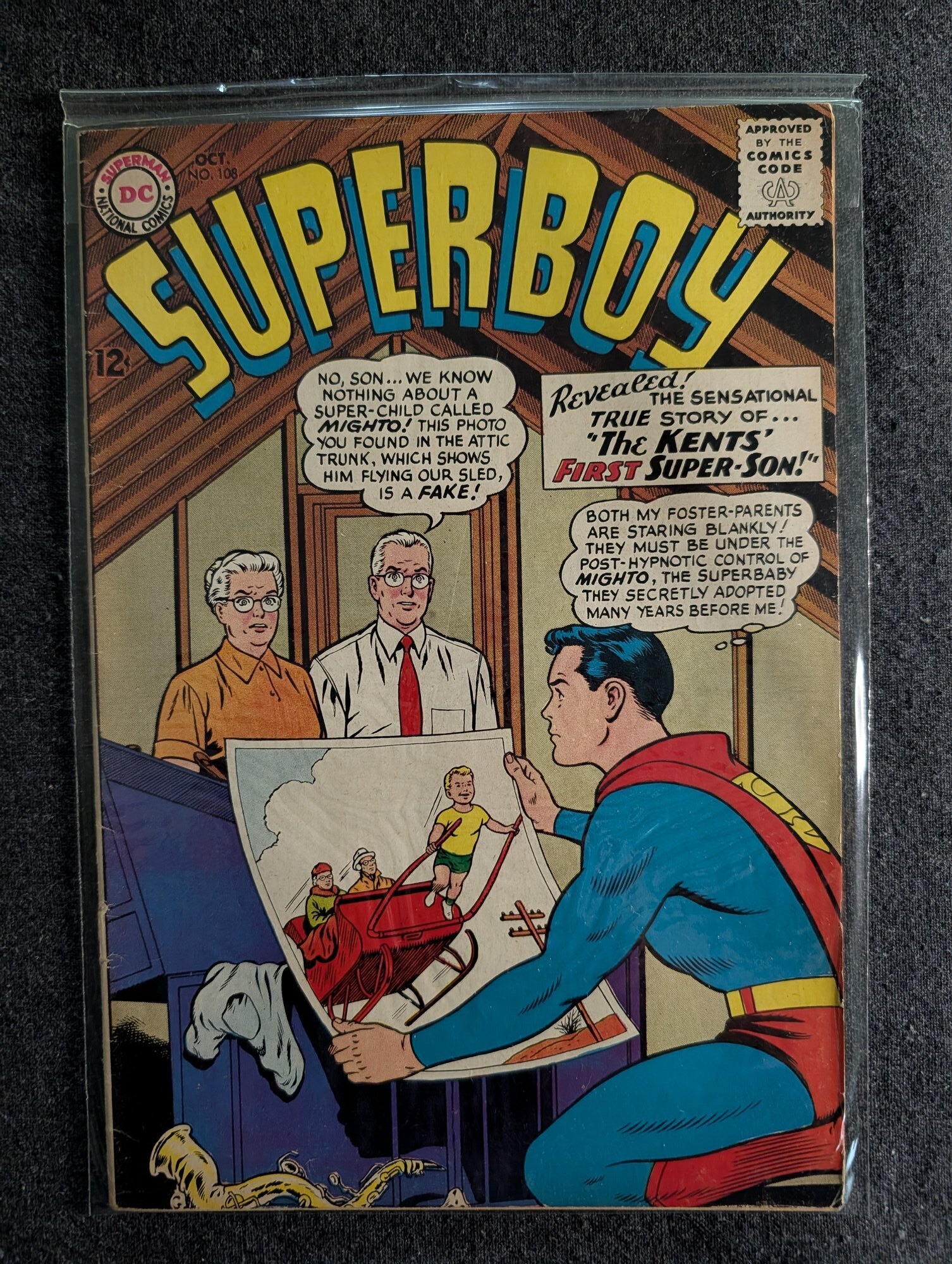
SUPERBOY #108
Mid-run Silver Age Superboy with Curt Swan cover, introducing Mighto and featuring the "Sorcery Boy" time-travel tale
// Unit specification
// Run position
// Condition analysis
Cover shows moderate wear consistent with a Silver Age book: soft, rounded corners, visible spine stress with light color break at the top and bottom of the spine, and general surface wear/scuffing across the cover. There is mild edge wear along the right border and some minor creasing near the top edge. The book is in a protective sleeve, which obscures fine texture detail; interior pages and back cover were not assessed.
// Valuation — market reference
| Bracket | Grade | Est. market value | Marker |
|---|---|---|---|
| LOW_RAW | 0.5 – 1.5 | $6 | |
| MID_RAW | 4.0 – 6.0 | $16 | |
| HIGH_CERT | 9.8 SLAB | $600 |
// Archive commentary
Superboy #108, cover-dated October 1963 and edited by Mort Weisinger, is a two-story issue from the heart of the Weisinger Superman office's continuity-building period. "The Kents' First Super-Son!" reveals that Jonathan and Martha Kent had raised a super-powered boy named Mighto before Kal-El's arrival, a retroactive wrinkle in the Smallville mythology that turns on hypnotic memory tampering rather than on any lasting addition to the cast. The backup, "The Mystery of Sorcery Boy!", sends Superboy to 1680 New England, where he is adopted by colonial-era Kents and mistaken for a sorcerer, and introduces the Luthor-resembling Bald-Pate Highwayman. George Papp handles interior art in his long-running house style, Curt Swan and George Klein supply the cover, and Henry Boltinoff contributes a Super-Turtle humor page. The issue records no first appearance of consequence and is not cited as a key by the standard guides.
Demand here is run-collector demand. Superboy volume one is widely assembled by Superman-family completists and by Legion of Super-Heroes collectors working outward from Adventure Comics, and issues in the #100-120 band trade steadily but quietly, with condition rather than content setting price. Raw copies surface regularly enough that mid-grade examples clear at modest levels, and the market shows little willingness to pay above guide for a non-key from this stretch. The upper end behaves differently: twelve-cent DC titles of this vintage were read and discarded at scale, certified populations for Superboy remain shallow, and top-census copies are scarce enough that grade alone carries the price. That scarcity, not story content, is the whole argument for the high bracket.
Buyers divide cleanly. Set builders and Silver Age readers absorb the low and mid grades, often in bulk, and are price-sensitive; registry-minded collectors and specialist dealers compete for the handful of high-census copies whenever one appears, which is infrequent. The practical consequence is a steep, discontinuous price curve with a long flat stretch from Good through Fine and a sharp climb above Very Fine. Copies in the mid range are best regarded as inexpensive run fill with predictable liquidity, while anything at the top of the census should be treated as a scarcity play whose realized price depends on who is bidding on the day.
// Copies in archive
| Unit | Grade | Variant | Status |
|---|---|---|---|
| ECA-008129 | ~4.5 | — | AVAILABLE |
| ECA-008131 | ~3.0 | — | AVAILABLE |
INQUIRE_ABOUT_THIS_UNIT
Institutional buyers, auction houses, and private collectors — direct line to the archive.