Approximate
Condition Profile
MARVEL COMICS · 8/69
UNIT ECA-006461
SGT. FURY AND HIS HOWLING COMMANDOS #69
Late Silver Age Marvel war title, John Severin cover, concluding the Hell's Kitchen storyline with Nick Fury's family
// Unit specification
| Publisher | Cover date | Era | Variant | Key attribute | Status |
|---|---|---|---|---|---|
| Marvel Comics | August 1969 | Silver | — | — | AVAILABLE |
// Condition analysis
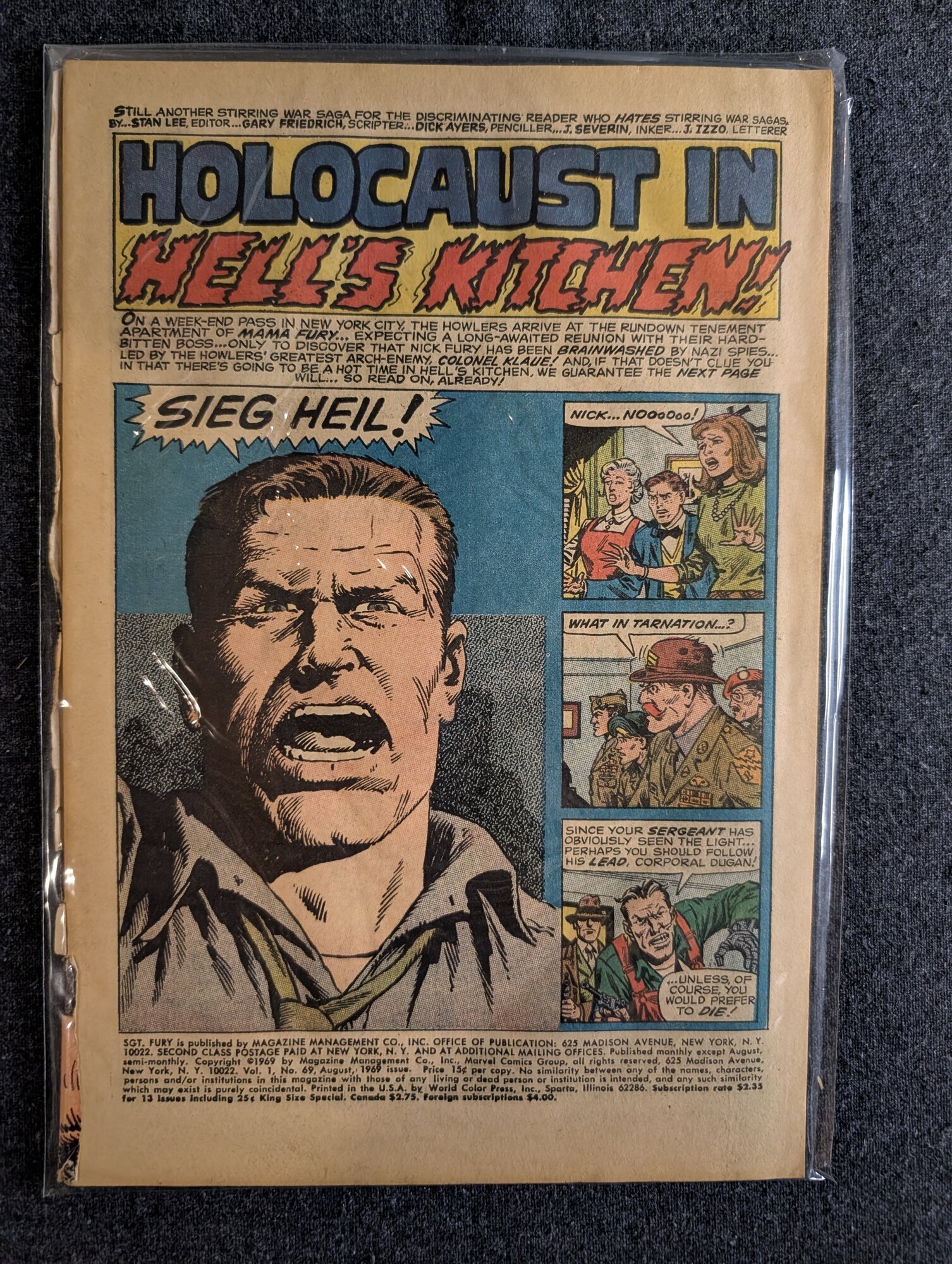
This image shows the first interior page (splash page) rather than the front cover, with the indicia confirming Sgt. Fury and his Howling Commandos Vol. 1 #69, published August 1969 by Magazine Management Co./Marvel Comics Group at 15 cents. Since the actual cover is not present in this photo, the book must be graded as coverless, which caps the grade regardless of the visible interior page's condition. The visible page shows heavy tanning/browning typical of Bronze Age newsprint, along with a visible staple and some edge wear along the spine area. Interior pages beyond this splash and the back cover were not assessed.
// Valuation — market reference
| Bracket | Grade | Est. market value | Marker |
|---|---|---|---|
| LOW_RAW | 0.5 – 1.5 | $5 | |
| MID_RAW | 4.0 – 6.0 | $14 | |
| HIGH_CERT | 9.8 SLAB | $325 |
// Archive commentary
Cover-dated August 1969, this issue closes out the two-part Hell's Kitchen sequence begun the prior month, with Gary Friedrich scripting "Holocaust in Hell's Kitchen," Dick Ayers penciling and John Severin inking and supplying the cover. The plot turns on Nick Fury drugged and brainwashed by Colonel Klaue while on stateside leave, leaving Dum-Dum Dugan and the rest of the Howlers to extract Fury's mother, sister Dawn and brother Jake from German agents; the Nazi officer Von Steurer is introduced here. The chapter is notable mainly for what it does with Fury's home life rather than for any first appearance of consequence, since Jake Fury had already been established in the espionage titles years earlier and named in the previous issue, and it stands as a representative example of the Friedrich-Ayers-Severin period that carried the book through the end of the 1960s.
Market behavior follows the pattern of the entire post-issue-60 stretch of the run: steady, unglamorous demand from set builders and war-comic readers, with pricing set by supply rather than by any speculative narrative. Copies in reading grades turn up constantly in dealer boxes and online lots, and mid-grade examples move without difficulty but without competition, so realized prices cluster tightly and have not tracked the Nick Fury character's screen exposure the way the early issues did. Certification is uncommon at this point in the run, which cuts both ways: high-grade copies are genuinely scarce on the census, but the buyer pool willing to pay a scarcity premium for a non-key late-run war book is small, and offerings at the top of the grade scale appear too infrequently to establish a reliable level.
The natural buyers are run collectors filling the back half of a Sgt. Fury set, Severin and Ayers followers, and Golden and Silver Age war specialists who value the title's later, more character-driven period. Across grades the spread is compressed, meaning a mid-grade copy costs only a modest multiple of a well-worn one, which makes solid VG/FN examples the sensible entry point for most collectors. Registry-minded buyers and those chasing top-census copies are the only participants for whom a certified high-grade example is worth pursuing, and for them acquisition timing matters more than price, since suitable copies surface rarely and are best bought when they appear.
// Copies in archive
| Unit | Grade | Variant | Status |
|---|---|---|---|
| ECA-006461 | ~0.3 | — | AVAILABLE |
INQUIRE_ABOUT_THIS_UNIT
Institutional buyers, auction houses, and private collectors — direct line to the archive.