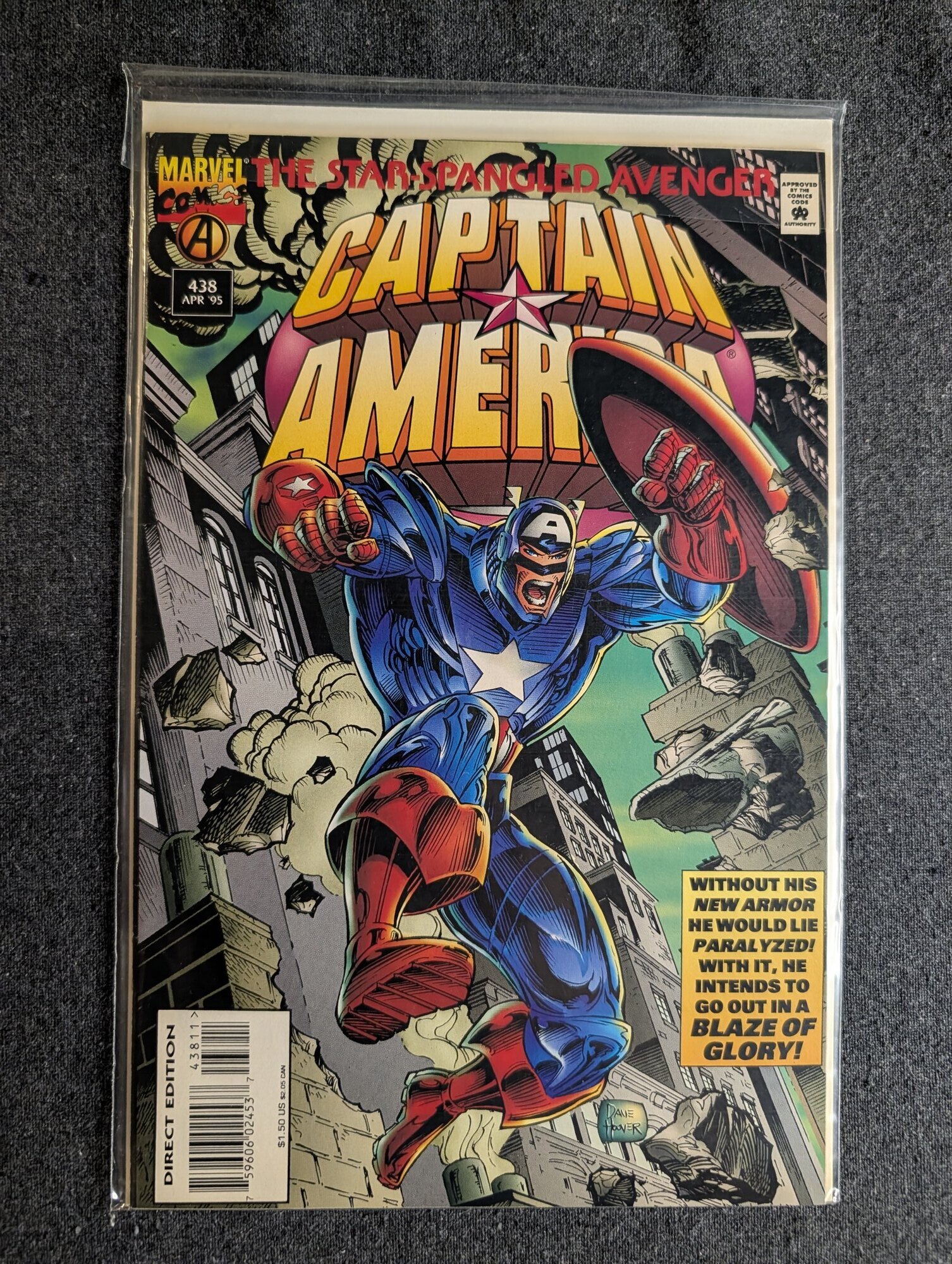
Approximate
Condition Profile
MARVEL COMICS · 4/95 · DIRECT EDITION
UNIT ECA-005801
CAPTAIN AMERICA #438
Debut of Captain America's Tony Stark-built exoskeleton armor, from the close of the Fighting Chance arc
// Unit specification
| Publisher | Cover date | Era | Variant | Key attribute | Status |
|---|---|---|---|---|---|
| Marvel Comics | April 1995 | Modern | Direct Edition | — | AVAILABLE |
// Run position
// Condition analysis
Cover shows sharp corners and clean, unbroken edges with no visible creasing or spine stress on the visible spine line. Colors appear bright and unfaded with strong gloss retained. Book is housed in a protective sleeve which limits full assessment of surface sheen; no chips, tears, or writing are visible on the front cover. Interior pages and back cover were not assessed, so grade is based solely on this front-cover photo.
// Valuation — market reference
| Bracket | Grade | Est. market value | Marker |
|---|---|---|---|
| LOW_RAW | 0.5 – 1.5 | $1 | |
| MID_RAW | 4.0 – 6.0 | $3 | |
| HIGH_CERT | 9.8 SLAB | $60 |
// Archive commentary
Cover-dated April 1995 and produced by the long-running team of writer Mark Gruenwald and penciler Dave Hoover with inks by Danny Bulanadi, Captain America #438 arrives at the crisis point of the "Fighting Chance" storyline, in which the deteriorating Super-Soldier Serum finally leaves Steve Rogers paralyzed. The issue introduces the powered exoskeleton designed by Tony Stark and Hank Pym that allows Rogers to keep operating in the field, a costume change that carried through the remainder of Gruenwald's tenure on the title. Free Spirit, Jack Flag, Flag-Smasher and ULTIMATUM figure in the story, and the armored redesign has remained a recurring reference point in discussions of Captain America's costume history.
Market behavior for the issue is that of a common 1990s Marvel direct-edition book: print runs were substantial, survivorship in high grade is good, and raw copies move in bulk lots or as single-digit fills rather than as standalone purchases. Certified activity is sparse, with only a small census and no consistent stream of slabbed sales to establish a firm ceiling, so the high-grade figure rests on the trajectory of comparable Gruenwald-era Captain America issues in top grade. Demand is driven almost entirely by costume-debut interest and by run collectors completing the 425-454 stretch, not by speculative pressure.
Buyers are largely Captain America completists, Gruenwald-run readers working through the Epic Collection material, and a narrow group of collectors who track costume and armor debuts. Across grades the book compresses sharply: raw copies from poor to very fine trade within a few dollars of one another, and essentially all of the value premium sits in certified near-mint-plus material, where scarcity of submissions rather than scarcity of copies sets the price. Any meaningful upside would depend on the exoskeleton design receiving screen or high-profile publishing attention; absent that, the issue should be catalogued as a modest run book with a footnote-level first.
// Copies in archive
| Unit | Grade | Variant | Status |
|---|---|---|---|
| ECA-005801 | ~9.4 | Direct Edition | AVAILABLE |
| ECA-005803 | ~9.2 | Direct Edition | AVAILABLE |
INQUIRE_ABOUT_THIS_UNIT
Institutional buyers, auction houses, and private collectors — direct line to the archive.