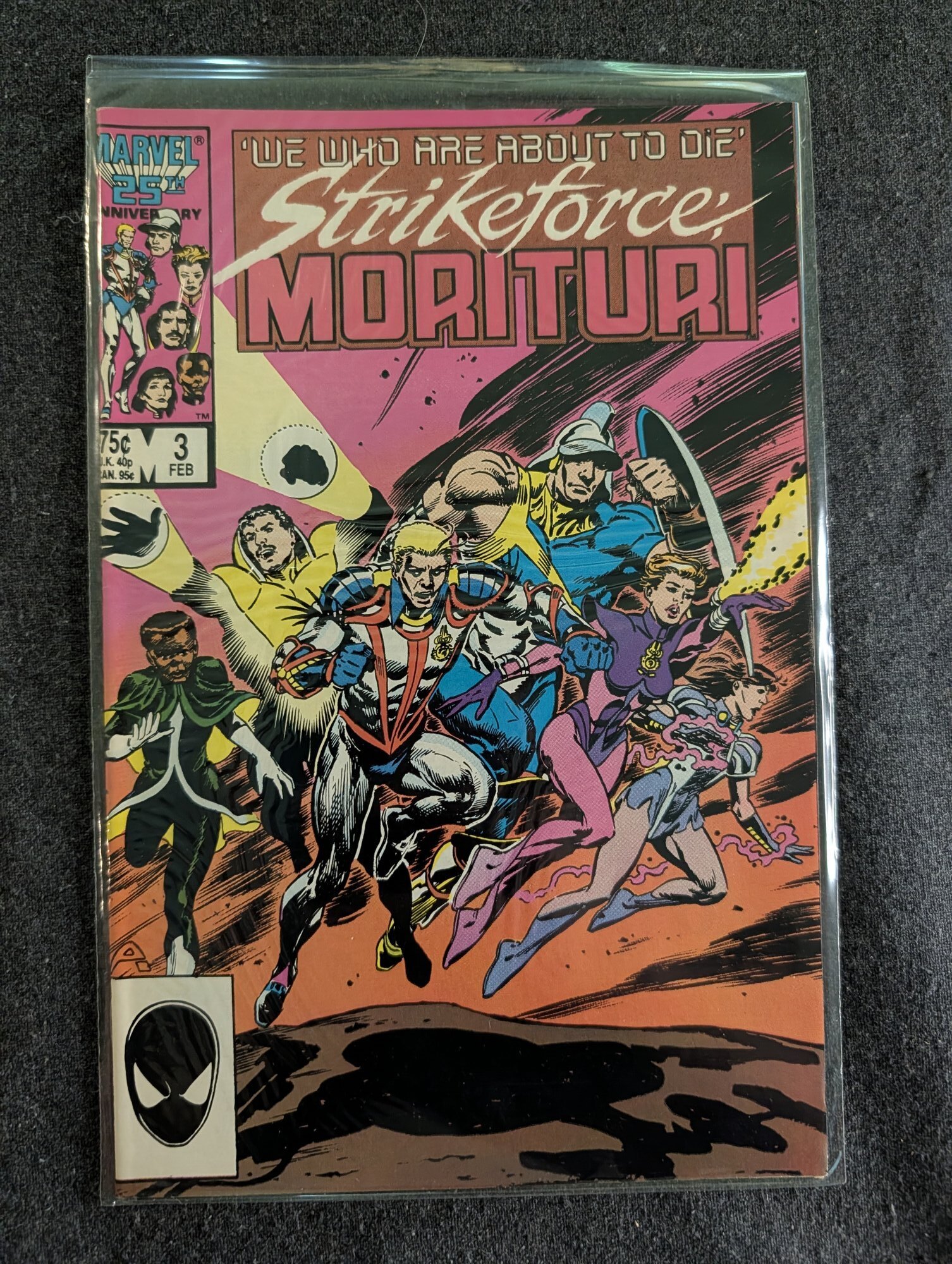
Approximate
Condition Profile
MARVEL COMICS · 2/87 · DIRECT EDITION
UNIT ECA-003136
STRIKEFORCE: MORITURI #3
Early issue of Peter Gillis and Brent Anderson's 1986 Marvel science-fiction series, direct edition
// Unit specification
| Publisher | Cover date | Era | Variant | Key attribute | Status |
|---|---|---|---|---|---|
| Marvel Comics | February 1987 | Copper | Direct Edition | — | AVAILABLE |
// Copies in archive
| Unit | Grade | Variant | Status |
|---|---|---|---|
| ECA-003136 | ~9.2 | Direct Edition | AVAILABLE |
// Run position
// Condition analysis
Cover shows strong gloss and sharp corners with no visible creases or spine stress; the Spider-Man head direct-edition logo in the lower left is clean and undamaged. Colors appear vibrant with no fading or staining visible, and edges look free of chipping in this photo. The book is in a protective sleeve which limits full assessment; interior pages and back cover were not examined, so grading is based solely on the visible front cover.
// Valuation — market reference
| Bracket | Grade | Est. market value | Marker |
|---|---|---|---|
| LOW_RAW | 0.5 – 1.5 | $1 | |
| MID_RAW | 4.0 – 6.0 | $3 | |
| HIGH_CERT | 9.8 SLAB | $60 |
// Archive commentary
Strikeforce: Morituri #3 continues the run that Peter B. Gillis and Brent Eric Anderson launched in late 1986, with Scott Williams on inks, Christie Scheele on color, and Janice Chiang lettering under editors Carl Potts and Jim Shooter. The premise — volunteers who accept superhuman powers from the Morituri process knowing it will kill them within a year of Earth's war against the alien Horde — gave Marvel a rare finite, casualty-driven series at a time when the line was dominated by open-ended franchises. This issue advances the early team roster, with Vyking, Radian, Adept, Marathon, and Snapdragon in the field alongside Dr. Kimmo Tuolema, the scientist whose process defines the book's fatalism. It is a mid-run story issue rather than a first appearance or origin, and Anderson's clean, grounded figure work here sits between his Ka-Zar and God Loves, Man Kills periods.
Market activity for the title is shallow. Print runs were healthy for 1986-87 and survival rates are high, so raw copies of the first several issues circulate constantly in dollar boxes and in complete-run lots, which is how most of this series changes hands. Certification is uncommon: the census across the run is measured in single-digit counts per issue for the top grades, which means high-grade slabs are technically scarce but not in demand, and asking prices from specialty dealers consistently outrun documented realized sales. The critical reputation of Gillis and Anderson's arc — reinforced by the later trade paperback collections — supports steady, modest reader interest without generating the speculative pressure that moves Copper Age keys.
Buyers divide into two groups: readers assembling the Gillis/Anderson run or the full thirty-one issues plus Electric Undertow, and Brent Anderson and Scott Williams completists. The former group is price-sensitive and buys in lots, which caps upside on individual raw copies in any grade below near mint. The latter occasionally pays a premium for a registry-quality slab, and because so few have been certified, a top-census example can command a figure far out of proportion to its raw value — though realizing that figure requires patience and the right venue rather than a quick marketplace flip. Low-grade copies function as reading material and lot filler; the practical dealer strategy is to move mid-grade copies in runs and reserve grading for genuinely pristine direct-edition copies only.
INQUIRE_ABOUT_THIS_UNIT
Institutional buyers, auction houses, and private collectors — direct line to the archive.