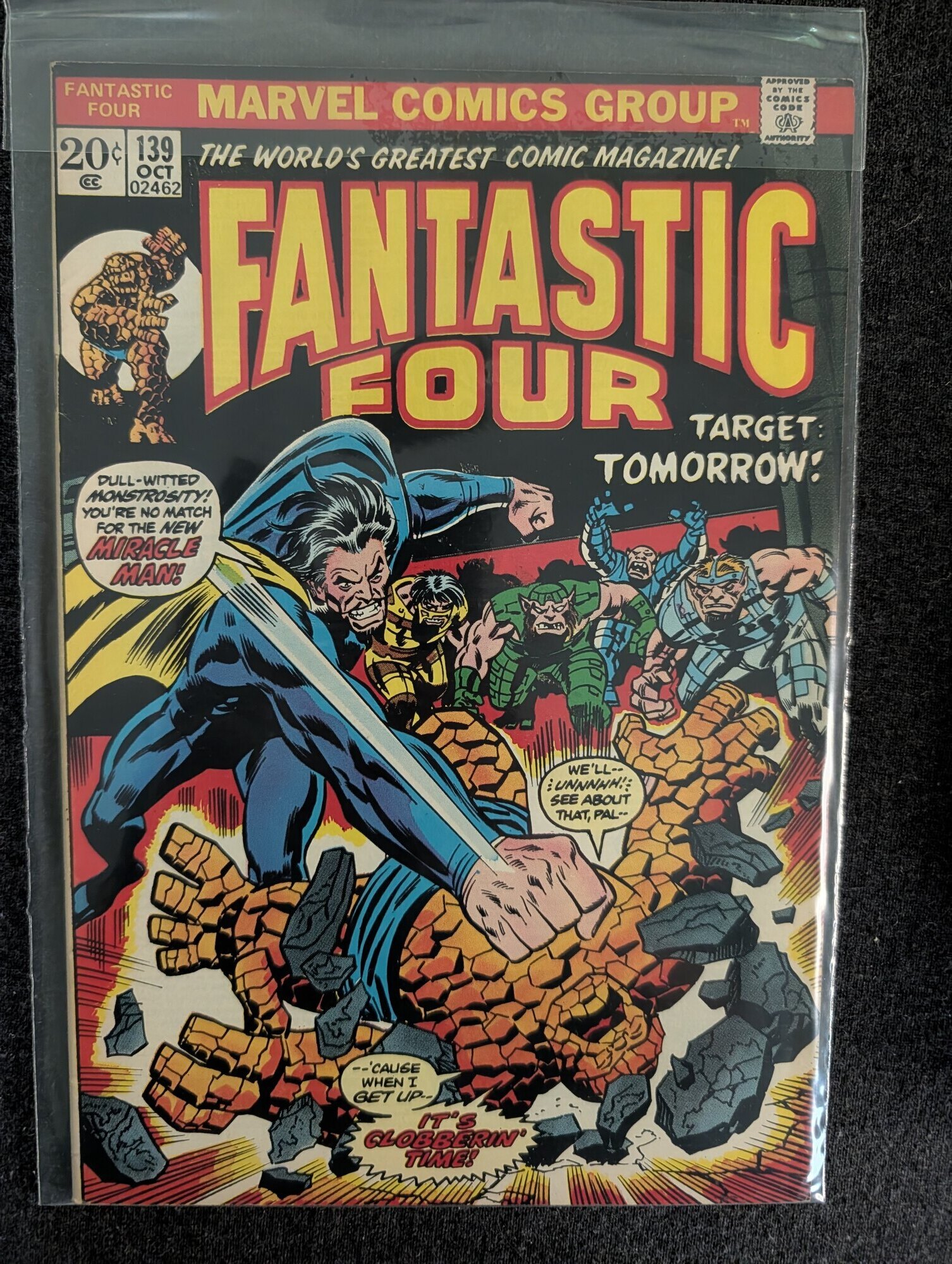
Approximate
Condition Profile
MARVEL COMICS · 10/73
UNIT ECA-028244
FANTASTIC FOUR #139
Bronze Age Fantastic Four featuring Thundra, John Buscema art
// Unit specification
| Publisher | Cover date | Era | Variant | Key attribute | Status |
|---|---|---|---|---|---|
| Marvel Comics | October 1973 | Bronze | — | — | AVAILABLE |
// Copies in archive
| Unit | Grade | Variant | Status |
|---|---|---|---|
| ECA-028244 | ~7.5 | — | AVAILABLE |
// Run position
// Condition analysis
Cover shows good gloss and bright, unfaded colors with strong ink saturation. Slight wear is visible at the top and bottom spine edges with minor whitening, and the corners show light blunting rather than sharp points. No major creases, tears, or color breaks are evident, though the book is in a protective sleeve which may obscure fine surface scuffing or minor edge wear. Interior and back cover were not assessed.
// Valuation — market reference
| Bracket | Grade | Est. market value | Marker |
|---|---|---|---|
| LOW_RAW | 0.5 – 1.5 | $5 | |
| MID_RAW | 4.0 – 6.0 | $21 | |
| HIGH_CERT | 9.8 SLAB | $425 |
// Archive commentary
Fantastic Four #139 arrived in October 1973 during Gerry Conway's run as writer, with pencils by John Buscema and inks by Joe Sinnott, continuing the storyline built around Thundra, the warrior woman introduced a few issues earlier. The issue sits within a stretch of the series often remembered for its subplot-driven soap opera pacing and recurring guest threats rather than any landmark first appearance, origin, or death. It reflects the classic Lee-Kirby-inherited FF formula carried forward by a new creative team in the early 1970s, with the team dynamic and Thundra's unresolved feud with the Thing driving the narrative.
Market data shows a typical long-tail Bronze Age curve: modest, steady demand across low and mid grades, with values compressing tightly between $20 and $35 through most of the graded population, then escalating sharply at the top of the census where high-grade survivors are scarce relative to demand. The small number of recorded 9.8 sales against a modest overall census size indicates that top-grade copies rarely reach the open market, which explains the outsized premium at that tier compared to the flat pricing seen from grades 3 through 8.5. There is no first-appearance or key-event premium at work here; the pricing behavior is driven almost entirely by condition scarcity rather than character or story significance.
This is a collectible for Fantastic Four run-builders and Bronze Age completists rather than key-issue speculators. Raw copies in low and mid grade trade cheaply and steadily as reading and filler copies for long-box collections, while CGC 9.8 slabs command a real premium reflecting genuine high-grade scarcity rather than character demand. Expect the book to move at a measured pace in any condition, with the top-grade slab as the only meaningfully volatile price point in an otherwise stable, low-key title.
INQUIRE_ABOUT_THIS_UNIT
Institutional buyers, auction houses, and private collectors — direct line to the archive.