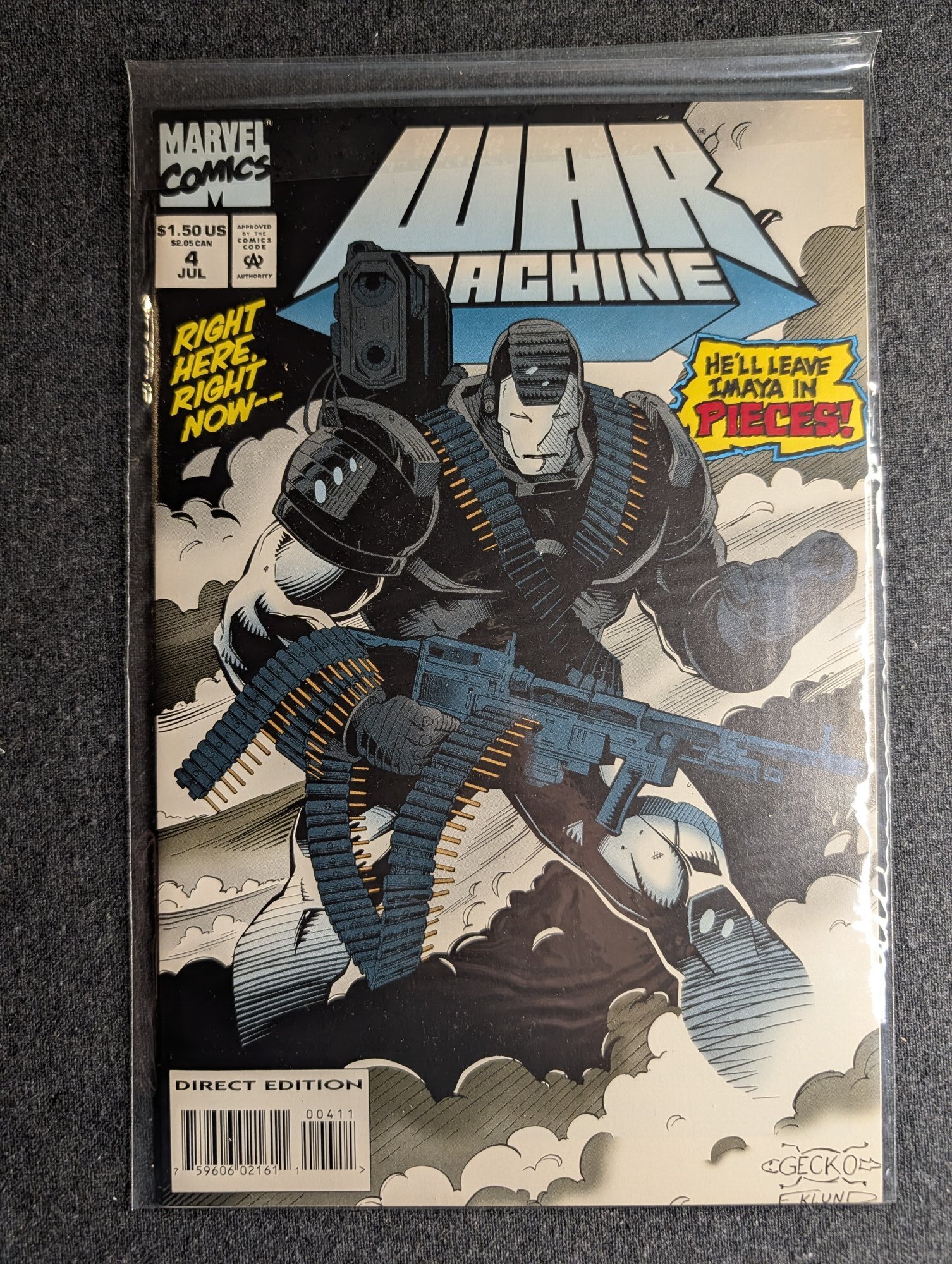
Approximate
Condition Profile
MARVEL COMICS · 7/94 · DIRECT EDITION
UNIT ECA-002724
WAR MACHINE #4
Conclusion of "Something to Believe In," with the death of Vincent Cetewayo and early art by Gabriel Hardman under his Gabriel Gecko byline
// Unit specification
| Publisher | Cover date | Era | Variant | Key attribute | Status |
|---|---|---|---|---|---|
| Marvel Comics | July 1994 | Modern | Direct Edition | — | AVAILABLE |
// Run position
// Condition analysis
Cover shows strong gloss and sharp, unblunted corners with no visible creasing or spine stress lines. The image is crisp with no color breaks, and the book is protected in a plastic sleeve, suggesting careful handling. Minor edge wear cannot be ruled out due to the sleeve's slight glare, and the interior and back cover were not assessed.
// Valuation — market reference
| Bracket | Grade | Est. market value | Marker |
|---|---|---|---|
| LOW_RAW | 0.5 – 1.5 | $2 | |
| MID_RAW | 4.0 – 6.0 | $3 | |
| HIGH_CERT | 9.8 SLAB | $70 |
// Archive commentary
War Machine #4 closes the four-part opening arc of James Rhodes's first ongoing title, scripted by Len Kaminski and Scott Benson with pencils and cover by the artist then signing as Gabriel Gecko — the future Gabriel Hardman of Hulk, Planet of the Apes, and Invisible Republic. The storyline sends Rhodes to the fictional African state of Imaya on a rescue mission for Worldwatch founder Vincent Cetewayo, drawing in Cable and Deathlok along the way; in this concluding chapter Cetewayo is killed by the Advisor, and Rhodes takes up his humanitarian cause, recruiting Sheva Joseph and reframing War Machine as a politically engaged operator rather than a Stark subordinate. The arc was Marvel's attempt to give Rhodes a distinct moral footing after his exit from Stark Enterprises, and it reads today as an unusually topical mainstream superhero story for its moment, written against reporting on the Somali, Rwandan, and Liberian conflicts.
Commercially, the book is a product of the 1994 print glut: distribution was heavy, survival rates are high, and supply of clean direct-market copies remains abundant in dealer stock and eBay lots. The first issue, with its silver embossed Collector's Edition cover, absorbs nearly all of the run's certified attention, leaving issue four with a thin census and almost no public high-grade sales history. That scarcity of slabs is a function of indifference rather than rarity, so certified copies are priced by comparison to neighboring issues rather than by their own record. Demand is driven by three narrow currents: Rhodes collectors building out the run, Hardman completists chasing his earliest professional interior work, and Deathlok and Cable supporting-appearance hunters.
The practical market divides cleanly. Raw copies in any grade below near mint are bin books and trade at bin-book money, usually as part of a full-run purchase rather than as singles; the run as a set moves more readily than its individual parts. The only bracket where meaningful money changes hands is a top-census slab, where the premium reflects grading cost and low population rather than collector competition, and where a single new submission can reset the market. Buyers should treat this as a run-completion and creator-interest purchase with modest optionality tied to any renewed screen prominence for Rhodes, not as a speculative position.
// Copies in archive
| Unit | Grade | Variant | Status |
|---|---|---|---|
| ECA-002724 | ~9.4 | Direct Edition | AVAILABLE |
INQUIRE_ABOUT_THIS_UNIT
Institutional buyers, auction houses, and private collectors — direct line to the archive.