Approximate
Condition Profile
MARVEL COMICS · 4/96 · DIRECT EDITION
UNIT ECA-002663
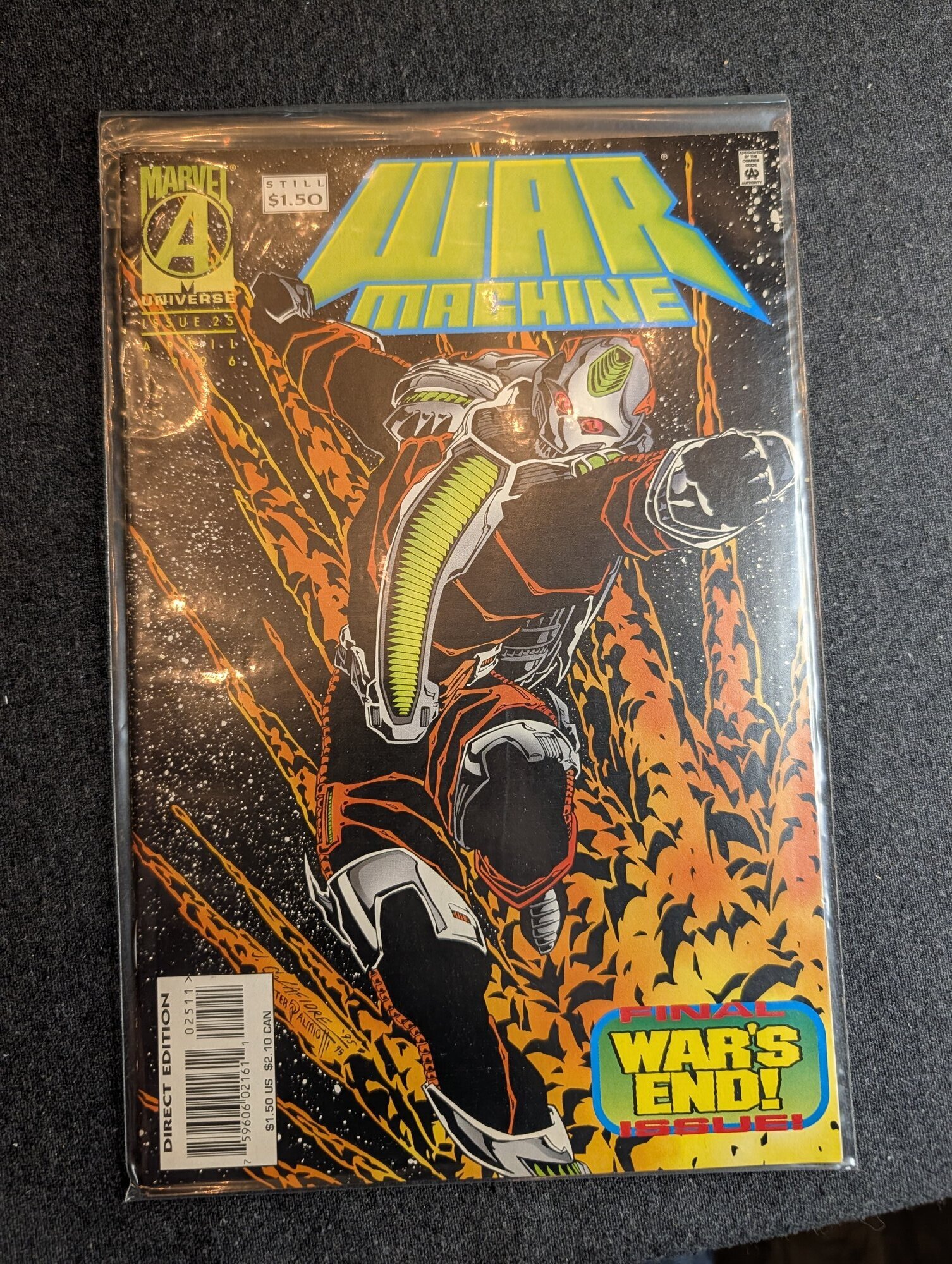
WAR MACHINE #25
Final issue of Marvel's first ongoing War Machine series, concluding the Eidolon Warwear arc
// Unit specification
| Publisher | Cover date | Era | Variant | Key attribute | Status |
|---|---|---|---|---|---|
| Marvel Comics | April 1996 | Modern | Direct Edition | — | AVAILABLE |
// Run position
// Condition analysis
Cover shows strong gloss and sharp corners with no visible creasing or spine stress; the book appears to be in a protective sleeve which limits close inspection of edges. Minor light reflection glare obscures some surface detail, and slight bend at the bottom left corner sleeve edge is visible but may just be the bag. No color breaks, stains, or tears are apparent on the front cover. Interior and back cover were not assessed.
// Valuation — market reference
| Bracket | Grade | Est. market value | Marker |
|---|---|---|---|
| LOW_RAW | 0.5 – 1.5 | $2 | |
| MID_RAW | 4.0 – 6.0 | $4 | |
| HIGH_CERT | 9.8 SLAB | $85 |
// Archive commentary
War Machine #25, cover-dated April 1996, closes the twenty-five issue run that spun James Rhodes out of Iron Man and into his own title. Dan Abnett scripts, with pencils by Fred Haynes and inks by Johnny Greene, over a cover by James Calafiore and Jimmy Palmiotti. The final arc had moved Rhodes well away from the gray-and-silver Stark hardware that defined the character's debut, bonding him instead to the alien Eidolon Warwear introduced in issues #18-19, and #25 resolves that transformation by sending him off-world rather than restoring the status quo. The issue appeared during the sharpest contraction of the direct market, when Marvel cancellations came quickly and print runs on mid-tier titles had fallen far below their 1993-94 peaks.
Demand is driven almost entirely by two narrow groups: run collectors closing out the 1994 series and buyers chasing the scarcer tail end of mid-1990s Marvel print runs. The book carries no first appearance and no census-supported certified market, so raw copies move as ordinary back-issue inventory, frequently absorbed into complete-set lots rather than sold individually. What separates it from the middle of the run is availability rather than significance; last issues from this window were shipped in genuinely small quantities and turn up less often in dealer boxes than #1 through #10, which were speculated on heavily and hoarded in quantity.
Collecting outlook is stable but unspectacular. Low-grade copies function as reading and filler stock and should be expected to trade accordingly, while mid-grade copies clear at modest set-completion prices with little grade sensitivity between VG and FN. The upside sits entirely in high-grade certified copies, where scarcity of submissions rather than underlying demand supports the price, and where the cost of grading itself accounts for much of the value; buyers pursuing that bracket are typically registry-minded Iron Man family collectors rather than speculators. Anyone building the run should prioritize copies with square spines and clean covers, since the flexible 1996 paper stock rarely survives casual storage in high grade.
// Copies in archive
| Unit | Grade | Variant | Status |
|---|---|---|---|
| ECA-002663 | ~9.2 | Direct Edition | AVAILABLE |
INQUIRE_ABOUT_THIS_UNIT
Institutional buyers, auction houses, and private collectors — direct line to the archive.