Approximate
Condition Profile
MARVEL COMICS · 5/69
UNIT ECA-002498
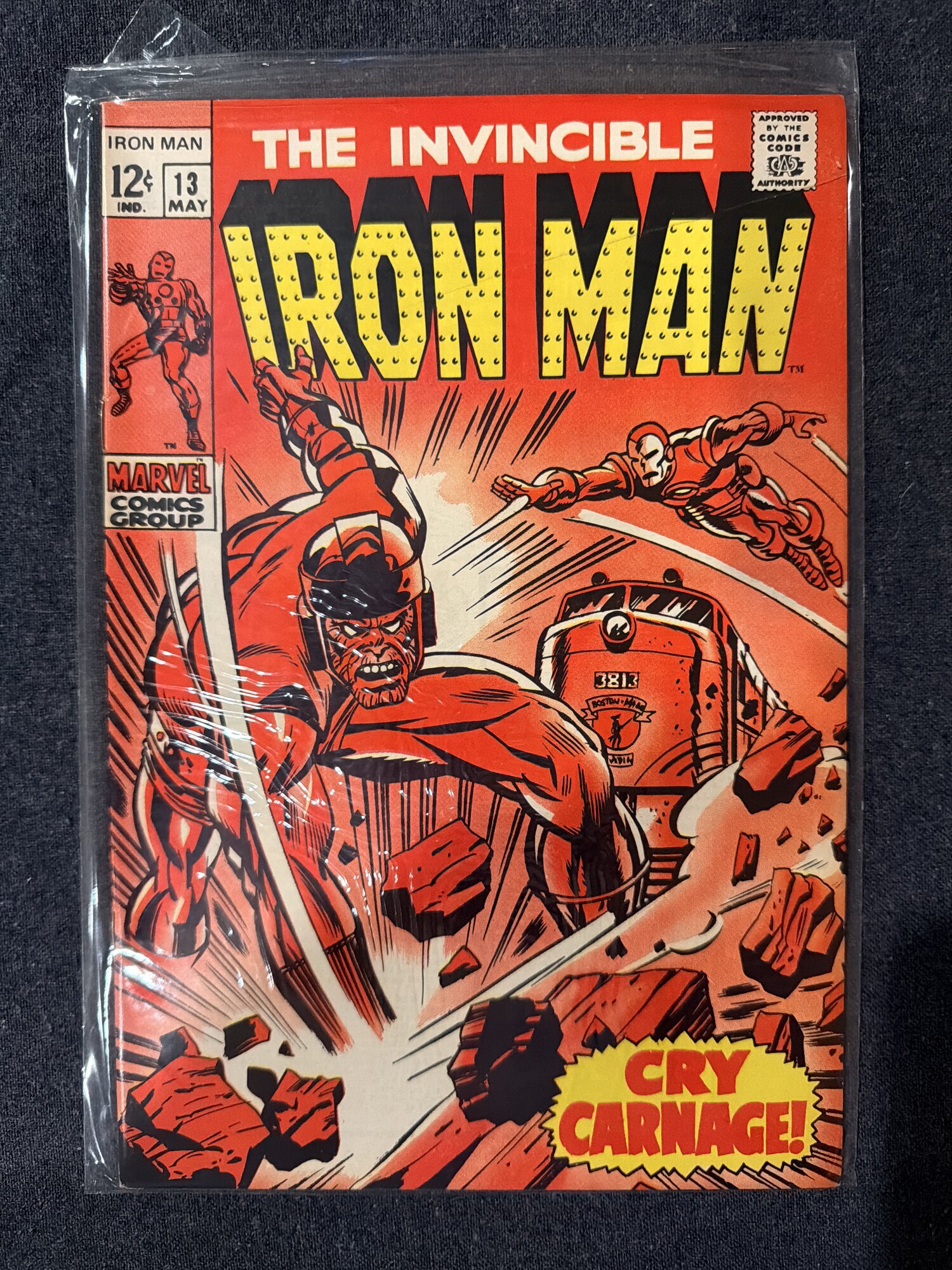
IRON MAN #13
Conclusion of the Controller two-parter, with Nick Fury and S.H.I.E.L.D., George Tuska cover
// Unit specification
| Publisher | Cover date | Era | Variant | Key attribute | Status |
|---|---|---|---|---|---|
| Marvel Comics | May 1969 | Silver | — | — | AVAILABLE |
// Copies in archive
| Unit | Grade | Variant | Status |
|---|---|---|---|
| ECA-002498 | ~6.5 | — | AVAILABLE |
// Run position
// Condition analysis
Cover shows good gloss and strong color with no major creases visible across the front surface. There is a small spine tick/stress mark near the top of the spine, and slight softening at the top corners. The book is protected in a plastic sleeve which obscures fine surface detail and may hide additional wear; edges appear generally clean without notable chips. Interior pages and back cover were not visible for assessment.
// Valuation — market reference
| Bracket | Grade | Est. market value | Marker |
|---|---|---|---|
| LOW_RAW | 0.5 – 1.5 | $14 | |
| MID_RAW | 4.0 – 6.0 | $23 | |
| HIGH_CERT | 9.8 SLAB | $1,000 |
// Archive commentary
Iron Man #13 closes out a two-part story pitting Tony Stark's armored alter ego against the mind-controlling villain the Controller, with Nick Fury and S.H.I.E.L.D. operative Jasper Sitwell folded into the espionage-flavored plot. Archie Goodwin scripts, George Tuska handles pencils and cover, and Johnny Craig inks, a veteran Silver Age creative team typical of Iron Man's late-1960s run as the series settled into its own identity following Tales of Suspense.
The issue is not a first appearance or origin story and carries no death or landmark creative debut, placing it outside the tier of recognized Iron Man keys. Demand is instead driven by run-completion collectors and Silver Age Marvel readers assembling a full Invincible Iron Man set, with the Controller two-parter and Fury/S.H.I.E.L.D. crossover appeal providing modest secondary interest. Census data shows a large surviving population across nearly all grades, with pricing that stays compressed and flat through the mid grades before rising sharply only at the top of the curve, a pattern typical of a well-preserved but non-key Silver Age issue.
This is a book that trades steadily rather than spikes: raw copies in low and mid grade serve budget-run builders and are priced accordingly, while high-grade CGC 9.6 and above draws targeted bidding from registry-focused collectors chasing census-top copies of a scarce-in-top-grade Tuska cover. Because no 9.8 has yet been certified, any future submission that cracks that grade would likely command outsized attention relative to the book's otherwise modest significance.
INQUIRE_ABOUT_THIS_UNIT
Institutional buyers, auction houses, and private collectors — direct line to the archive.