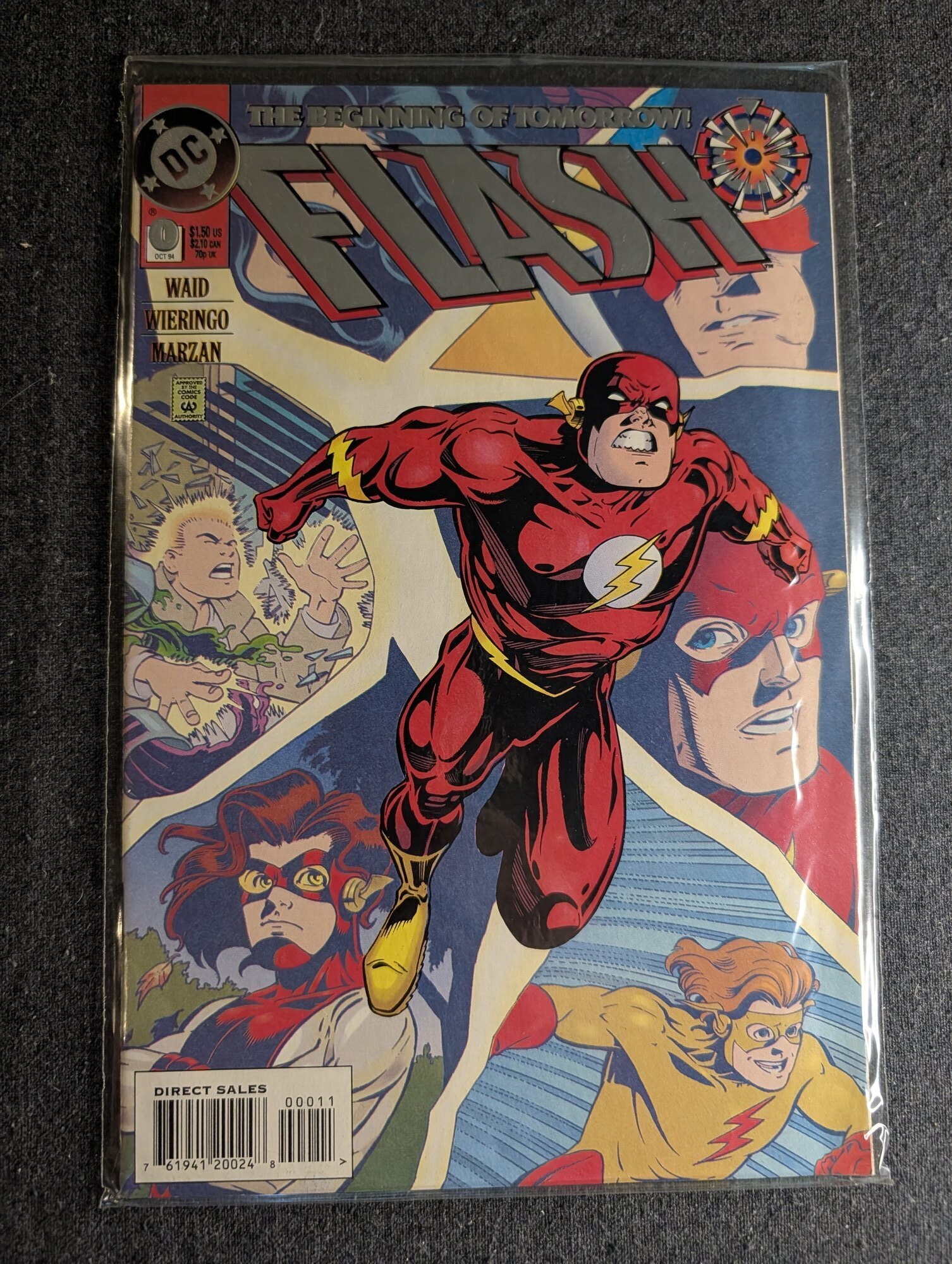
Approximate
Condition Profile
DC COMICS · 10/94 · DIRECT EDITION
UNIT ECA-001941
THE FLASH #94
Zero Hour tie-in concluding "Reckless Youth," with early Impulse and guest pencils by Carlos Pacheco
// Unit specification
| Publisher | Cover date | Era | Variant | Key attribute | Status |
|---|---|---|---|---|---|
| DC Comics | October 1994 | Modern | Direct Edition | — | AVAILABLE |
// Copies in archive
| Unit | Grade | Variant | Status |
|---|---|---|---|
| ECA-001941 | ~9.2 | Direct Edition | AVAILABLE |
// Run position
// Condition analysis
Cover shows strong gloss and vibrant color with sharp, unblunted corners and clean edges; no visible spine ticks, creases, or color breaks in this image. The book is protected in a plastic sleeve, and the surface appears free of stains or writing. Interior pages and back cover were not assessed, so the grade reflects front-cover presentation only.
// Valuation — market reference
| Bracket | Grade | Est. market value | Marker |
|---|---|---|---|
| LOW_RAW | 0.5 – 1.5 | $2 | |
| MID_RAW | 4.0 – 6.0 | $4 | |
| HIGH_CERT | 9.8 SLAB | $55 |
// Archive commentary
Published by DC in 1994, Flash #94 closes out the three-part "Reckless Youth" storyline by Mark Waid and ties directly into the Zero Hour crossover, handing the narrative off to Zero Hour: Crisis in Time #4. Wally West and the newly arrived Bart Allen take the fight to the Kobra cult and Abra Kadabra before the time crisis pulls them out of the moment entirely, with Iris Allen, Linda Park, Max Mercury, Waverider, Argus, and the Pied Piper filling out the cast. Mike Wieringo supplies the cover, while interior pencils come from Carlos Pacheco, then near the start of his American career, inked by Wayne Faucher and Jose Marzan Jr. The issue is an early Impulse appearance from the run that introduced him two months earlier, and it sits at the hinge between Waid's Bart Allen debut arc and the Terminal Velocity epic that follows.
Market behavior reflects the issue's supporting role rather than a first appearance. Copies circulate in quantity from a period of heavy print runs and heavy speculator retention, so raw examples move as ordinary back-issue stock across nearly the full grade spectrum, with little separation between a beaten low-grade copy and a solid mid-grade one. Certified demand is limited and sporadic: submission volume is low because the book does not carry the first-appearance label that drives grading on Flash #91 and #92, and the slabs that do surface trade in line with other high-grade mid-run issues from the Waid era. Interest, where it exists, comes from the Impulse run's completists and from readers tracking Pacheco's earliest DC work rather than from crossover collectors, since Zero Hour tie-ins as a group have never developed independent price support.
Buyers are principally Flash run collectors filling the 90-100 stretch, Impulse and Bart Allen specialists who want every 1994 appearance in sequence, and Zero Hour set builders. Practically, the book trades as a raw commodity: grade matters mainly at the top, where near-mint copies command a genuine premium over everything below, while the difference between a reading copy and a mid-grade one is measured in a couple of dollars. Certification only makes economic sense at 9.8, and even then the spread over a strong raw copy is modest, so dealers are generally better served pricing this issue as a well-labeled run book than as a slab candidate.
INQUIRE_ABOUT_THIS_UNIT
Institutional buyers, auction houses, and private collectors — direct line to the archive.