Approximate
Condition Profile
ICG · 4/86
UNIT ECA-001889
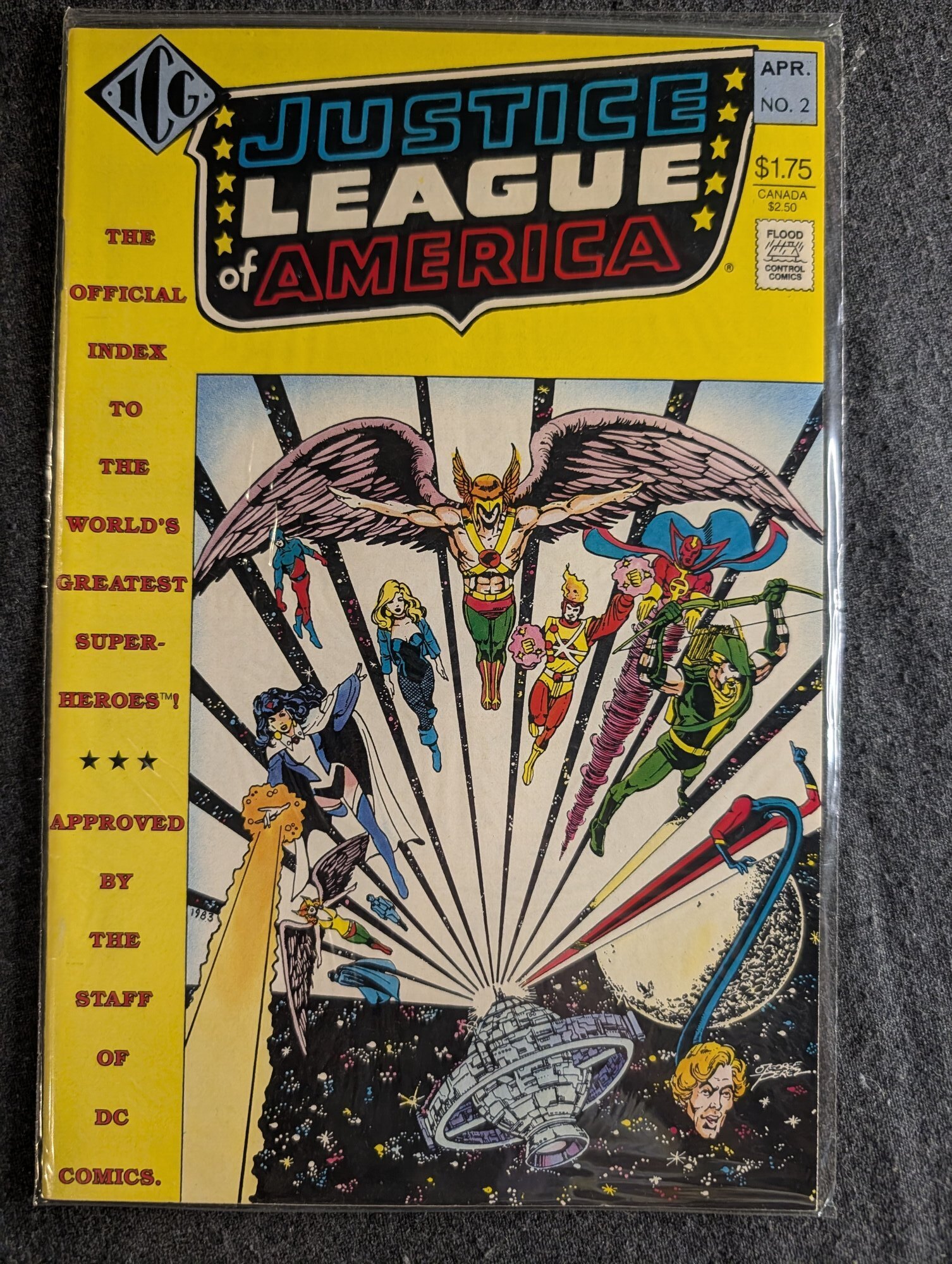
THE OFFICIAL JUSTICE LEAGUE OF AMERICA INDEX #2
Second issue of ICG's Official Justice League of America Index, covering JLA #20–56, with a George Pérez cover
// Unit specification
// Copies in archive
| Unit | Grade | Variant | Status |
|---|---|---|---|
| ECA-001889 | ~9.2 | — | AVAILABLE |
// Condition analysis
Cover shows bright, unfaded yellow background and sharp, vibrant George Pérez artwork with strong color separation. Corners appear sharp with no visible blunting, and the spine shows no obvious stress lines or ticks in this view. A retailer price/inventory sticker ('Flood Control Comics') is affixed over the barcode area, which is a common seller addition rather than a printing defect but does obscure the original UPC box, making direct/newsstand determination impossible. The book is in a protective plastic sleeve, which limits full assessment of surface gloss and any micro-scuffing; interior pages and back cover were not assessed.
// Valuation — market reference
| Bracket | Grade | Est. market value | Marker |
|---|---|---|---|
| LOW_RAW | 0.5 – 1.5 | $1 | |
| MID_RAW | 4.0 – 6.0 | $2 | |
| HIGH_CERT | 9.8 SLAB | $40 |
// Archive commentary
The Official Justice League of America Index was part of the mid-1980s wave of publisher-authorized indexing projects, and ICG's edition applied the same methodology Marvel and DC had licensed elsewhere: issue-by-issue synopses, full credits, character appearance tables, and cross-references. This second installment covers Justice League of America #20–56, the stretch that carried the team from its early Gardner Fox period through the Earth-One/Earth-Two crossover years, and its member profiles foreground the second-tier Leaguers who define that run — Green Arrow, Black Canary, Hawkman and Hawkwoman, the Atom, Elongated Man, Red Tornado, Zatanna, and Firestorm. George Pérez supplied the cover art, drawing on his own long association with the team, and the consultant roster behind the series included fan-historians whose indexing work predated the direct market. The text was typeset rather than hand-lettered, a reminder that these were reference publications first and comics second.
Market behavior follows from that: the ICG indexes are working tools for collectors and researchers, not speculative books, and they trade accordingly. Demand comes in two narrow channels — completists assembling the seven-issue set, and Pérez cover collectors who track his credits across small-press and reference titles. Copies surface regularly on eBay and through established back-issue dealers, usually in high grade because they were bought by adults and filed rather than read to pieces, which compresses the spread between grade bands to almost nothing. Full runs move more readily than singles, and a beaten copy is worth little more than shipping, since supply of clean examples is never the constraint.
Certification is rare and largely uneconomic here; the cost of grading exceeds the book's raw value by an order of magnitude, so any slab on the market is an outlier priced by scarcity of the slab itself rather than scarcity of the comic. Buyers should treat this as a fill-in purchase — best acquired inside a run lot or alongside other ICG and Eclipse indexes — and dealers should expect long shelf time on single copies. Its lasting value is documentary: for anyone working through the Silver Age JLA, the appearance charts and credit tables remain genuinely useful, and that utility, rather than any collectible premium, is what keeps the title in circulation.
INQUIRE_ABOUT_THIS_UNIT
Institutional buyers, auction houses, and private collectors — direct line to the archive.