Approximate
Condition Profile
DC COMICS · 11/91
UNIT ECA-001803
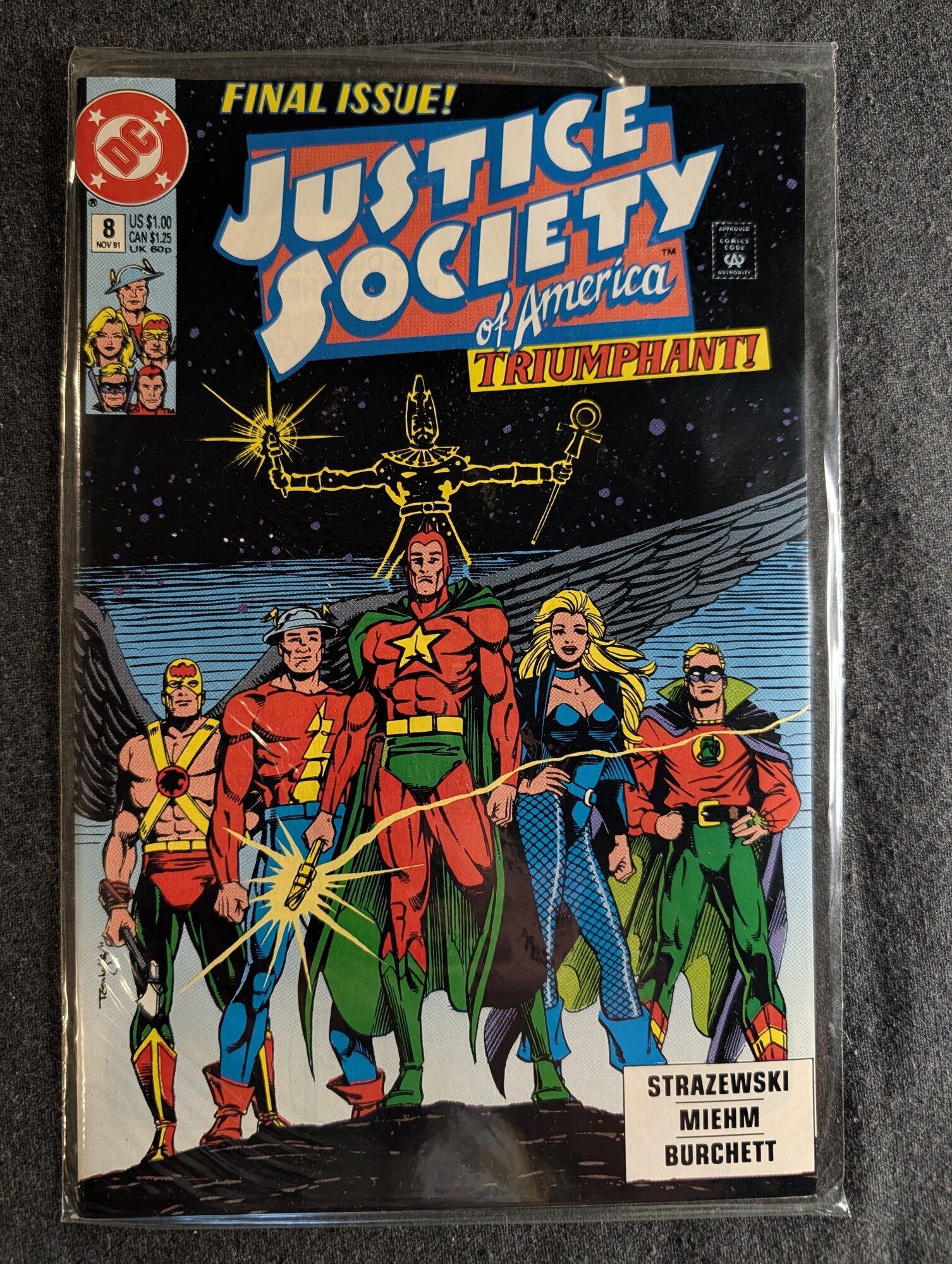
JUSTICE SOCIETY OF AMERICA #8
Concluding issue of the 1991 eight-part JSA revival, with the Golden Age team against Vandal Savage and Solomon Grundy
// Unit specification
// Condition analysis
The cover shows strong gloss and vibrant color with sharp corners and no visible creasing, spine stress, or edge wear in this photo. The book is enclosed in a protective plastic sleeve, which limits full assessment of surface texture and edge condition. No visible staining, fading, or color breaks are apparent, though slight glare from the sleeve obscures fine detail near the spine. Interior pages and back cover were not assessed.
// Valuation — market reference
| Bracket | Grade | Est. market value | Marker |
|---|---|---|---|
| LOW_RAW | 0.5 – 1.5 | $1 | |
| MID_RAW | 4.0 – 6.0 | $2 | |
| HIGH_CERT | 9.8 SLAB | $55 |
// Archive commentary
Published with a November 1991 cover date, this is the closing chapter of the eight-issue Justice Society of America series that returned the Golden Age lineup to their own title for the first time in years. Len Strazewski scripted the run as a period piece set in 1950, structuring it in the linked-chapter manner of the original All-Star Comics stories, with pencils by Mike Parobeck and inks by Rick Burchett. The finale brings the threads together as Jay Garrick's Flash, Alan Scott's Green Lantern, Hawkman, Starman, and Black Canary confront Vandal Savage, Solomon Grundy, and the living constellation menace seeded in the first issue. The series carries no first appearances, but it is a well-regarded bridge between the Roy Thomas All-Star Squadron era and the 1992 ongoing that followed, and it stands as early major-publisher work by Parobeck, whose reputation grew substantially through his later Batman Adventures run.
Market profile is that of a plentiful late-Copper Age DC book. Print runs from 1991 were generous, distribution was overwhelmingly direct-market, and high-grade unread copies remain easy to source from dealer stock and long boxes, which caps raw pricing across every mid and lower band. Demand is driven almost entirely by two groups: readers assembling the complete eight-issue story, which has never been collected in trade, and Parobeck completists. Set buying is where the money actually is, and full runs consistently outperform the sum of their loose parts. Certified examples surface rarely because the economics discourage submission, so census data offers little guidance and slabbed pricing is thin and erratic rather than established.
For a dealer archive this is inventory rather than investment. Low-grade copies are effectively reading material and move only as filler or bulk; mid-grade copies compete directly against near-mint stock at similar money, making them the least efficient band to hold. The realistic path to value is high-grade raw or complete-set presentation, and any certified copy should be understood as a scarcity play in a market with almost no comparable transactions to reference. Buyers should also note that the series is frequently catalogued inconsistently, with the 1991 miniseries and the 1992 ongoing both indexed under the same title, so accurate identification by cover date matters more here than for most books of the period.
// Copies in archive
| Unit | Grade | Variant | Status |
|---|---|---|---|
| ECA-001803 | ~9.2 | — | AVAILABLE |
INQUIRE_ABOUT_THIS_UNIT
Institutional buyers, auction houses, and private collectors — direct line to the archive.