Approximate
Condition Profile
MARVEL COMICS · 9/74
UNIT ECA-012232
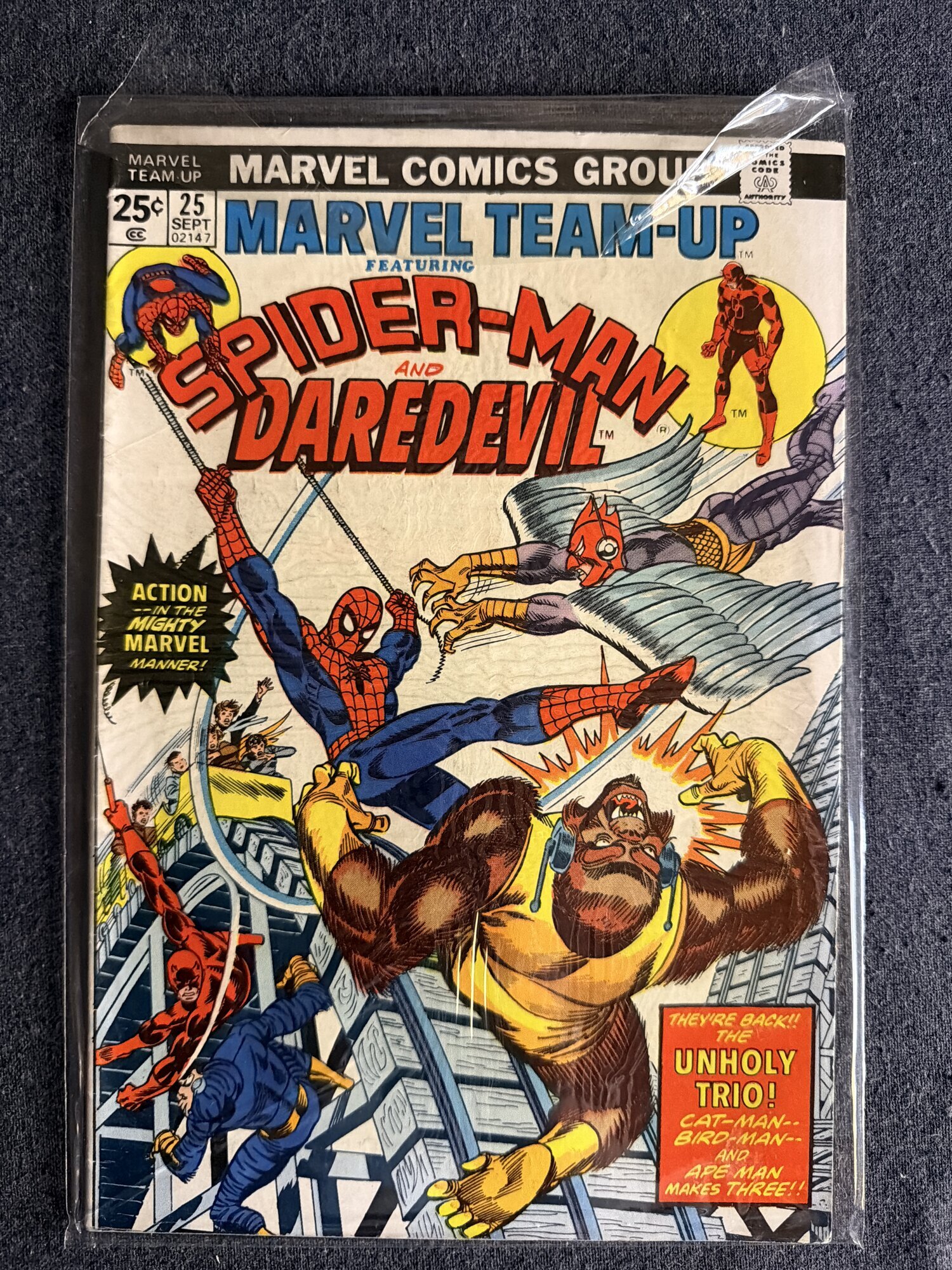
MARVEL TEAM-UP #25
Bronze Age Spider-Man team-up issue from Marvel's rotating-guest-star anthology series
// Unit specification
| Publisher | Cover date | Era | Variant | Key attribute | Status |
|---|---|---|---|---|---|
| Marvel Comics | September 1974 | Bronze | — | — | AVAILABLE |
// Copies in archive
| Unit | Grade | Variant | Status |
|---|---|---|---|
| ECA-012232 | ~5.5 | — | AVAILABLE |
// Run position
// Condition analysis
Cover shows moderate wear consistent with a mid-grade Bronze Age book: visible vertical creasing and surface wrinkling across the upper right and center of the cover, a small crease/bend near the bottom right corner, and general softness at the corners. There is a diagonal stress line running through the artwork and some minor color rub along the top edge near the logo. The book is in a protective sleeve with some plastic glare obscuring fine detail; interior and back cover were not assessed.
// Valuation — market reference
| Bracket | Grade | Est. market value | Marker |
|---|---|---|---|
| LOW_RAW | 0.5 – 1.5 | $9 | |
| MID_RAW | 4.0 – 6.0 | $19 | |
| HIGH_CERT | 9.8 SLAB | $500 |
// Archive commentary
Marvel Team-Up launched in 1972 as a showcase pairing Spider-Man with a different hero (or occasionally villain) each month, and by issue #25 in September 1974 the title had settled into a reliable Bronze Age rhythm under regular series artist Sal Buscema, whose kinetic, workmanlike pencils defined the book's look for years. The series occupies a modest but real place in Marvel's 1970s output: it is not an origin or first-appearance title, but it functioned as connective tissue across the shared universe, giving readers crossovers that mainstream ongoing titles rarely delivered on a monthly basis.
The GoCollect FMV curve for this issue reflects a typical mid-tier Bronze Age team-up book: modest raw values across low and mid grades, a meaningful step up at 9.4 and 9.6, and a near-total absence of top-census 9.8 copies, with only eight submitted and none yet sold. That gap between a well-populated 9.6 tier and an essentially unattested 9.8 tier is where scarcity-driven demand shows up most clearly, since a small handful of collectors chasing a census-topping copy can move the price disproportionately relative to the modest raw-copy market below it.
This is a book for series-run collectors and Spider-Man guest-appearance completists rather than investment-grade key-issue buyers. Raw copies in low and mid grade trade cheaply and steadily as reading or filler copies for long boxes and run-builders, while pressure concentrates almost entirely at the top of the CGC pyramid, where a clean 9.8 becomes disproportionately valuable simply because so few exist. Expect slow, low-volume trading in the middle grades and sporadic, higher-stakes activity whenever a top-census slab surfaces.
INQUIRE_ABOUT_THIS_UNIT
Institutional buyers, auction houses, and private collectors — direct line to the archive.