Approximate
Condition Profile
MARVEL COMICS · 12/89 · NEWSSTAND
UNIT ECA-001170
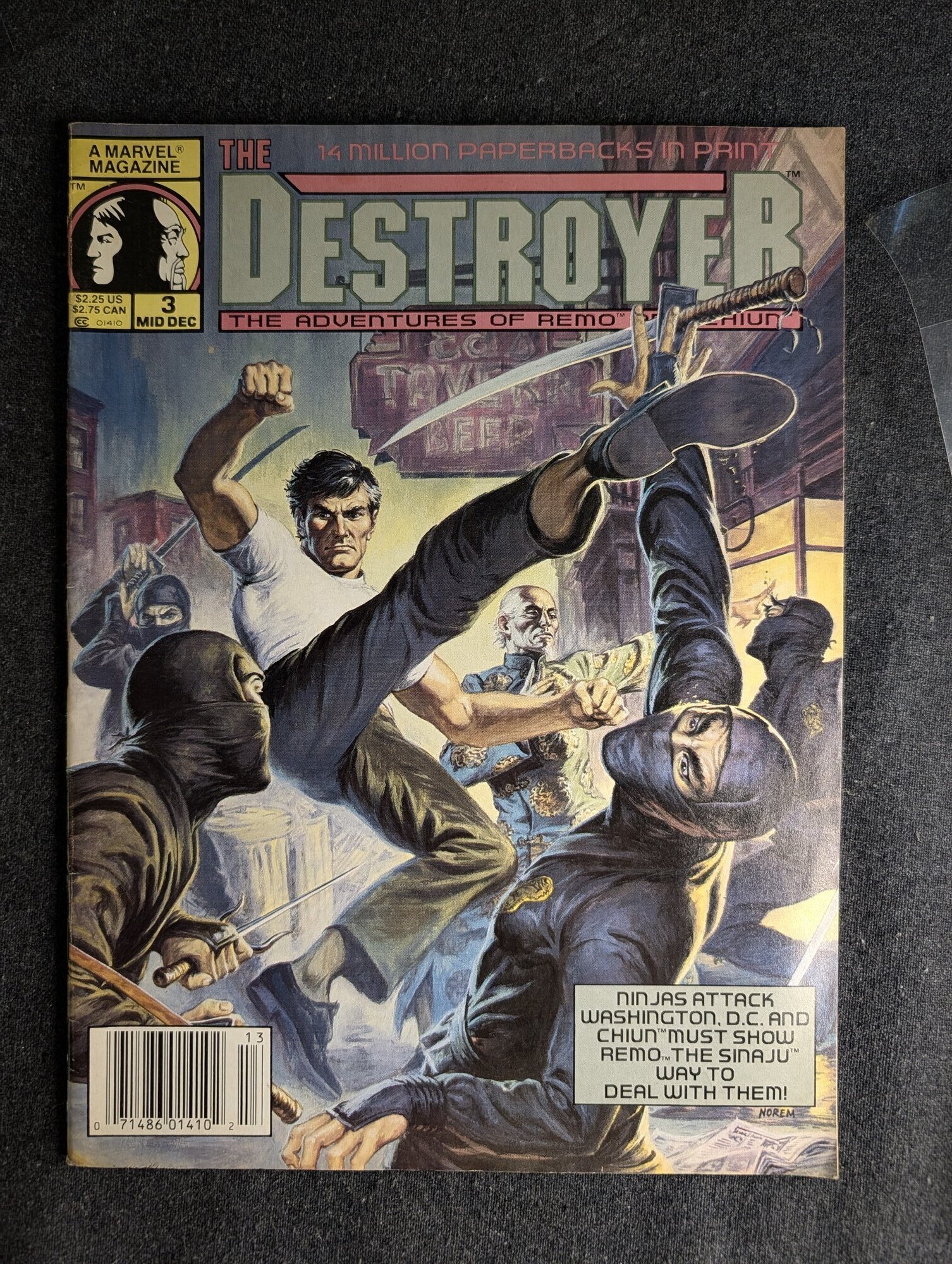
THE DESTROYER #3
1989 Marvel black-and-white Destroyer magazine, Lee Weeks interior art with an Earl Norem painted cover
// Unit specification
| Publisher | Cover date | Era | Variant | Key attribute | Status |
|---|---|---|---|---|---|
| Marvel Comics | December 1989 | Copper | Newsstand | — | AVAILABLE |
// Copies in archive
| Unit | Grade | Variant | Status |
|---|---|---|---|
| ECA-001170 | ~8.0 | Newsstand | AVAILABLE |
// Condition analysis
Image is rotated 90 degrees; cover shows generally sharp corners and clean color with no major creases visible. There is a small crease or bend near the top edge and a faint sticker-residue/light scuff area near the top left, plus minor edge wear along the right border. No significant spine stress lines are visible, though the spine itself is not fully shown due to rotation. Interior and back cover were not assessed.
// Valuation — market reference
| Bracket | Grade | Est. market value | Marker |
|---|---|---|---|
| LOW_RAW | 0.5 – 1.5 | $3 | |
| MID_RAW | 4.0 – 6.0 | $7 | |
| HIGH_CERT | 9.8 SLAB | $60 |
// Archive commentary
The Destroyer #3 belongs to Marvel's short-lived 1989-1990 black-and-white magazine adapting Warren Murphy and Richard Sapir's long-running men's-adventure novel series about Remo Williams, the government-created assassin, and his Korean master Chiun. This issue is written by Will Murray with interior art by Lee Weeks (early in his career), inking by Chris Ivy and Mark Texeira, lettering by Jack Morelli, and a painted cover by Earl Norem, a veteran of Marvel's magazine line. The story sends Chiun and Remo against ninjas in Washington, D.C., continuing the tone of the Sinanju mythos rather than introducing any new character of lasting consequence.
Market demand is modest and driven mainly by two niches: readers and completists of the Destroyer prose franchise, and collectors who follow Lee Weeks and Earl Norem cover work. The 48-page magazine format sat outside the direct-market superhero mainstream, so print runs saw heavy reading use and few pristine survivors, yet the corresponding lack of collector attention keeps raw prices at pocket-change levels. Certified examples of any issue in this run are scarce on the CGC census, which is why the occasional high-grade slab carries a disproportionate premium relative to the raw book.
This is a supporting title for a specialist rather than a key. Raw copies trade briskly and cheaply, often bundled in run lots, and appeal to franchise fans and bargain-bin browsers. The upside sits almost entirely in top-census certified copies, where thin supply rather than broad demand sets the price; buyers pursuing a registry-quality set are the realistic audience for a graded example, while everyone else is served by an affordable raw copy across the grade spectrum.
INQUIRE_ABOUT_THIS_UNIT
Institutional buyers, auction houses, and private collectors — direct line to the archive.